

I almost ignored it, honestly. It looked too soft around the edges. Bright colors, pixel art, farming loops — the kind of thing that usually gets passed around as “cozy” while something more transactional hums underneath. I’ve trained myself to be wary of anything in crypto that feels immediately approachable. That’s usually where the catch is hiding.
And yet, Pixels kept resurfacing. Not loudly, not in the usual aggressive way these projects try to stay relevant. Just… there. People actually playing it. Not just farming tokens, but lingering. That part is harder to fake.
The thing is, most Web3 games fail because they're not actually games. They're economies pretending to be games. The entire structure is built around extraction—get people in, get them buying, get them recruiting, watch it unravel when the new money stops flowing. It's exhausting. And after watching it happen a dozen times, you start to assume every project wearing the "Web3 game" label is just another variant of the same pump.
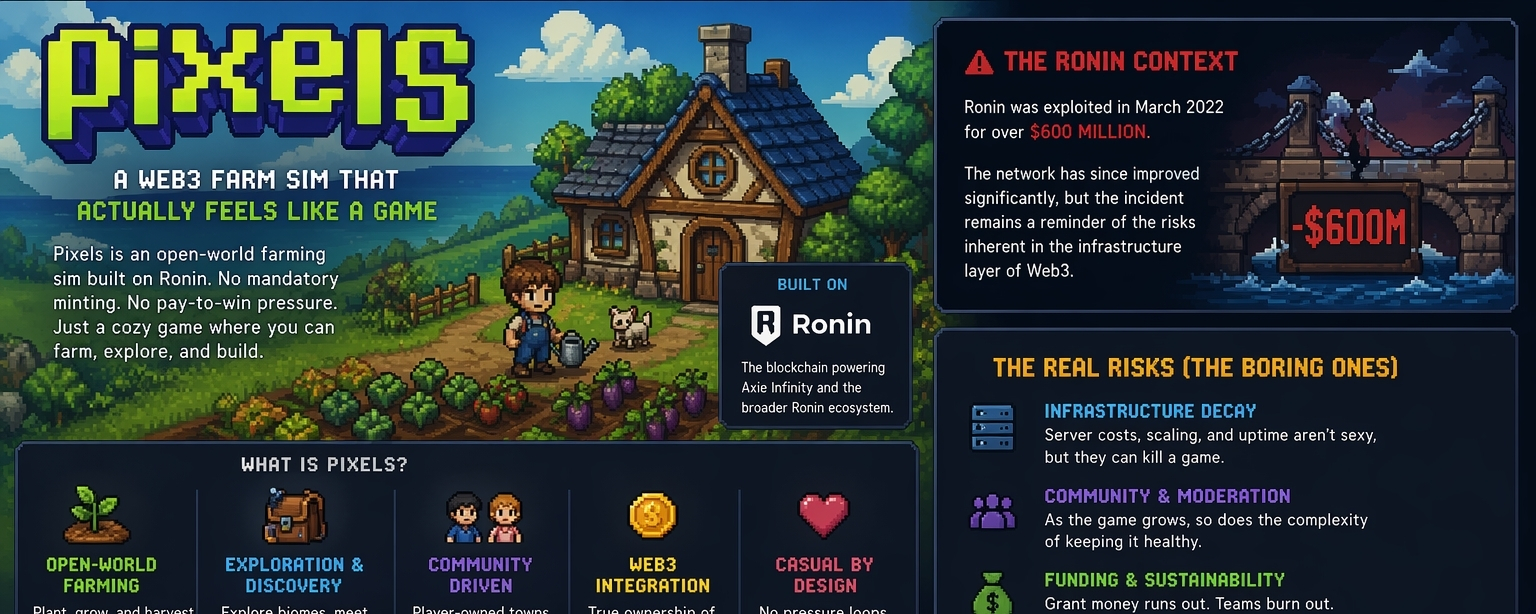
Pixels sits in this weird spot though. It's on Ronin, which already has baggage—Axie Infinity's network, the one that got drained for over $600 million. That's where things start to feel uncomfortable. You can't talk about Ronin without talking about that bridge exploit, about the fragility of the infrastructure layer that supposedly makes all of this possible. And yet here's Pixels, building something genuinely casual on top of it. Open-world farming. Exploration. No pressure to mint, no aggressive tokenomics shoved in your face on day one.
Maybe that's too harsh. Or maybe it's not harsh enough.
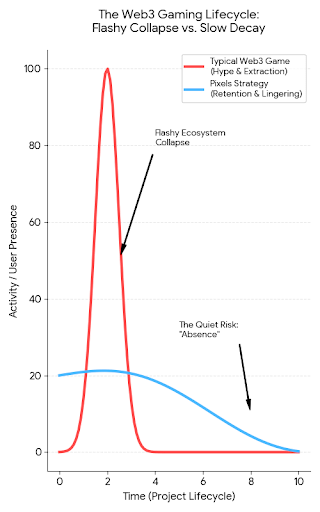
What I keep circling back to is this: what happens when the boring parts break? Not the flashy ecosystem collapse, but the slow decay. The server costs. The moderation as the community grows. The decision fatigue when real money is involved but the game is supposed to feel *light*. Casual games thrive on low stakes. Web3 introduces stakes whether you want them or not. Ownership sounds great until you realize it means every item, every plot, every interaction could become a calculation instead of a choice.
I've watched projects survive the hype cycle only to die from something mundane—running out of grant money, core team burnout, a single bad upgrade that breaks user trust forever. Pixels has users, actual retention numbers that don't look like a Ponzi curve. That's rare. But rare doesn't mean durable.
And there's this deeper thing I can't shake. Farming sims work because they're predictable. You plant, you wait, you harvest. The loop is meditative. Introducing economic unpredictability—token prices, NFT floors, network congestion—it fractures that. Even if the game itself is well-designed, even if the team has good intentions, the substrate it's built on is volatile by nature. Ronin has improved since the exploit, sure. But improved infrastructure is still infrastructure that required improvement. It's still trust layered on trust, and somewhere down the stack, something is probably more fragile than anyone wants to admit.
I don't know if Pixels "works" long-term. I don't even know what success looks like for something like this anymore. Is it still running in two years? Is it fun? Is it profitable without being predatory?
Maybe the question isn't whether it survives, but whether anyone will care enough to notice when it doesn't.
