
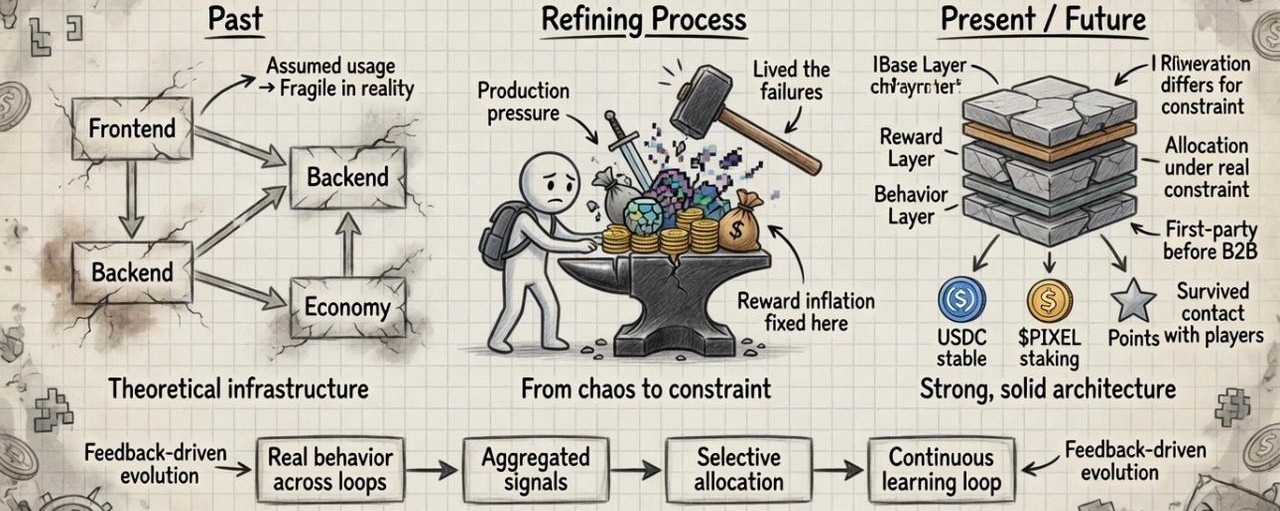

Most infrastructure in Web3 starts with a diagram.
Boxes, arrows, maybe a clean explanation of how value should flow. It looks convincing until it meets real users. Then the gaps show up fast incentives don’t behave the way you expected, rewards leak, and the system starts paying for activity that doesn’t actually matter.
That’s why this approach from Pixels feels different.
They didn’t start with infrastructure.
They started with a game that broke.
And then kept fixing it.
That changes what Stacked actually is.
Because it’s not a theoretical layer built for other teams. It’s a system that came out of production pressure reward inflation, farming behavior, players showing up for payouts and disappearing right after.
That history is what shaped the architecture.
And you can see it in how Stacked is positioned.
At the surface, it still looks like a player app. Missions, streaks, rewards. Familiar structure.
But underneath, it’s operating as a LiveOps engine.
Event tracking. Cohort segmentation. Reward allocation. Fraud filtering. Experiment loops. Attribution.
That’s not something you design upfront.
That’s something you build after seeing where things fail.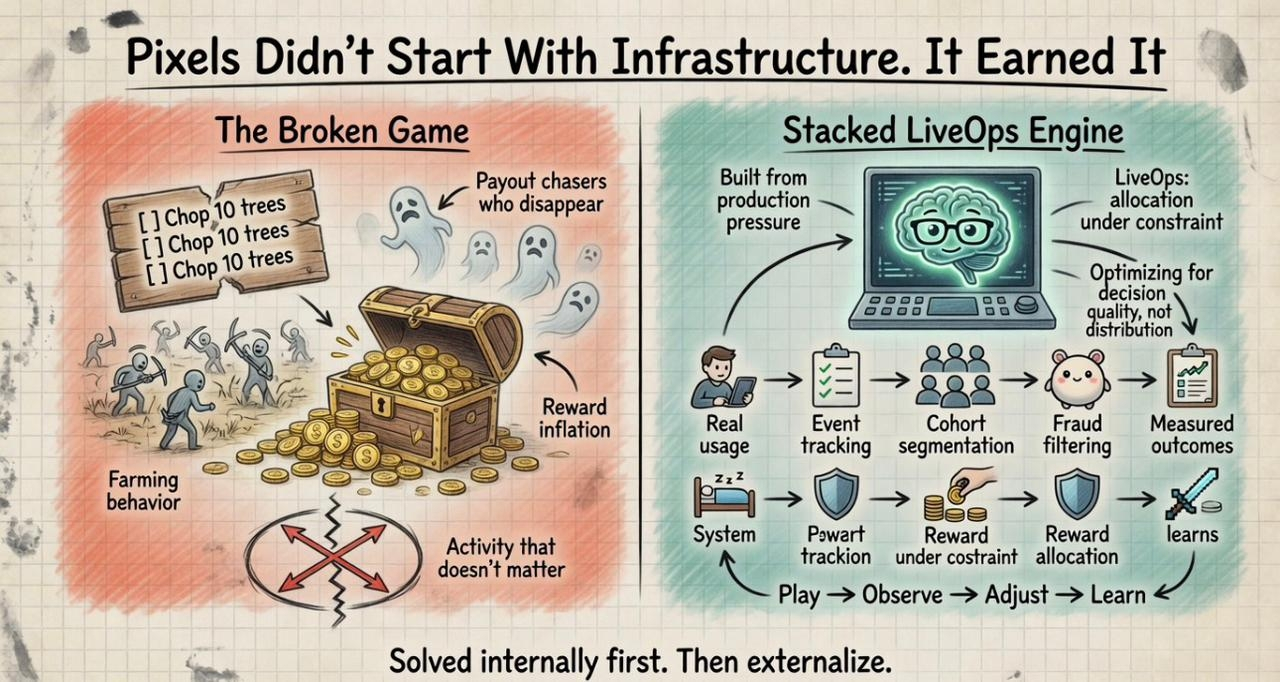
Because the real problem wasn’t “how do we give players more to do?”
It was “what happens to the economy when this behavior scales?”
That’s where most infrastructure-first approaches struggle.
They assume the workload.
Pixels has already lived it.
So when Stacked makes decisions, it’s not guessing.
It’s working off patterns it has already seen in its own loops.
That’s also why the rollout is controlled.
If this was just a middleware product, you’d expect a wide launch. More partners, more integrations, faster distribution.
Instead, it’s starting with internal titles.
Pixel Dungeons, Sleepagotchi, Chubkins.
That’s not a small move.
It’s a filter.
These are environments where the team already understands the failure points. They know where rewards get farmed, where players churn, where activity looks strong but doesn’t convert into anything meaningful.
So every experiment inside Stacked produces clean signal.
If something overpays, they see it. If a cohort behaves differently than expected, they isolate it. If a reward actually improves retention or spending, they can scale it.
That’s how the system gets trained.
Because this isn’t static infrastructure.
It’s allocation under constraint.
Rewards are limited.
Budget is real.
And every decision has a trade-off.
Funding one behavior means ignoring another.
That’s the layer most “infrastructure-first” systems never reach.
They optimize for distribution.
Stacked is optimizing for decision quality.
And that difference shows up in the token design too.
If you’re building middleware, you usually force everything through one asset. It simplifies the model, even if it breaks the economics later.
Pixels is moving away from that.
Different reward types.
Points for shaping behavior. Stable assets for predictable value. And $PIXEL shifting toward staking and positioning inside the ecosystem instead of constant emission.
That separation only makes sense if reward allocation is already under control.
Otherwise, multiple rewards just create fragmentation.
But here, they’re coordinated.
Because the system deciding rewards sits above the games.
Not inside them.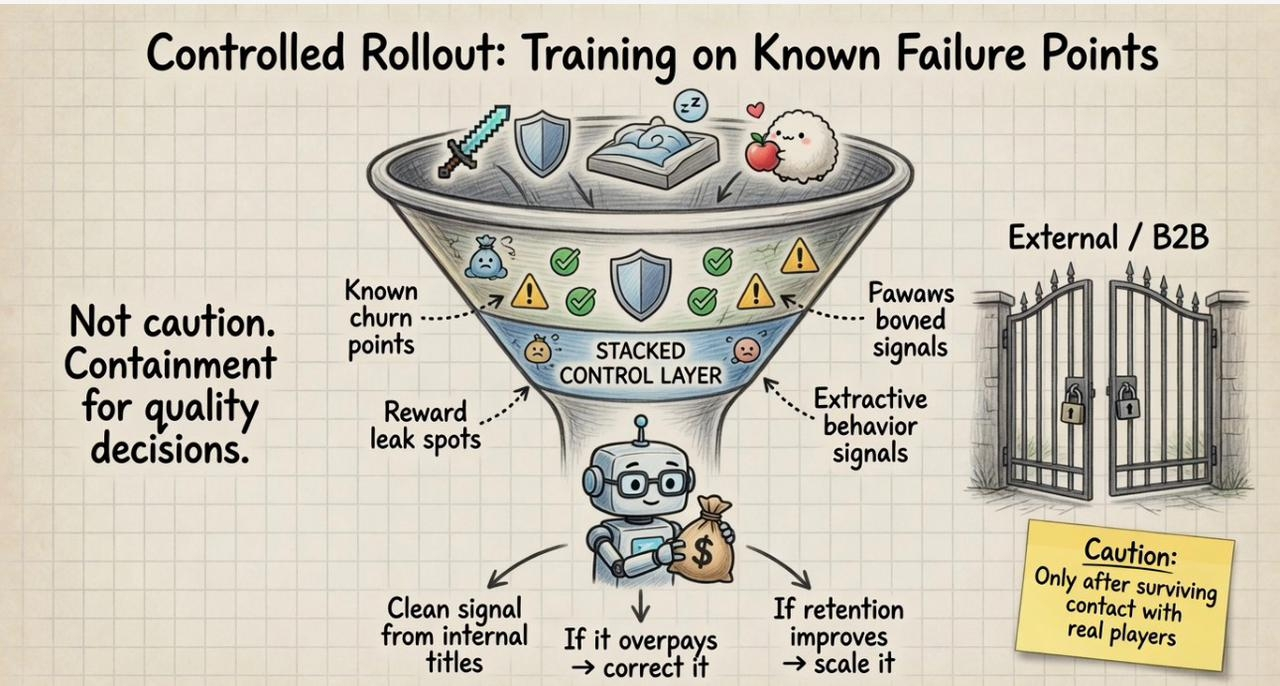
That’s where the architecture becomes clear.
Behavior is observed across loops. Signals are aggregated. Cohorts are defined. Budget is allocated. Outcomes are measured.
And then the system adjusts.
Play → behavior observed → reward adjusted → behavior shifts → system learns
That loop is continuous.
And it only exists because the system was built on top of real usage, not assumed usage.
That’s why first-party matters before B2B.
Because without production pressure, you don’t know where incentives actually break.
You don’t see how players behave when rewards change.
You don’t understand which signals matter and which ones are noise.
And without that, your infrastructure is clean on paper but fragile in reality.
Pixels is doing it in reverse.
Solve it internally first.
Then externalize it.
That’s a slower path.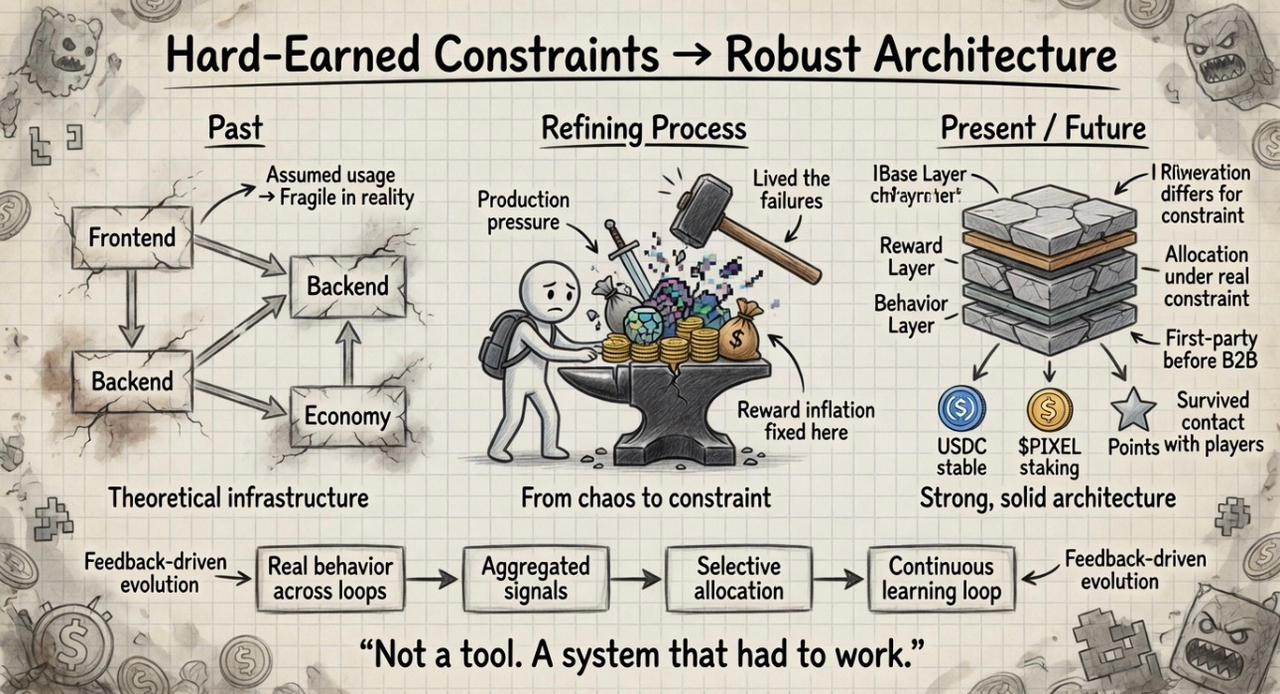
But it produces something different.
Not just a tool.
A system that has already survived contact with players.
And that’s why this doesn’t feel like a simple expansion into infrastructure.
It feels like turning hard-earned constraints into a product.
Not by promising a better system.
But by building one that already had to work.