
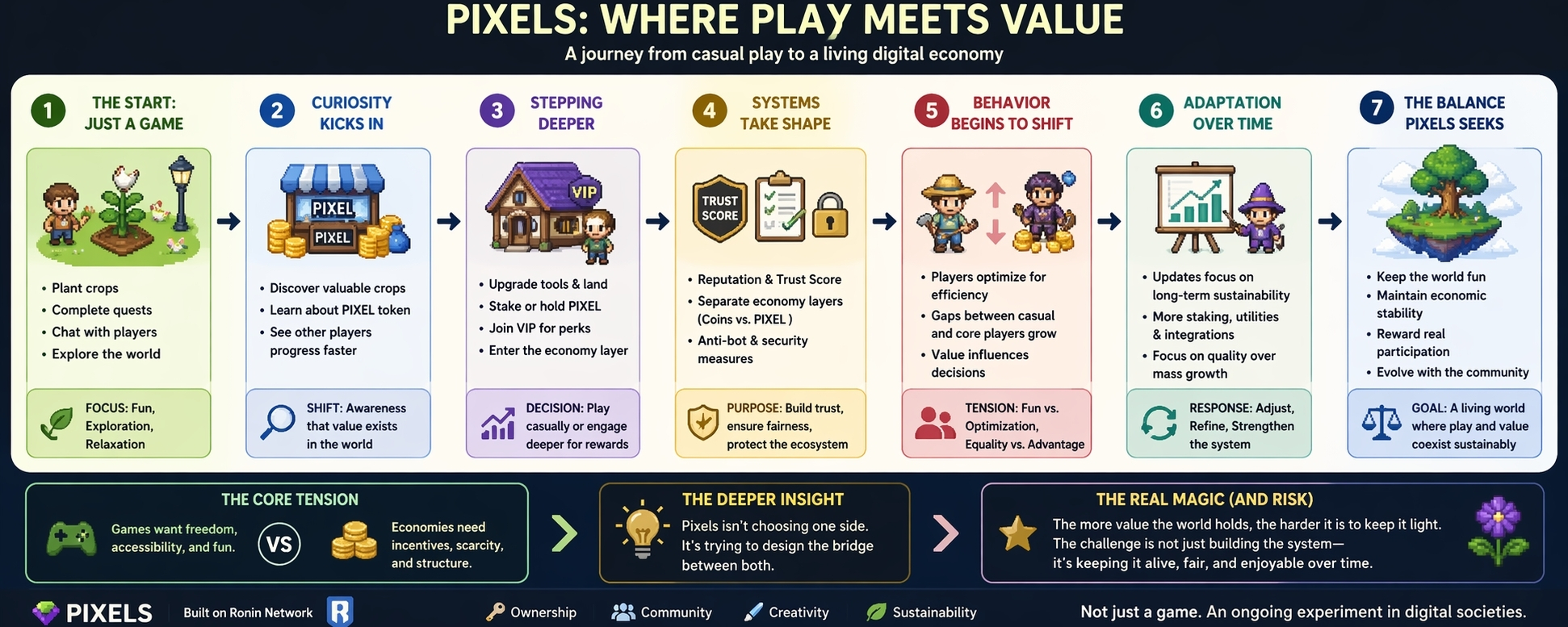
I keep coming back to this one feeling every time I log into Pixels it starts like a calm little farming game, but after a while, you realize there’s something deeper quietly running underneath it.
At first, it’s easy to see what everyone talks about. You plant crops, walk around, chat with people, maybe decorate your land. It feels simple, almost nostalgic. Like those old-school farming games where you just chill and pass time.
But then something small happens.
You notice that certain crops are more valuable. You realize some players are progressing faster. Someone mentions staking, or VIP perks, or earning PIXEL tokens. And suddenly, the game isn’t just a game anymore it’s a system.
That’s where things get interesting.
A lot of people say Pixels is “just a fun Web3 game with ownership.” But that’s only half the story. Because the moment real value enters even a little the way people play starts to change.
I remember watching a new player just casually farming, doing random tasks, not thinking much. Then a few days later, the same player was optimizing routes, tracking rewards, figuring out what gives the best return. Nothing forced them to do it it just naturally happened.
That shift is subtle, but powerful.
Pixels tries to manage this in a smart way. For example, they separated casual gameplay from the deeper economy. You can use in-game Coins for basic stuff, while PIXEL tokens are tied to more serious actions. So if you just want to relax, you can. But if you want to go deeper, there’s a whole layer waiting.
Sounds clean on paper. In reality, the line isn’t that clear.
Because curiosity pulls you in.
You start asking: “What if I upgrade this? What if I own land?” “What if I earn instead of just playing?” And without realizing it, you step into a different version of the same world one where decisions matter more.
I’ve seen players who never cared about tokens suddenly start tracking prices. I’ve seen social spaces turn into places where people quietly compare progress. Not in a toxic way, just… naturally. Like any system where effort and reward exist.
And Pixels knows this tension exists.
That’s why they introduced things like reputation systems and trust scores. Not everyone gets treated the same anymore. If you’re consistent, active, and “real,” the system recognizes you differently than someone just passing through.
On one hand, that makes sense. Web3 games have been wrecked by bots and people just extracting value. So building some kind of trust layer is necessary.
But on the other hand, it changes the vibe.
The idea of “anyone can join and play equally” slowly turns into “some players matter more than others.” Not officially, not loudly but you can feel it over time.
And honestly, this isn’t a Pixels-only thing. It’s what happens when games and economies mix.
I remember a small moment that stuck with me. I was just farming, nothing serious, when I saw a player managing multiple plots, clearly optimized, moving fast, almost like a routine. It didn’t look like fun anymore it looked like work.
But then, a few minutes later, that same player was chatting casually with others, laughing, helping someone new.
That’s the strange part.
Pixels isn’t fully one thing or the other. It’s not purely a game, and it’s not purely an economy. It keeps switching between the two depending on how you approach it.
And maybe that’s the real point.
Even the recent updates show this direction. They’re not just adding more content they’re tightening systems. More focus on long-term players, more structured rewards, more emphasis on meaningful participation instead of just mass activity.
It feels like they’re trying to slow things down on purpose.
Because most Web3 games didn’t fail from lack of users they failed because the system couldn’t handle how users behaved.
Pixels seems to be learning from that.
But there’s still a question that lingers in my mind.
What happens over time?
Because the more valuable a system becomes, the harder it is to keep it “light.” The casual players might feel left behind. The serious players might get too serious. And the balance that makes the world feel alive… starts to stretch.
I don’t think Pixels has fully solved this. I’m not sure anyone has.
But I do think it’s trying something more honest.
Instead of pretending that play and money don’t affect each other, it’s building a space where both exist and then adjusting as things shift.
Some days, it feels like a cozy farming game.
Other days, it feels like a quiet economy disguised as one.
And most of the time, it’s somewhere in between.
That in-between space is messy, a bit unpredictable, and sometimes uncomfortable. But it’s also where the most interesting things are happening.
Because maybe the real story of Pixels isn’t about farming or tokens at all.
It’s about watching what people do when a game starts to matter just a little bit more than a game should.
