

Parson I caught myself thinking about Pixels again, not in that quick, scrolling kind of way, but properly thinking, like the kind where you sit with an idea a little too long and it starts revealing things you didn’t notice before. It’s strange how a game that looks so soft and almost innocent on the surface farming, wandering, gathering can carry this heavier undercurrent of systems, ownership, and quiet ambition. And maybe that’s the part that keeps pulling me back. Not just what it is, but what it’s trying to become.
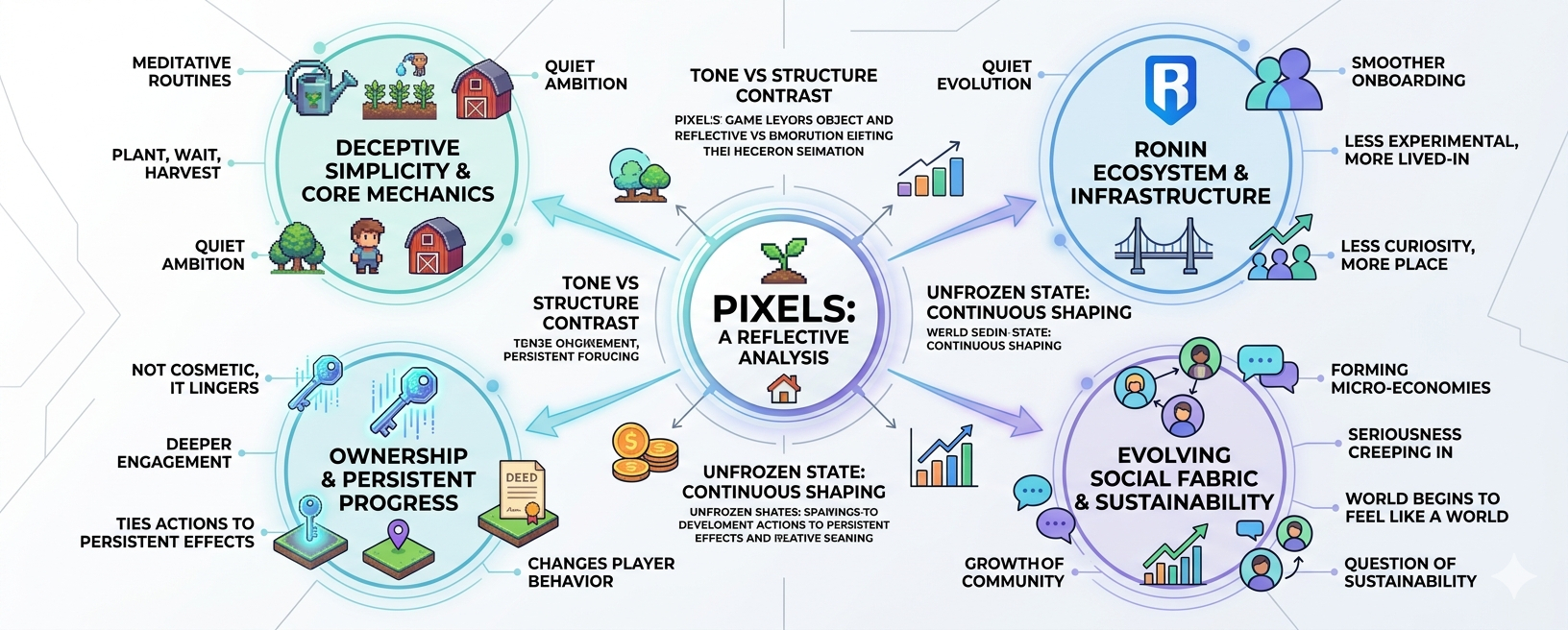
At first glance, Pixels feels familiar in a comforting way. Crops, land, little routines. You plant something, you wait, you harvest. It’s almost meditative. But then there’s this subtle shift, like the ground beneath the simplicity isn’t as stable as it looks. Because everything you do isn’t just “progress” in the traditional gaming sense it’s tied to something more persistent, more real in a digital way that people are still trying to fully understand. Ownership here isn’t just cosmetic, it lingers. And that changes how small actions feel. Even watering a crop feels slightly different when you know it feeds into a larger loop that extends beyond just play.
I keep circling back to how Pixels exists on Ronin. That matters more than people casually admit. There’s been this quiet evolution lately more players entering not just to “try a Web3 game” but because the ecosystem itself is starting to feel less experimental and more… lived-in. The onboarding friction has been smoothing out, slowly but noticeably. It’s not gone, not completely, but it’s not that sharp wall it used to be. And Pixels benefits from that. It’s becoming less of a curiosity and more of a place.
And the player behavior is shifting too. That’s something you don’t immediately notice unless you’ve been watching for a while. People aren’t just logging in to test mechanics anymore; they’re settling into loops. Building routines. Forming micro-economies without even labeling them as such. There’s a kind of quiet seriousness creeping in, even among casual players. And it’s interesting because the game itself still feels light, almost playful. That contrast—between tone and underlying structure is where Pixels feels most alive.
Recently, there’s been more emphasis on how progression and rewards are balanced, and you can feel the developers adjusting things in real time, almost like they’re listening closely but also experimenting at the same time. Not everything lands perfectly. Some changes feel abrupt. Others take time to make sense. But that’s part of the texture of it, I guess. It doesn’t feel frozen or overly controlled. It feels like something still being shaped, and maybe that’s why it holds attention longer than expected.
There’s also this ongoing question in my mind about sustainability. Not in a dramatic sense, but in a quieter, more practical way. Can a game like this maintain its charm once the novelty of ownership fades for newer players? Or does it evolve into something deeper? I don’t think Pixels has fully answered that yet, and maybe it doesn’t need to right now. Sometimes the act of figuring it out is what keeps people engaged.
And then there’s the social layer, which feels like it’s slowly stretching its arms. Not loudly, not aggressively, but you can sense it expanding. Interactions feel more meaningful when players start recognizing each other, when land isn’t just land but tied to a person, a pattern, a presence. It’s subtle, but it changes the atmosphere. The world begins to feel less like a system and more like… well, a world.
I keep wondering if Pixels is accidentally doing something important. Not by trying to be revolutionary, but by staying grounded in something simple and letting the complexity grow around it. That’s a different approach. Less noise, more layering. And in a space where so many projects try to prove themselves loudly, Pixels almost whispers its way forward.
But then again, maybe I’m overthinking it. Or maybe that’s exactly what this kind of project invites this slow, reflective kind of engagement where you’re not just playing, you’re observing, questioning, returning to the same ideas from different angles. Because every time I step back and then look again, something small has shifted. A mechanic tweaked. A behavior changed. A feeling slightly different.
And somehow, that’s enough to keep thinking about it.
