
I didn’t expect Pixels to stay on my radar for long.
At first glance, it looked like just another soft, pixel-style farming game simple mechanics, light visuals, and the usual promise of “play and earn” sitting quietly in the background. I’ve seen that pattern too many times. A lot of projects in this space start with charm but collapse under their own economics. So naturally, I approached Pixels with doubt.
But the longer I observed it, the more I realized that it wasn’t trying to impress me quickly. It was trying to hold me slowly. And that difference changed everything about how I understand the project today.
I see Pixels now not just as a Web3 game, but as a system that is carefully experimenting with digital ownership, behavior, and economic sustainability in a way most projects never manage to reach.
When I think about Web3 gaming, I think about a fundamental promise: giving players ownership. Pixels delivers on that but what makes it stand out to me is how it goes beyond ownership and starts shaping how that ownership is actually used.
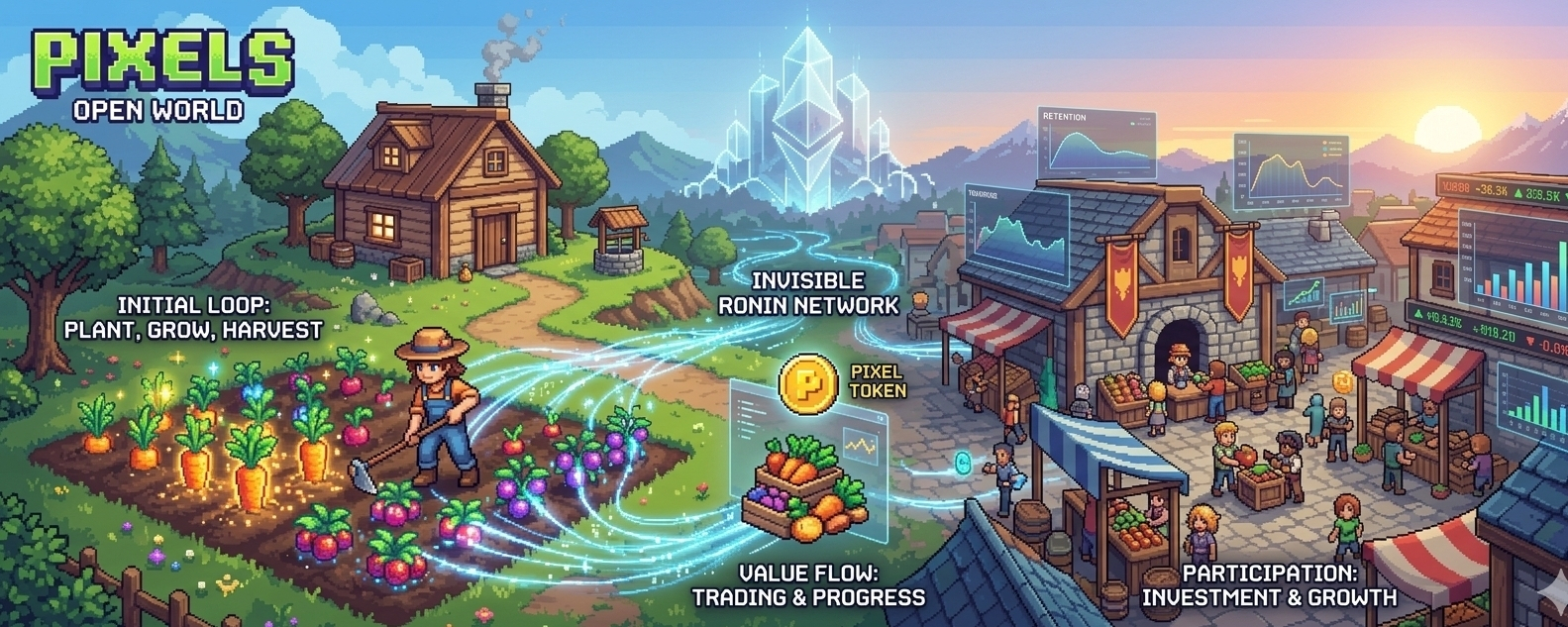
Inside Pixels, I don’t just play. I produce, I trade, I decide, and I adapt. The game revolves around farming, exploration, and creation, but underneath that simplicity is a layered system where every action connects to an economy. Crops are not just crops they are inputs in a broader supply chain. Land is not just a visual asset it’s a productive resource. Time is not just time it’s an investment.
That’s where I started seeing something deeper.
The project runs on the Ronin Network, which I see as one of the more practical approaches to blockchain infrastructure for gaming. Instead of forcing heavy, expensive interactions on users, it prioritizes speed and low costs. From my perspective, this is where the Layer-1 versus Layer-2 discussion becomes real. Ronin behaves like a purpose built Layer 1, but in terms of user experience, it solves the same problems that Layer-2 solutions aim to fix scalability, cost, and accessibility.
And honestly, that matters more than technical labels.
Because if a game cannot handle user activity smoothly, the entire economy breaks before it even starts.
What I find interesting is how Pixels uses a hybrid system. Not everything is on-
chain, and I think that’s a smart decision. High value assets, NFTs, and the PIXEL token exist onchain, while everyday actions happen off chain. This creates a balance where the blockchain secures ownership and value, but gameplay remains fast and fluid.
I’ve come to believe that this hybrid approach is not a compromise it’s necessary.
Fully on-chain games often struggle with speed and cost, while fully off-chain games lose the essence of Web3. Pixels sits in between, and that middle ground is what allows it to function at scale.
When I look at the PIXEL token itself, I don’t just see a currency. I see a coordination tool. It connects different parts of the ecosystem governance, premium features, asset creation, and economic incentives. But more importantly, its value is tied to activity inside the game.
And that’s where many projects fail.
They create tokens first and utility later. Pixels feels like it is doing the opposite building activity first, then letting the token reflect that activity.
From what I’ve observed, the tokenomics have also evolved significantly. Early GameFi models were heavily inflationary. Rewards were high, but sustainability was low. Players would extract value and leave, causing the system to collapse.
Pixels seems to have learned from that.
Rewards are more controlled now. Progression requires effort. And value is not handed out easily it’s earned through participation and strategy. I think this shift is critical because it changes player behavior. Instead of short-term farming, it encourages longer-term involvement.
And behavior is everything in a system like this.
The more I explore Pixels, the more I see how it mirrors real-world economic structures. There are players who specialize in production, others who focus on trading, and some who coordinate groups or guilds. It starts to feel less like a game and more like a small, self-contained economy.
This is where the concept of tokenization becomes meaningful to me.
In Pixels, assets are not just digital items they are tokenized representations of value. Land, resources, and collectibles can be owned, traded, and utilized in ways that resemble real-world assets. While it doesn’t directly tokenize physical assets, it captures the logic behind real-world asset systems: scarcity, utility, and exchange.
And I think that’s an important step.
Because before blockchain can fully integrate real-world assets, it needs environments where people understand how tokenized systems behave. Pixels is quietly becoming one of those environments.
Land, in particular, stands out to me. It’s not just about owning land it’s about what that land allows me to do. Production, customization, efficiency all of it ties back to land ownership. And as more players join the ecosystem, the importance of productive assets increases.
This creates a natural hierarchy, similar to what we see in real economies.
Some players operate at scale, optimizing output and coordinating with others. Smaller players find niche strategies to survive and grow. It’s not perfectly balanced, but it’s dynamic. And I think that dynamism is what keeps the system alive.
Another aspect I pay attention to is user retention.
In most Web3 games, user activity spikes at launch and then fades. Pixels doesn’t follow that exact pattern. It has managed to maintain a relatively strong user base, and I think that’s because it focuses on engagement rather than hype.
There’s no constant pressure to “buy now” or “act fast.” Instead, the game slowly builds habits. Daily actions, progression systems, and social interactions create a rhythm that keeps players coming back.
From my perspective, this is one of the most underestimated strengths of the project.
Because in the end, an economy only works if people stay.
When it comes to privacy, Pixels follows the standard blockchain model. I interact through a wallet, which gives me control over my assets without revealing my identity. It’s pseudonymous, not fully private, but it strikes a balance between transparency and control.
I think this is enough for a gaming environment.
Full privacy systems are important in certain areas of Web3, but in a game like Pixels, usability matters more. And adding too much complexity could hurt adoption.
The broader Web3 integration is where things get even more interesting for me.
Pixels is not just a standalone game it’s part of a larger shift in how digital experiences are structured. It connects gaming with decentralized finance concepts, even if it doesn’t present itself as a DeFi platform. Trading, asset ownership, and economic participation all exist within the game, but they feel natural rather than forced.
This is something I rarely see done well.
Most projects either lean too heavily into financialization or ignore it completely. Pixels integrates it in a way that feels organic.
Still, I don’t see it as perfect.
There are risks. The entire Web3 gaming sector is still evolving, and many projects struggle with funding, user retention, and economic balance. Pixels is navigating these challenges, but it’s not immune to them.
If the economy becomes too complex, new players might feel overwhelmed. If rewards become too limited, players might lose motivation. If token demand weakens, the entire system could slow down.
These are real concerns, and I think about them often when analyzing the project.
But at the same time, I see a level of awareness in how Pixels is being developed. Changes are not rushed. Systems are adjusted gradually. And the focus seems to remain on long-term stability rather than short-term excitement.
That gives me some confidence.
When I step back and look at the bigger picture, I don’t see Pixels as just another GameFi project. I see it as an evolving experiment one that is trying to answer a difficult question:
What happens when players actually own part of the game, and that ownership is tied to a functioning economy?
So far, the answer is still unfolding.
I think the real test for Pixels is not where it stands today, but where it goes from here. Can it scale without breaking its economy? Can it keep players engaged without relying on unsustainable rewards? Can it continue to balance fun and financial incentives?
If it manages to do that, then it becomes more than just a successful game.
It becomes a model.
And from my perspective, that’s what makes it worth paying attention to. Not because it promises something extraordinary, but because it is quietly building something that actually works.
In a space full of noise, Pixels doesn’t try to be loud. It focuses on structure, behavior, and sustainability. And I’ve started to believe that this quiet approach might be its biggest strength.
Because systems that last are rarely the ones that shout the most.
