
For a long time, free-to-play systems have followed a script so familiar that most players recognize it without even thinking. You enter a game and everything feels open. Progress comes easily, rewards feel consistent, and the experience appears generous. Then, slowly, friction begins to surface. Progress stalls, rewards thin out, and the system starts nudging you toward a paid layer. It’s not subtle anymore. It’s expected.
What makes Pixels interesting is that it doesn’t immediately follow that pattern.
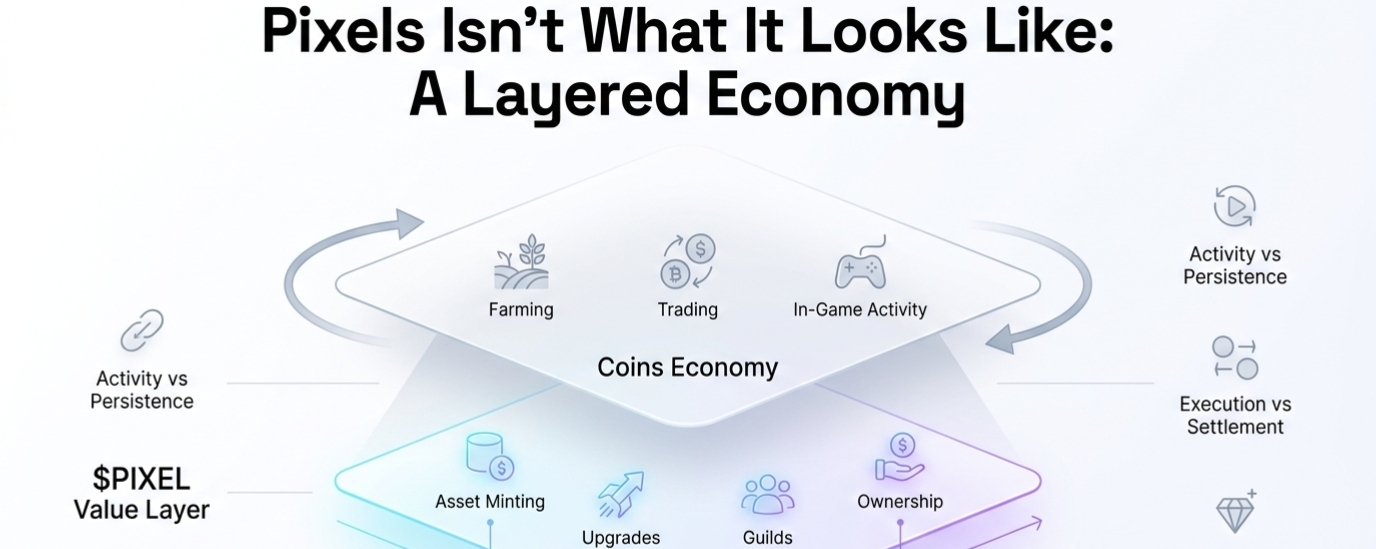
At first glance, it feels unusually open. You can spend hours inside the game without ever interacting with $PIXEL. The core gameplay loop functions smoothly on its own. You farm, you trade, you earn Coins, and you reinvest them back into the same loop. There’s no aggressive pressure pushing you toward a premium layer. No obvious wall interrupting your progress. The system feels self-contained, almost complete in itself.
That initial feeling is what makes the deeper structure easy to miss.
Because after spending more time observing how the system behaves, a subtle disconnect begins to appear. The effort players put into the game does not always translate into something that carries forward in a meaningful way. Activity is constant, but persistence is selective. And that’s where the design starts to feel different from a typical free-to-play economy.
Most of the visible activity in Pixels revolves around Coins. They act as the primary medium of exchange within the game’s everyday interactions. You earn them through gameplay, spend them on upgrades or items, and then repeat the process. It’s a loop designed for accessibility and flow. But Coins have a limitation that isn’t immediately obvious. They are highly functional in the moment, yet they don’t seem to hold weight beyond the cycle they operate in. They enable activity, but they don’t necessarily preserve it.
This creates a kind of economic layer where movement is constant, but memory is minimal.
In contrast, Pixel appears in a much more selective way. It is not embedded into every interaction or pushed into the player’s path early on. Instead, it shows up in specific parts of the system, usually where something persists longer or connects to broader structures. Whether it’s tied to asset minting, deeper upgrades, or guild-related mechanics, its presence feels intentional rather than ubiquitous. It doesn’t dominate the experience, but it quietly defines where certain forms of value begin to stick.
This difference changes how the system behaves, even if most players don’t consciously notice it.
Two players can spend the same amount of time in Pixels and walk away with very different outcomes. One might remain entirely within the Coin loop, staying active, progressing steadily, and engaging with the game on a surface level that feels rewarding in the moment. The other might interact with $PIXEL occasionally, not constantly, but strategically enough to anchor parts of their progress into something that persists beyond immediate gameplay cycles.
At first, the difference between these two approaches is almost invisible. Both players are engaged. Both are progressing. But over time, the divergence becomes more meaningful. One form of activity continues to circulate within a closed loop, while the other begins to connect with systems that extend beyond it.
This is where Pixels starts to resemble a broader concept often seen in blockchain systems, where there is a separation between execution and settlement. In many networks, a large amount of activity can occur continuously, but only certain actions are finalized or recorded in a way that has lasting significance. Pixels seems to echo a similar structure, although in a more abstract and less technical form. Most of the gameplay operates at the level of execution, where actions are frequent and fluid. The parts connected to Pixel feel closer to settlement, where outcomes are more durable and interconnected.
What makes this particularly interesting is how softly this distinction is implemented.
The system does not force players to engage with Pixel early on. It does not create immediate pressure or obvious limitations that push users toward it. Instead, the gap between the two layers emerges gradually. It feels less like a barrier and more like a slow drift. Players can remain in the Coin-driven loop for a long time without feeling restricted, which makes the experience feel genuinely free in the short term.
However, this subtlety introduces a potential challenge.
Most players do not naturally think in layered systems. They respond to what is visible and immediate. If the difference between Coins and $PIXEL remains too abstract, a significant portion of the player base may never engage with the deeper layer in a meaningful way. In that scenario, the token risks becoming somewhat detached from the majority of in-game behavior. It exists within the system, but its influence is not fully integrated into the everyday experience of most players.
At the same time, the economic structure continues to evolve regardless of player perception. Token distribution, unlock schedules, and supply dynamics operate independently of how users choose to engage. If the areas of the game that utilize $PIXEL do not expand at a pace that matches its availability, pressure can begin to build. This is not a new phenomenon in digital economies. Many systems have demonstrated that even well-designed structures can face imbalance if growth and utility are not aligned with timing.
Yet despite these risks, there is something undeniably compelling about the approach Pixels is taking.
If the ecosystem continues to expand, particularly beyond a single gameplay loop, the separation between Coins and Pixel could become increasingly significant. Coins may remain tied to localized, moment-to-moment interactions, serving as the engine of daily activity. Meanwhile, $PIXEL could evolve into a connective layer that links different parts of the ecosystem together. In that role, it would function less like a traditional premium currency and more like a mechanism for carrying value across systems.
At that point, the design begins to move beyond a simple game economy and into something that resembles infrastructure.
This shift introduces both opportunity and tension. On one hand, it allows for a more sophisticated and scalable system where different types of value are handled in different ways. On the other hand, it raises questions about fairness and accessibility. If most players remain within the visible layer while value quietly accumulates in less obvious parts of the system, the experience is no longer entirely neutral. It becomes selective, not through explicit paywalls, but through the way it determines what is preserved and what is transient.
What makes this dynamic particularly effective is that it does not disrupt the player experience. The system does not demand attention or force understanding. Players can continue engaging with the game comfortably, without ever needing to analyze its deeper mechanics. The structure operates in the background, shaping outcomes without interrupting the flow.
From the outside, Pixels still appears to offer a free and open economy.
But after spending time with it, that perception starts to shift. The system is not simply free in the traditional sense. It is layered. And within those layers, the same amount of effort can lead to very different kinds of value depending on where and how it is applied.
That distinction may not be immediately visible.
But over time, it becomes the part that matters most.
