
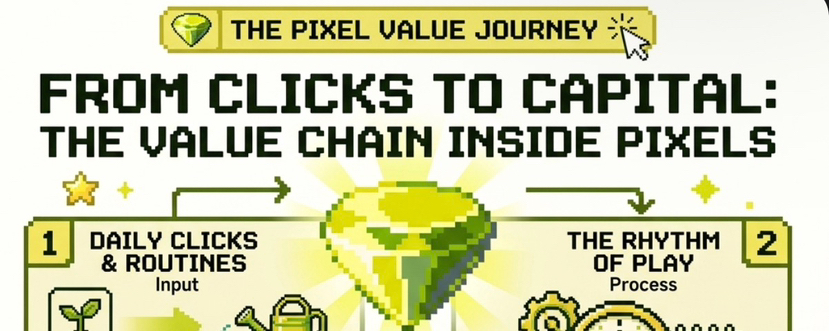
To be honest, when I first started playing Pixels, I did not think much about what I was doing. I would log in, click through my routine, plant, harvest, maybe explore a little, and then leave. It felt light, almost disposable, like something that did not carry over much meaning from one session to the next. I think I treated each action as separate, like it only mattered in that exact moment.
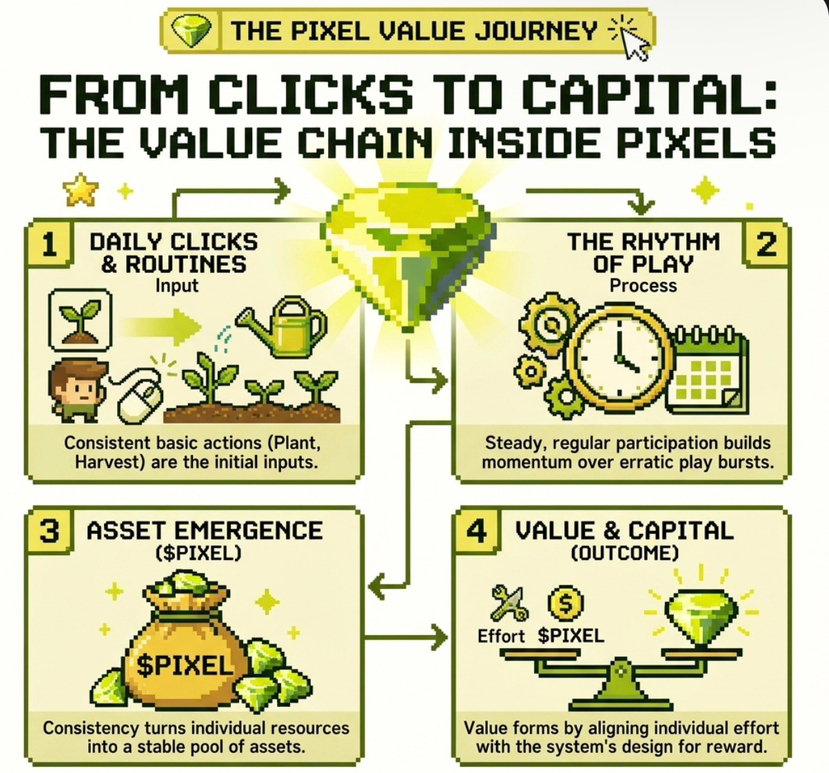
At the beginning, I assumed progress was just about time. If I played more, I would naturally move forward faster. That idea felt simple and fair. But after a while, I started noticing something that did not fully match that expectation. Some players seemed to progress in a smoother way, even when it did not look like they were spending more time than I was.
Slowly, I began to question my own pattern. My activity was inconsistent. Some days I would spend a lot of time in the game, while other days I would barely log in. At the time, it did not seem important because nothing in the game directly punished me for missing time. Still, I think that inconsistency was quietly affecting my results.
Over time, I started noticing that repetition had a different impact when it was steady. The same actions felt more connected when I returned regularly. When I played in bursts, everything felt slightly fragmented, like I was restarting instead of continuing. I think the difference was not in the effort itself, but in how that effort was distributed.
In a way, this is where the idea of a value chain started to make sense to me. Each action was small, but it did not stay isolated. Planting led to harvesting, harvesting led to resources, and those resources shaped future decisions. The chain extended beyond a single session, linking my actions over time in a way I had not fully noticed before.
What felt even more subtle was how rhythm influenced that chain. When my actions followed a pattern, the system seemed to respond more smoothly. Progress felt less forced, almost as if the game was aligning with my timing. When my pattern broke, that sense of flow disappeared, even though I was technically doing the same things.
I think this is where $PIXEL started to feel different to me. It did not seem like a simple reward for completing tasks. Instead, it felt more like something that reflected how I was engaging with the system. When my behavior was scattered, the outcomes felt scattered too. When my behavior became consistent, the results started to feel more stable.
Interestingly, this reminded me of how value forms outside of games. On social platforms, showing up once does not matter much, but consistent presence builds momentum. In markets, timing and repetition often matter more than isolated actions. I think Pixels reflects something similar, but in a quieter and less obvious way.
At some point, I realized that the system was not just responding to what I did, but to the pattern behind it. My clicks were not just actions. They were signals that formed a rhythm over time. That rhythm seemed to matter more than any single decision I made.
Another thing I began to notice was that I was not interacting with the system alone. Other players were part of the same environment, and their consistency seemed to shape the overall flow as well. Even without direct interaction, there was a shared structure forming from collective behavior.
Because of that, value started to feel less like something I directly created and more like something that emerged from alignment. It was not only about effort, but about how that effort fit into a larger pattern. The system did not explain this, but it revealed it slowly through experience.
In the end, I am not entirely sure where the shift actually happens. There is no clear moment where clicks turn into capital. It feels gradual, almost invisible, as if small actions are quietly accumulating into something more structured over time.
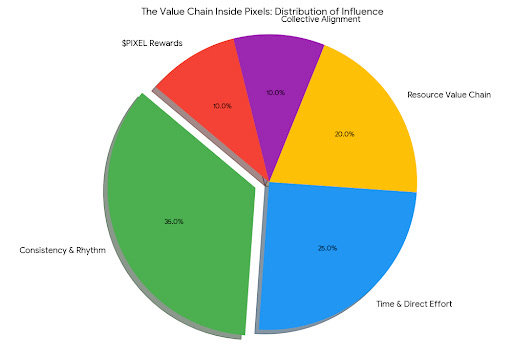
And thinking about it now, I am left wondering whether I am really building value through what I do, or if I am just slowly aligning with a system that was already designed to reward certain patterns without making them obvious.
