
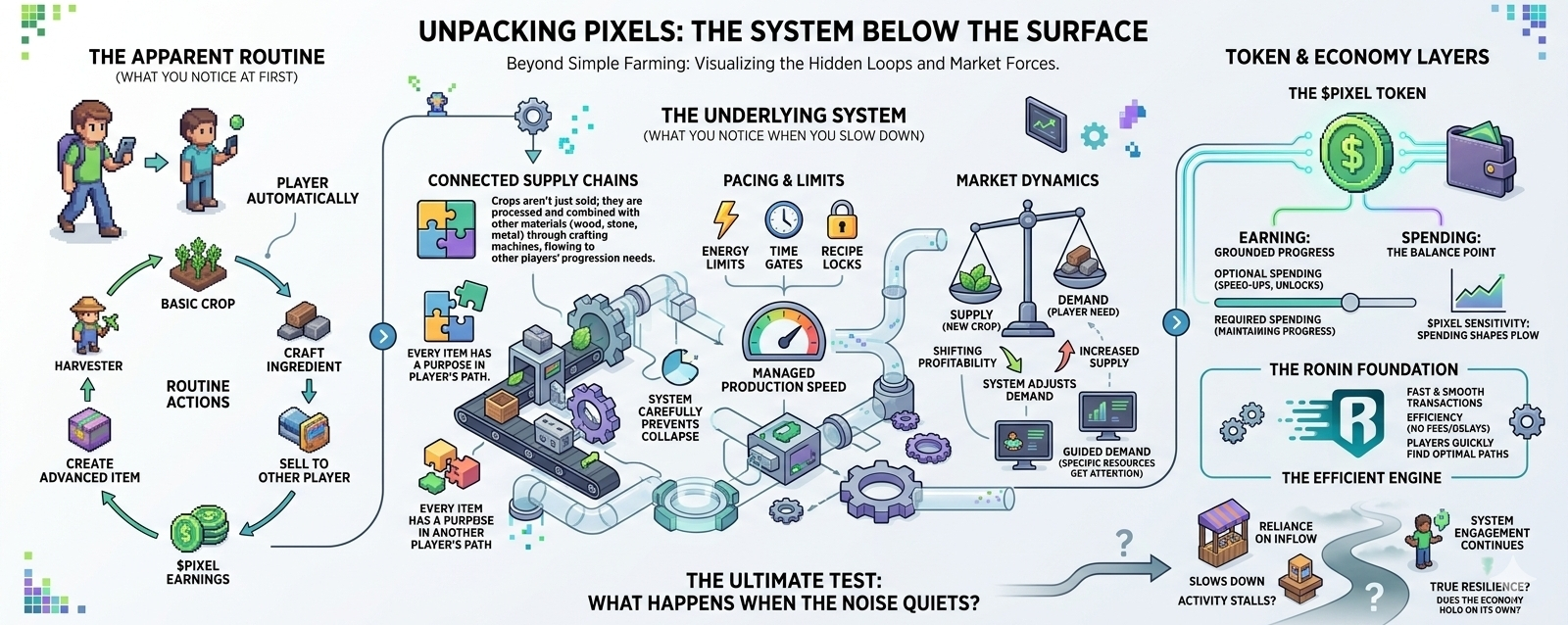
I was sitting outside after dinner, the kind of evening where nothing is really happening but you’re not in a rush to go inside either. Phone in hand, I opened Pixels without thinking much about it. Same plan as always—check crops, maybe craft something useful, sell it, log off.
Just routine.
But somewhere in the middle of it, I caught myself doing things almost automatically. No hesitation, no real decision-making. Just moving from one step to the next like I already knew the outcome.
That’s when it felt different.
Not in a bad way—just… clearer.
Because what I thought was a simple farming loop started to look more like a system quietly guiding everything I did.
Most people still explain Pixels in the easiest way possible. A farming game with a token. Grow, harvest, earn $PIXEL, maybe trade a few items. That version works if you’re just passing through.
But if you stay a little longer, you start noticing something else.
The farming part isn’t really the point.
It’s just where you begin.
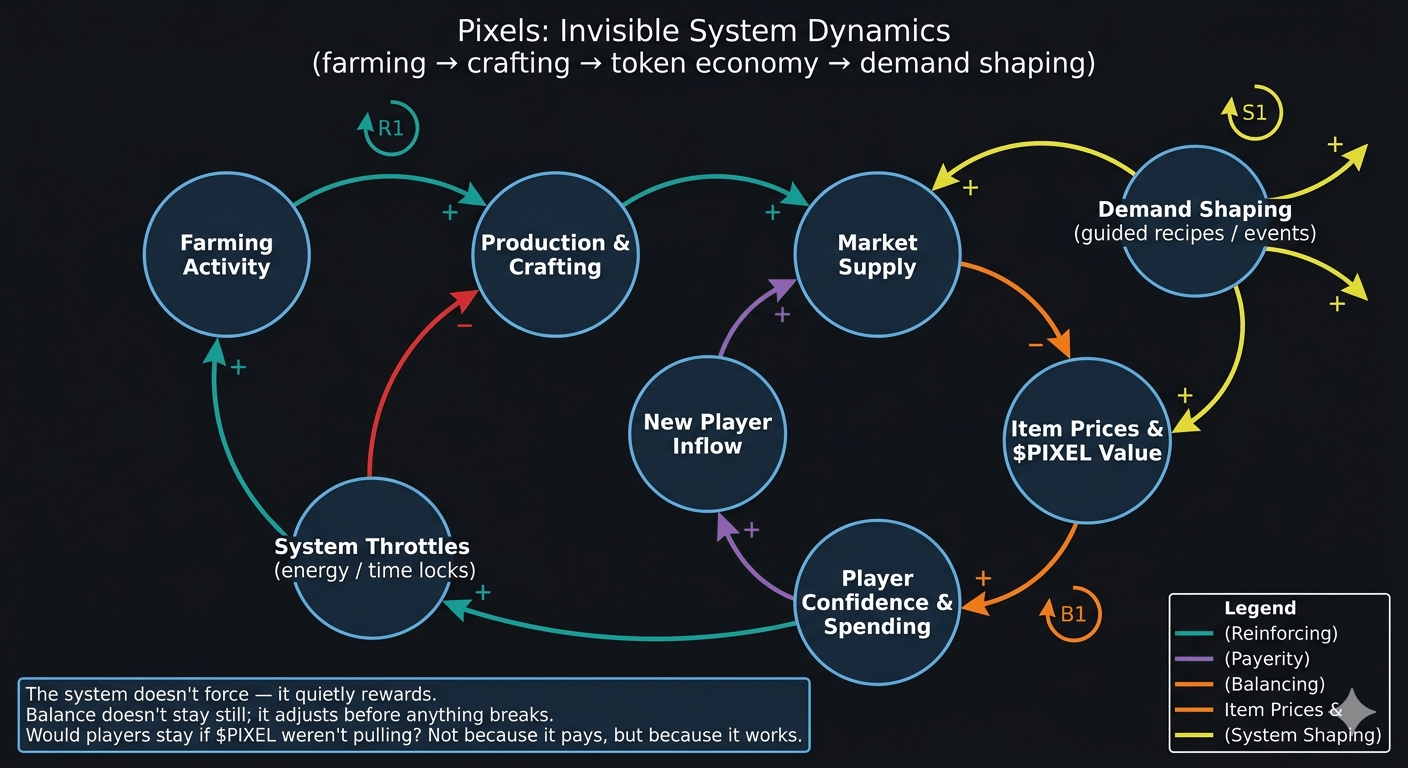
Everything you collect, every crop, every material—it’s all moving somewhere. Nothing really exists on its own. It’s always part of a chain leading into something else.
You harvest a crop, but that’s not the end. It becomes an ingredient. That ingredient becomes part of a recipe. That recipe turns into something another player actually needs.
And most of the time, you’re not making things for yourself—you’re making them because someone else is already on the next step.
That’s the loop.
And once you see it, it changes how you play.
You stop asking “what should I grow?” and start asking “what actually moves?” What sells, what’s needed, what fits into someone else’s path.
The system doesn’t force you into that thinking—it just quietly rewards it.
At the same time, it doesn’t let you move too fast either.
There are limits everywhere. Energy runs out quicker than you expect. Time slows certain actions. Some recipes stay locked until you’ve spent enough time progressing. Better tools help, but getting them isn’t instant. Even access to certain parts feels controlled.
At first, it all feels normal. Like pacing.
But after a while, it feels intentional.
Like the system is carefully managing how much gets produced and how quickly it enters the market.
Because if everything opened up at once, it wouldn’t take long for things to break. Everyone would chase the same profitable items, and suddenly those items wouldn’t be worth anything anymore.
Here, that collapse never really happens.
Things shift before they get there.
I’ve been repeating one loop a lot lately, almost without thinking about it.
Harvest something basic.
Process it into something more useful.
Craft an item tied to progression.
Sell it to someone who doesn’t want to go through all those steps.
It sounds simple, but it rarely stays simple for long.
Because the moment something becomes profitable, people notice. And when enough people notice, they move in quickly.
That’s when the system starts to feel tight again.
Either supply slows down, or demand shifts somewhere else.
It’s subtle, but it’s always there.
Then there’s the token side, which adds another layer to everything.
At first, earning $PIXEL makes the whole process feel grounded. Like your time is actually translating into something real. Even when item prices fluctuate, there’s still that steady sense of reward.
But after a while, I started paying more attention to where that token actually goes.
Not just earning it—but using it.
And that’s where things get less clear.
A lot of the spending feels optional. Speeding things up, unlocking small advantages, making life easier. It’s useful, but not always necessary.
That kind of spending depends on how people feel.
If they’re confident, they spend without thinking much. If they’re unsure, they hold back.
And when people hold back, the flow slows down.
On the other side, if spending becomes something you need to do just to keep moving, it solves that problem—but creates another.
It starts to feel like everything has a cost attached.
Not heavy, not overwhelming—but enough that you notice it.
Somewhere between those two—optional and required—is where the system tries to stay balanced.
And that balance doesn’t stay still.
Another thing I’ve been watching is where demand really comes from.
Sometimes it feels natural. Players need items, tools, materials. Things get used, replaced, bought again. In those moments, everything feels connected.
Other times, it feels guided.
Like the system is quietly pointing everyone in a direction—this item matters right now, this resource is worth focusing on. And people follow, because that’s where activity is.
It works. It keeps everything moving.
But it also means the system is shaping demand, not just responding to it.
And when that push slows down, things feel different.
That’s where you start noticing whether the economy holds on its own.
Ronin plays a bigger role in all of this than it seems at first.
Everything is smooth. Fast. You don’t think about fees or delays. You just act.
Craft, list, buy, sell—it all happens naturally.
That ease makes the system feel alive.
But it also makes it efficient.
If there’s a better way to do something, it doesn’t stay hidden. Players find it quickly. And once they do, it spreads just as fast.
Which means the system is constantly being tested.
Not by design—but by people trying to make the most out of it.
And over time, that testing starts to show patterns.
As long as new players keep coming in, everything feels stable. They buy items, they create demand, they keep things moving.
But if that slows down, the system has to rely on its own structure.
That’s when you see what’s actually holding everything together.
I don’t think there’s a clear answer yet.
From the outside, Pixels feels balanced. Nothing feels completely off, nothing feels out of control.
But balance doesn’t always mean stability.
Sometimes it just means the system is good at adjusting before anything breaks.
So instead of trying to figure it all out, I just watch what happens when things quiet down.
When rewards aren’t as strong.
When activity slows a bit.
When there’s no obvious push guiding everyone.
Do people still show up?
Do they keep producing, keep trading, keep engaging?
Or do things start to stall?
And one thought keeps coming back, especially on nights like that—when everything is calm, and there’s no rush to do anything.
If $PIXEL wasn’t pulling as hard… if things slowed down for a while…
Would this still feel like something worth coming back to?
Not because it pays.
But because it works.