
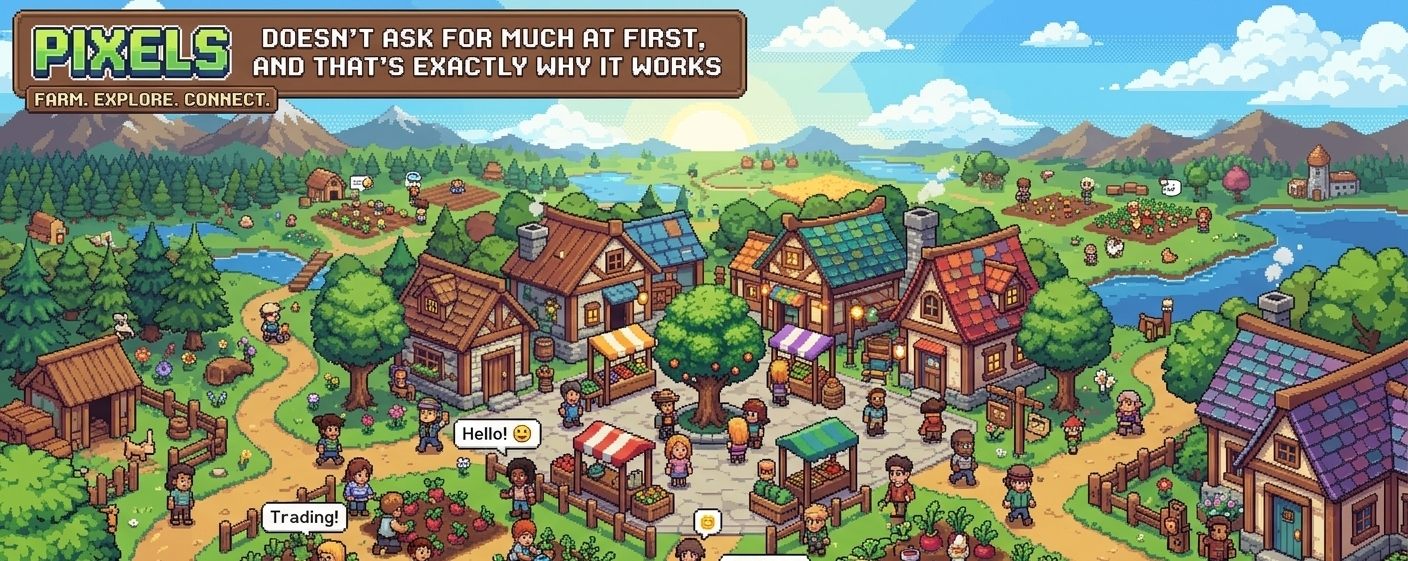
Pixels does not hit you like one of those games that tries too hard in the first five minutes. It does not come in loud. It does not act like it is changing your life. It just gives you a world, gives you a routine, and lets you settle into it. That is probably its smartest move. A lot of games, especially in this space, make the mistake of trying to impress people before they have earned even a little trust. Pixels goes the other way. It keeps things simple. Farming, exploring, moving around, seeing other players, doing small tasks, coming back later. Nothing too dramatic. And honestly, that helps more than people think.
The reason it sticks with people is not because the idea is wildly new. Farming games have been around forever. Slow loops are not new. Open worlds are not new either. Even the social side is something players already understand. But sometimes a game does not need to reinvent everything. Sometimes it just needs to get the feeling right. Pixels gets that feeling right more often than not. It feels easy to enter. Easy to understand. Easy to come back to. That kind of ease matters because most people do not want a game that feels like work before they even know if they like it.
What I find interesting about Pixels is that it feels small in the beginning, but not empty. There is a difference. Some games feel small because there is just not much there. Pixels feels small in a calmer way. More personal. More low-pressure. The world is not screaming for your attention every second. You can just exist in it for a while. Farm a bit. Walk around. See what other people are doing. Leave. Return later. That quiet pace gives the game a kind of comfort that a lot of louder projects never manage to build.
And the social part really helps with that. Even when you are doing simple things, the fact that other players are around gives the whole world more weight. It stops the game from feeling like a lonely system of chores. A shared world always changes the mood. Even if people are just doing their own thing, that presence matters. It makes the place feel lived in. It gives the routine a little warmth. Without that, the farming loop would probably feel too thin after a while. With it, the same loop feels more grounded.
That is probably the biggest strength of Pixels. It makes repetition feel softer.
Because yes, it is repetitive. Obviously. That is part of the design. You do similar things again and again. You build a rhythm. You follow familiar patterns. But the game presents that repetition in a way that feels calmer than most. It does not feel like it is yelling at you to optimize every second. It does not feel desperate. It lets you move at your own pace, and that makes a huge difference. A slow game can be boring when it has no atmosphere. Pixels avoids that by giving the routine enough life around it to keep it from going flat too quickly.
There is also something nice about how clear it all feels. You do not need to overthink what the game wants from you. The world is readable. The loop is readable. The structure makes sense. That simplicity is part of its charm. People always act like more systems automatically mean more depth, but that is not true. Sometimes more systems just mean more noise. Pixels feels more comfortable with being straightforward, and I think that works in its favor.
At the same time, the reason people keep talking about it is not only because it feels calm. It is because there is something sticky about the way it turns ordinary actions into habit. That is where the game gets its real strength. It becomes part of a rhythm. Not a massive commitment. Not some huge event. Just a place you can return to without stress. That kind of design is easy to underestimate, but it is often what gives a game real staying power.
So no, Pixels is not built on some giant dramatic idea. That is probably why it feels more natural than a lot of other projects. It works because it understands pace. It understands routine. It understands that people sometimes want a game that does not fight them. And in a space full of noise, pressure, and too many promises, that alone makes it stand out.