
Crypto has this way of wearing people down.
Every cycle comes with a new batch of tokens, a new “future of everything,” and a new reason why this time the noise is supposed to matter. A few years ago it was DeFi. Then metaverse land. Then AI got stapled onto half the market whether it made sense or not.
After a while, you stop reacting to big promises.
You start paying more attention to whether something feels real.
That is part of why Pixels (PIXEL) caught my attention a bit.
Not because it sounds world-changing.
Not because Web3 gaming suddenly fixed all the things that have been broken for years.
It just feels like it is trying to do something more grounded. And in crypto, that already makes it unusual.
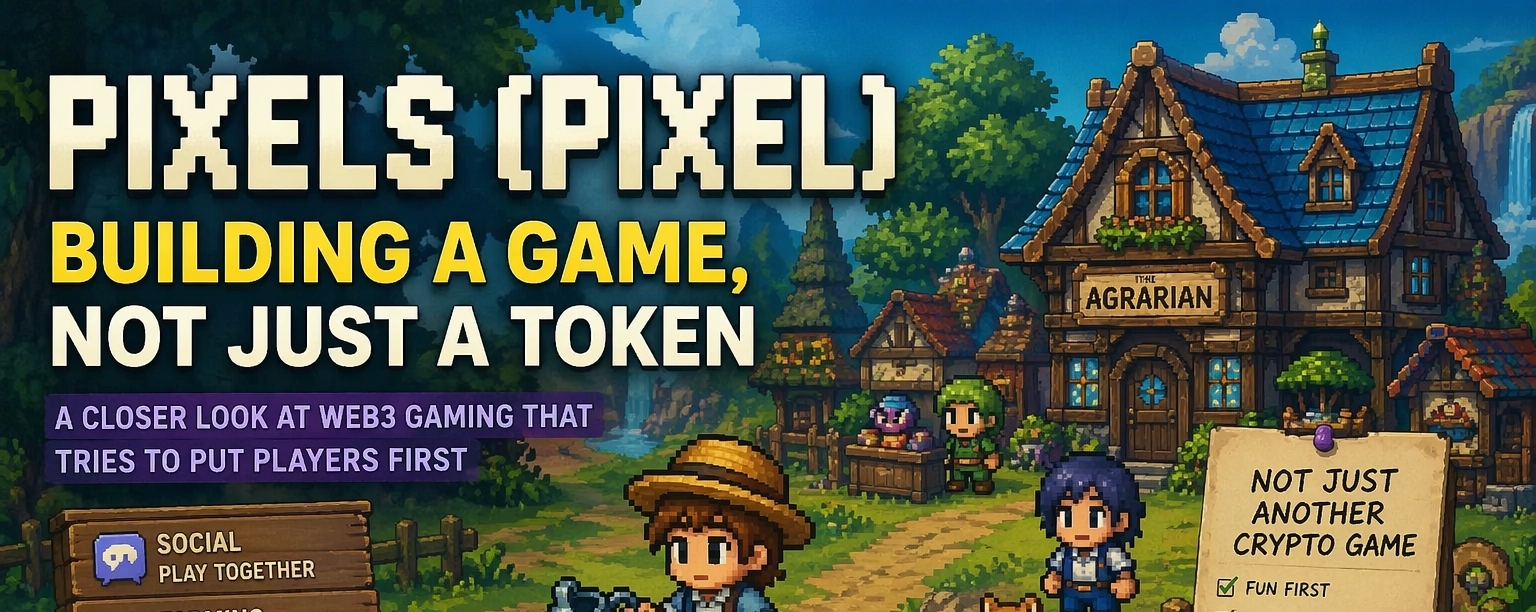
Pixels is a social casual game on Ronin. Farming, exploring, building, hanging around in a shared world. On the surface, that all sounds pretty simple. Maybe even too simple for a market that loves grand narratives and overbuilt ideas.
But honestly, simple is probably what this space needed.
One of the biggest problems with blockchain gaming has always been that most of it never really felt like gaming. It felt like economics first, gameplay second. Too many projects were basically token systems with a map attached. You were not really there because the world pulled you in. You were there because there was some reward loop, some earning angle, some short-term incentive.
That usually works for a little while.
Then people leave.
Because most players do not actually care about “owning assets” in the abstract. They care about whether a game is fun, whether it is easy to come back to, whether it has some charm, some rhythm, some reason to stay.
That is the friction Pixels seems to be pushing against.
It is not trying to sell people on a giant theory. It is leaning into something much more ordinary: daily activity, social presence, familiar mechanics, a world that feels lived in. That might not sound exciting if you are looking for the next explosive narrative, but I think that is exactly why it stands out a little.
It is at least pointed in a more believable direction.
That does not mean it is solved.
Far from it.
Crypto has a habit of turning every decent product into a market event. The second a token is involved, the atmosphere changes. People stop acting like players and start acting like they are positioning. Every update gets filtered through price. Every piece of traction gets overinterpreted. And eventually the project has to carry two very different burdens at once: being a good product and being a good speculative story.
That is where things usually get messy.
With Pixels, the real question is whether the game can hold people when the market gets quiet.
Can people enjoy it when there is nothing to farm except the game itself?
Can it build habits instead of just attracting opportunists?
Can it keep the economy from overpowering the world?
Those are harder questions than token buyers usually want to ask, but they matter more than most of the standard crypto talking points.
I also think the casual social angle is important.
A lot of Web3 games in the past felt like they were designed by people who understood tokenomics better than player behavior. They underestimated how much game communities are built on routine, mood, and social energy. Not everything has to be intense. Not everything has to feel like a competition or a financial strategy. Sometimes people just want a place they can return to without effort.
That is something traditional games figured out a long time ago.
Crypto mostly did not.
So when a project leans toward accessibility and repetition instead of complexity and financial engineering, I notice. Not because I think that automatically makes it good, but because it suggests the team may at least understand where the old model kept breaking.
Still, skepticism is healthy here.
Web3 gaming has burned through a lot of goodwill. We have seen enough polished trailers, enough inflated user stories, enough ecosystems that looked busy until incentives dried up. Pixels could absolutely run into the same wall. The genre is hard. Retention is hard. Building an economy around a game without distorting the game is very hard.
And markets make all of it worse.
So I do not look at Pixels and see some final answer for blockchain gaming.
I just see a project that feels a bit more honest about what might actually work.
That is different.
Maybe it succeeds. Maybe it fades like many others have. But at least it is chasing something more believable than the usual crypto fantasy. It is trying to make people show up for the world first, not just for the token.
That may not be enough.
But it is enough to make it worth watching.
