Gaming tokens are often discussed as if they should be judged by the same framework used for ordinary crypto assets: price action, exchange listings, liquidity depth, market narrative, and short-term upside. That lens is not useless, but it is incomplete. In a game economy, a token is not only a tradeable asset. It is also a behavior-shaping tool. Its real strength depends less on whether traders can rotate into it for momentum and more on whether players repeatedly choose to use it because it makes the game easier, faster, richer, or more enjoyable.
That is why PIXEL is a more interesting case study than many token discussions admit. Pixels is not a token looking for a story. It is a live social casual game on Ronin built around farming, exploration, progression, and creation, with PIXEL positioned as part of the economic layer rather than as a detached financial wrapper. Pixels’ own materials frame PIXEL as a premium in-game currency used for items, upgrades, and cosmetic enhancements, while the game also uses off-chain Coins for everyday spending, which players can purchase with PIXEL inside the game. Ronin and Pixels have also described the shift away from BERRY’s in-game role toward PIXEL as the main on-chain token, alongside newer staking and ecosystem uses.
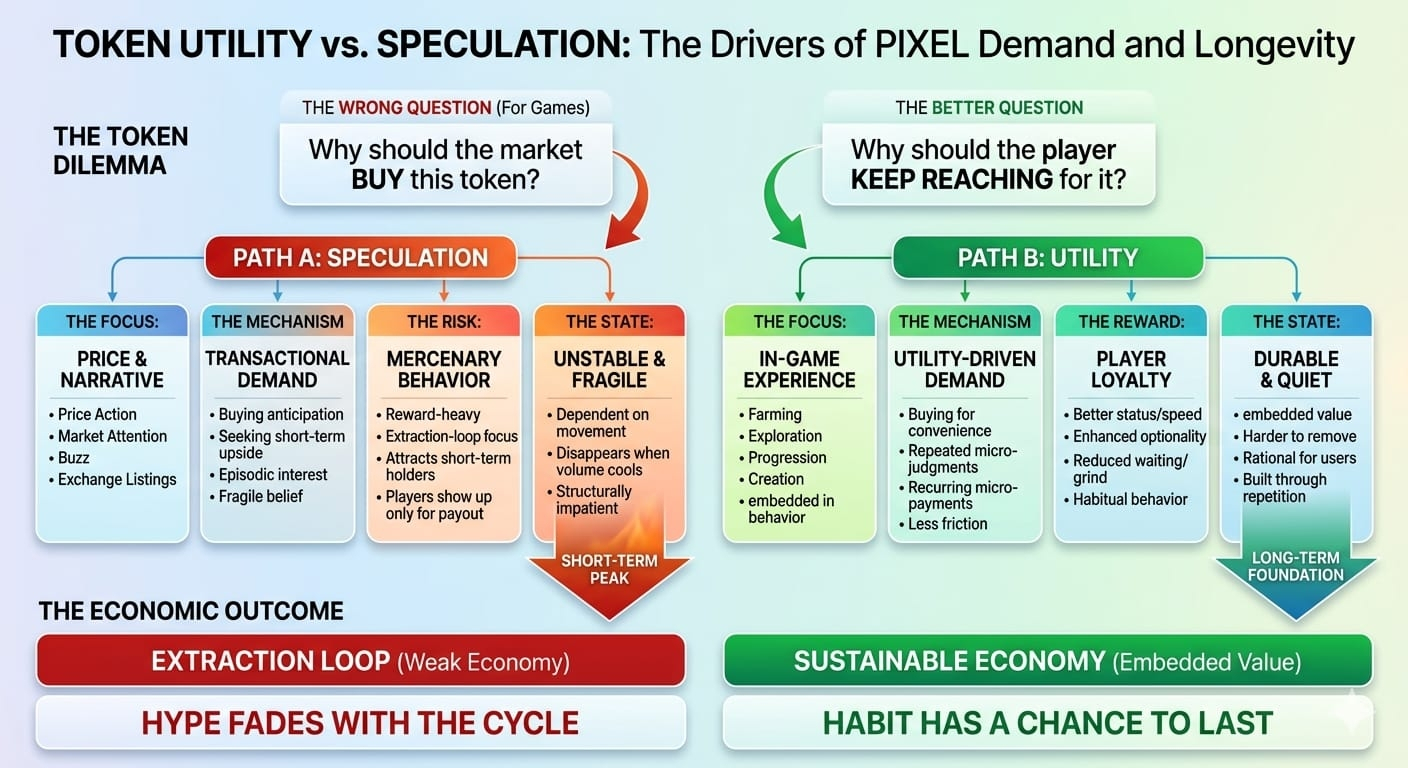
That distinction matters because it exposes the central mistake people make when evaluating gaming tokens. They ask, “Why should the market buy this token?” when the better question is, “Why should the player keep reaching for it?” Those are related questions, but they are not the same. Speculation can answer the first one for a while. Only utility can answer the second one over time.
Speculation is powerful because it compresses attention. It creates a reason for people to care immediately. It increases visibility, concentrates liquidity, and gives a token cultural presence beyond the game itself. PIXEL benefited from exactly that kind of attention when the token launch and broader Ronin integration pulled the project into the center of crypto gaming conversation. That kind of speculative demand is real. It can attract new users, pull dormant observers into the ecosystem, and create the sense that something important is happening.
But speculation is also structurally impatient. It is drawn to movement, not maintenance. It rewards anticipation more than repetition. A purely speculative holder does not need to love the game, understand the progression loop, or develop any in-game habit at all. They only need a reason to believe someone else will want the token later at a higher price. That can produce strong short-term demand, but it is fragile demand. It is demand that disappears the moment the story weakens, volume cools, or attention moves elsewhere.
Utility-driven demand works differently. It is less theatrical, but usually more durable. It emerges when the token becomes embedded in ordinary player behavior. Not because players are ideologically committed to tokenomics, but because using the token is the path of least resistance inside the game. That is where gaming tokens either become economically alive or slowly drift into irrelevance.
Pixels’ own language around PIXEL is revealing here. The project has consistently tied demand to practical player questions: does this token save time, unlock convenience, improve status, or meaningfully enhance the experience? That is a far healthier framing than the standard crypto obsession with narrative alone. In games, demand is not only born from belief. It is born from friction. If a token reduces friction, it gains relevance. If it adds friction, players route around it.
This is why convenience may be a stronger driver of PIXEL demand than hype. Not convenience in the lazy sense, but in the economic sense. Players spend to remove waiting, reduce grind, simplify resource access, or move through progression with more control. Those decisions do not require a grand market thesis. They require repeated micro-judgments: this saves me time; this improves my loop; this makes the game feel better. Over thousands of users and millions of interactions, those small choices matter more than a week of speculative excitement.
The same is true of premium advantages. Many crypto discussions treat premium utility as somehow less noble than “pure” decentralization narratives, but games have never worked that way. Players have always paid for speed, status, customization, efficiency, and optional advantages. The question is not whether premium utility exists. The question is whether it is integrated well enough to feel desirable rather than extractive. PIXEL’s long-term strength depends on whether it becomes the preferred instrument for meaningful optionality inside Pixels: the token players willingly use because it enhances their experience without turning the economy into a punishment machine for non-spenders.
This is the deeper tension between reward and relevance. A token can reward users and still fail to matter. Airdrops, emissions, and incentives can create temporary engagement, but temporary engagement is not the same as embedded demand. Reward-heavy systems often teach users how to extract value from a game rather than how to stay loyal to it. They create mercenary behavior. Players show up for the payout, optimize for withdrawal, and leave the moment returns decline. That is not an economy in the strong sense. It is an extraction loop wearing the language of community.
A more durable model is one where the token stops feeling like an external prize and starts functioning like an internal instrument. That is the difference between transaction and habit. Transactional demand is episodic. Habitual demand is recurring. Transactional demand asks whether the token is useful today. Habitual demand makes the token part of how the player normally plays.
That is why the shift from extraction to loyalty is so important when thinking about PIXEL. Loyalty in a game economy is not a sentimental idea. It is an economic one. It means users keep returning, keep spending, keep progressing, and keep participating because the system continues to serve them. A token that sits inside those loops has a much stronger foundation than a token sustained mainly by market excitement. Pixels’ use of PIXEL for premium functionality, in-game conversion into Coins, staking, and broader ecosystem activity suggests an attempt to move the token closer to recurring utility rather than leaving it as a mere speculative chip.
That does not mean speculation is irrelevant. In fact, speculation often plays a useful early role. It bootstraps awareness. It can finance attention before a game fully earns habit. It can pull users toward a product they might otherwise ignore. In crypto gaming, that is often the bridge between obscurity and scale. The problem begins when speculation is mistaken for proof of durable demand. It is not proof. It is an amplifier. It can make a signal louder, but it cannot create long-term value out of thin air.
The more serious way to assess PIXEL, then, is to ask whether the token is becoming harder to remove from the actual player experience. If Pixels can make PIXEL the natural route to convenience, progression smoothing, premium expression, ecosystem perks, and sticky in-game identity, then the token gains something more important than market buzz. It gains embedded value. Embedded value is what happens when demand is not dependent on a fresh narrative every month. It is supported by behavior people repeat because it feels rational inside the product.
This is also where hype and embedded value diverge most sharply. Hype is loud precisely because it is unstable. It needs constant renewal. Embedded value is quieter because it is already installed inside the user experience. The player does not need to be persuaded anew every week. They already know why the token matters to them.
For crypto gaming readers who care about token design, this is the real takeaway. A gaming token should not be judged only by tradability, narrative strength, or market performance. It should be judged by the quality of its utility, the smoothness of its integration, and the frequency with which ordinary users choose it over available alternatives. If the token is merely reward-shaped, it invites extraction. If it is utility-shaped, it can build loyalty. If it only fuels attention, it will fade with the cycle. If it fuels habit, it has a chance to last.
PIXEL’s long-term demand, in that sense, will not be decided by speculation alone, even if speculation remains part of the story. It will be decided by whether Pixels keeps turning the token into a practical, desirable, and recurrent part of play. In gaming economies, that is what real demand looks like. Not just movement. Not just hype. Not just reward. Relevance.