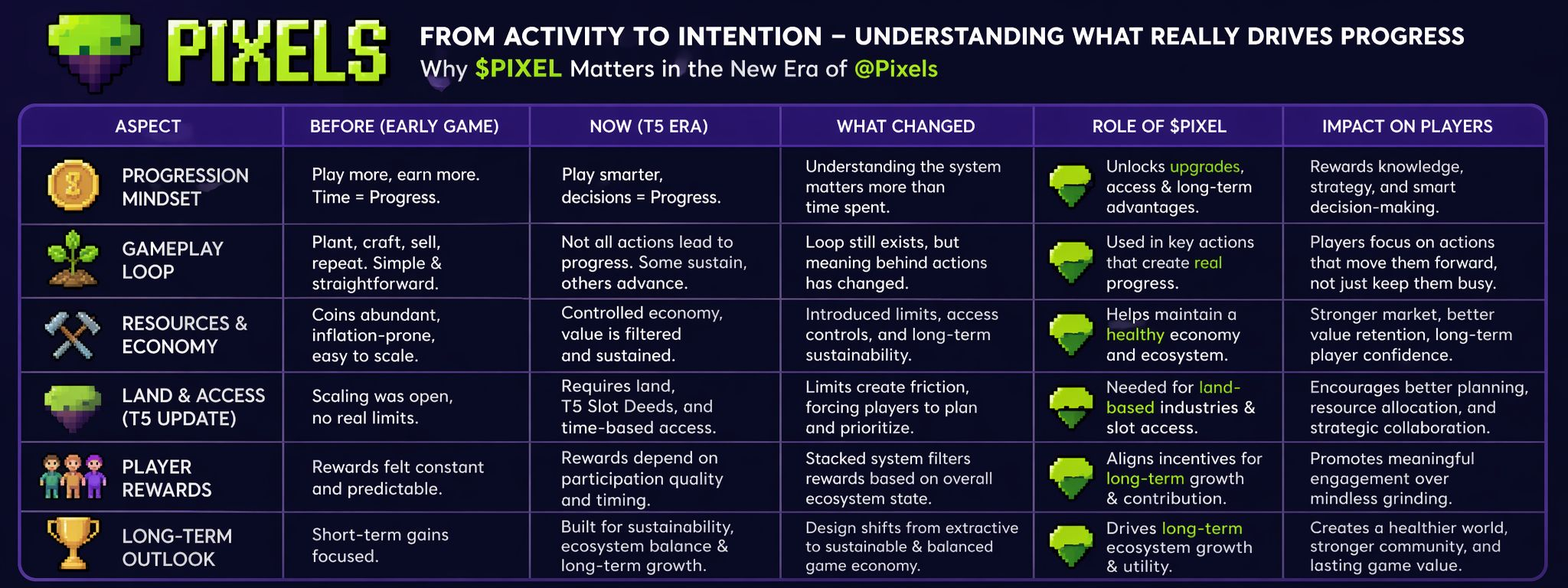
There’s a moment in @Pixels where the whole experience quietly changes, and if you’ve played long enough, you probably felt it too. At the beginning, everything looks simple. You log in, plant crops, craft items, sell on the market, and repeat. It feels smooth, almost too smooth. Progress seems natural, Coins keep moving, and nothing really stops you from continuing the loop.
But that surface doesn’t last.
After spending more time inside the game, you start noticing something subtle but important. Not every action you take actually moves you forward. Some things just keep you busy. And that’s where Pixels starts separating itself from most Web3 games.
It’s not about doing more anymore. It’s about doing the right things.
The loop is still there, but the meaning behind it changes.
Coins vs $PIXEL – Activity vs Real Progress
Most of the visible economy in @Pixels runs on Coins. You earn them through farming, crafting, and basic gameplay. They keep the system active and give players a sense of constant movement. You always feel like you’re doing something.
But Coins don’t really carry weight long-term. They’re part of the loop, not the progression.
That’s where $PIXEL comes in.
What’s interesting is that pixel is not everywhere. It’s not thrown into every activity or reward system. Instead, it appears in very specific places, and those places tend to be the ones that actually matter over time.
Upgrades. Access. Positioning. Ownership.
That design choice changes how players think. You stop focusing on how much you’re doing and start thinking about where your effort is going.
It’s a shift from activity to intention.
And once you notice it, you can’t unsee it.
T5 Changed the Way the Game Breathes
The introduction of Tier 5 wasn’t just another content update. It changed the structure of progression itself.
Before T5, scaling felt open. You could expand your gameplay almost endlessly if you were willing to put in the time. More effort generally meant more output.
Now, that’s no longer true.
T5 introduced limitations in a very controlled way. Industries require NFT land. Access is restricted through T5 Slot Deeds. Each slot only unlocks a portion of capacity, and even that access isn’t permanent. After 30 days, it expires unless you actively maintain it using Preservation Runes crafted at the Quantum Recombinator in Pixels HQ.
This creates something the game didn’t have before: friction that forces decision-making.
You can’t just scale infinitely anymore. You have to choose where to invest, what to maintain, and when to expand.
And that’s where the game starts feeling less like a casual farming loop and more like an economic system.
Time Alone Doesn’t Carry You Anymore
One of the biggest mindset shifts in pixels is realizing that time spent does not equal progress gained.
Two players can spend the same number of hours in the game and end up in completely different positions.
At first, that feels confusing.
You start questioning your strategy. Maybe you think you’re not optimizing energy correctly. Maybe you assume you’re wasting time traveling or choosing the wrong crops or crafts.
But eventually, it clicks.
The game isn’t measuring effort the way you think it is.
It’s measuring understanding.
Things like timing, positioning, access to land, and awareness of systems start to matter more than raw grinding. The players who move ahead aren’t always the ones playing longer. They’re the ones making better decisions inside the same time window.
That’s a very different design compared to traditional play-to-earn models.
Stacked – The Invisible Layer That Changes Everything
You don’t always see it directly, but you feel it.
Stacked operates in the background, quietly shaping how rewards flow through the system. It’s not just about completing actions anymore. It’s about how those actions fit into the broader state of the game.
Rewards don’t feel random, but they don’t feel fixed either.
They feel filtered.
This is where Pixels starts moving away from predictable reward loops and toward something more adaptive. It’s less about repeating a task and more about how your behavior aligns with the system at that moment.
That makes the experience harder to “solve,” but more interesting to play.
Because now, you’re not just playing the game.
You’re trying to understand it.
The Economy Feels Controlled, Not Chaotic
Most Web3 games struggled with one core problem. They rewarded activity too aggressively, which led to inflation, value drain, and eventually player exit.
Pixels feels like it’s trying to avoid that mistake.
Instead of flooding the system with rewards, it introduces control points. Not every action produces lasting value. Not every reward enters circulation immediately. Some of it is delayed, filtered, or tied to specific conditions.
This slows things down, but in a good way.
It creates a sense that the economy is being managed, not just left to grow uncontrollably.
That doesn’t mean it’s perfect. There are still rough edges. Some systems feel unclear. Some mechanics take time to understand.
But the direction is different.
It’s not about maximizing output anymore.
It’s about sustaining value.
Land, Access, and Positioning Are Becoming Core
Another shift that’s becoming more obvious is how important land and access are starting to feel.
With around 5,000 NFT land plots capable of hosting production, ownership isn’t just cosmetic. It directly impacts how players interact with the game’s economy.
Landowners can host industries. Other players can use those setups. Value flows between participants, even when one side is offline.
This creates a layered system where not every player has the same role.
Some produce. Some optimize. Some provide access. Some manage systems.
And that variety is what gives the economy depth.
It’s no longer a single loop.
It’s multiple overlapping systems.
Long Term, This Changes Player Behavior
All of these design choices lead to one outcome.
Players stop thinking short-term.
You don’t log in just to extract value and leave. You start thinking about setup, positioning, timing, and sustainability.
You start asking different questions.
Is this action moving me forward, or just keeping me busy?
Is this resource something I should use now, or hold for later?
Is my current setup efficient, or just comfortable?
That shift in thinking is what separates Pixels from most other projects in the space.
It’s not trying to push players faster.
It’s trying to make them think deeper.
Final Thought
Pixels is still evolving, and it’s not perfect. There are still moments where things feel unclear or unbalanced. But the direction is what stands out.
It’s moving away from the typical play-to-earn loop and toward something more structured, more controlled, and more dependent on player understanding.
It doesn’t reward you just for showing up.
It rewards you for figuring it out.
And that’s why PIXEL feels different.
It’s not just a reward token.
It’s a key that unlocks the parts of the game that actually matter.