I almost didn’t catch it. I was doing my usual routine in Pixels, clicking through tasks, buying a few small items, and I realized something felt… smoother. No wallet pop-ups, no waiting. Just instant actions. At first, I thought maybe my connection was better that day. It wasn’t.
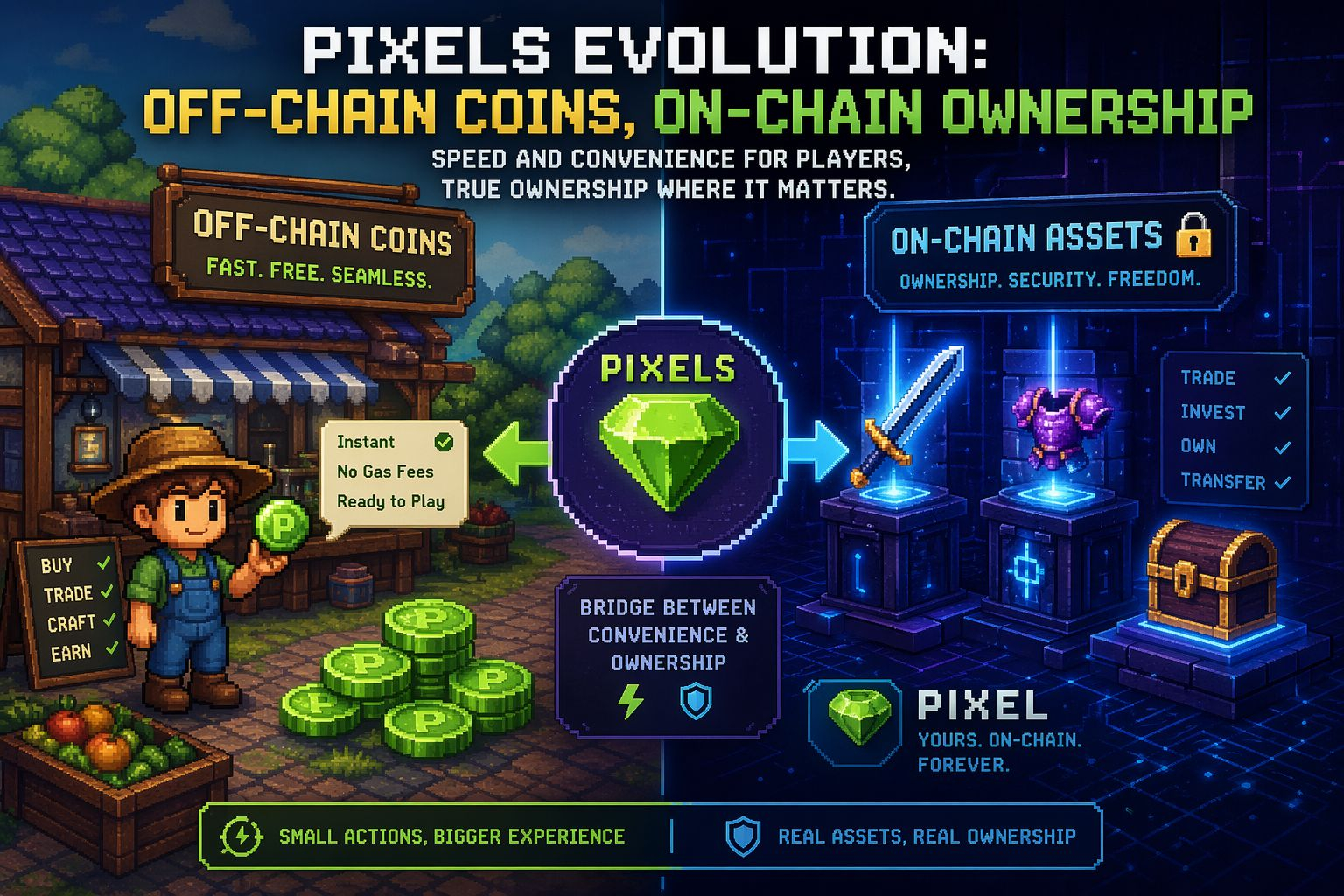
That’s when I went back and actually read the update properly. Pixels had introduced off-chain coins into its economy.
And I’ll be honest, I had to read it twice.
Because if you’ve been around Web3 games long enough, that move feels a little backwards. The whole pitch of games like Pixels — especially with tokens like PIXEL — is ownership. Your assets live on-chain, in your wallet, under your control. That’s the selling point. So why would a project built on that idea start moving part of its economy off-chain?
At first, I didn’t love it.
But after sitting with it for a bit (and actually playing more), I started to see what they were trying to fix.
Every small action on-chain has friction. Gas fees, confirmations, wallet approvals — even if they’re minor, they add up fast in a game loop where you’re constantly interacting. And let’s be real, that kind of friction kills momentum. You stop thinking like a player and start thinking like you’re signing transactions all day.
Off-chain coins remove that entirely. Everything becomes instant. You click, it happens. No fees, no interruptions.
From a gameplay perspective, it’s objectively better.
But here’s the part that kept bothering me — and I think most people are overlooking it.
Ownership quietly changes.
When your PIXEL tokens sit in your wallet, they exist independently of the game. You control them. You can move them, sell them, hold them — no permission needed. But when you’re holding off-chain coins, those balances live entirely on Pixels’ servers.
That’s not the same thing.
It’s closer to how traditional games work. Your gold in an MMO or your in-game currency in a mobile game — it’s there because the developer says it is. You don’t really “own” it in the Web3 sense.
And to be fair, Pixels isn’t the first to do this. They’re just being more explicit about it.
What’s interesting is how they’ve positioned it. Off-chain coins aren’t replacing the on-chain economy — they’re sitting underneath it. Small, routine transactions happen off-chain, while larger assets and meaningful trades still live on-chain.
On paper, that’s a clean hybrid.
But in practice, there’s a subtle shift happening.
The definition of what counts as “routine” versus “significant” isn’t decided by players. It’s decided by the team. And if you’ve spent any time in game economies, you know those boundaries can move over time — usually in ways that benefit retention and revenue more than player control.
I tested this a bit myself.
Instead of moving everything on-chain like I usually would, I left a portion of my earnings sitting off-chain for a few days. Nothing major — just a small buffer I’d normally convert. And yeah, it felt smoother to use. I didn’t have to think about fees or timing.
But at the same time, I caught myself hesitating before letting that balance grow too much.
Because I wasn’t entirely sure what I was holding anymore.
And I think that’s the real takeaway here — not whether off-chain coins are good or bad, but how easily they blur the line between convenience and control.
If conversion between off-chain and on-chain stays simple, transparent, and unrestricted, then this system works. It becomes a usability layer, not a replacement. But if that bridge ever gets tighter — limits, delays, fees — then you’re effectively dealing with two separate economies, one of which you don’t fully own.
That distinction matters more than it seems.
I don’t think Pixels made this change lightly. If anything, it probably saved the game from feeling too slow or expensive for casual players. And honestly, from a gameplay standpoint, it’s a clear upgrade.
But as someone holding PIXEL and actively using the ecosystem, I’m paying a lot more attention now to where my value actually sits.
Because when everything feels seamless, it’s easy to forget what’s happening underneath.
And in Web3, that “underneath” is kind of the whole point.
@Pixels $PIXEL #pixel