
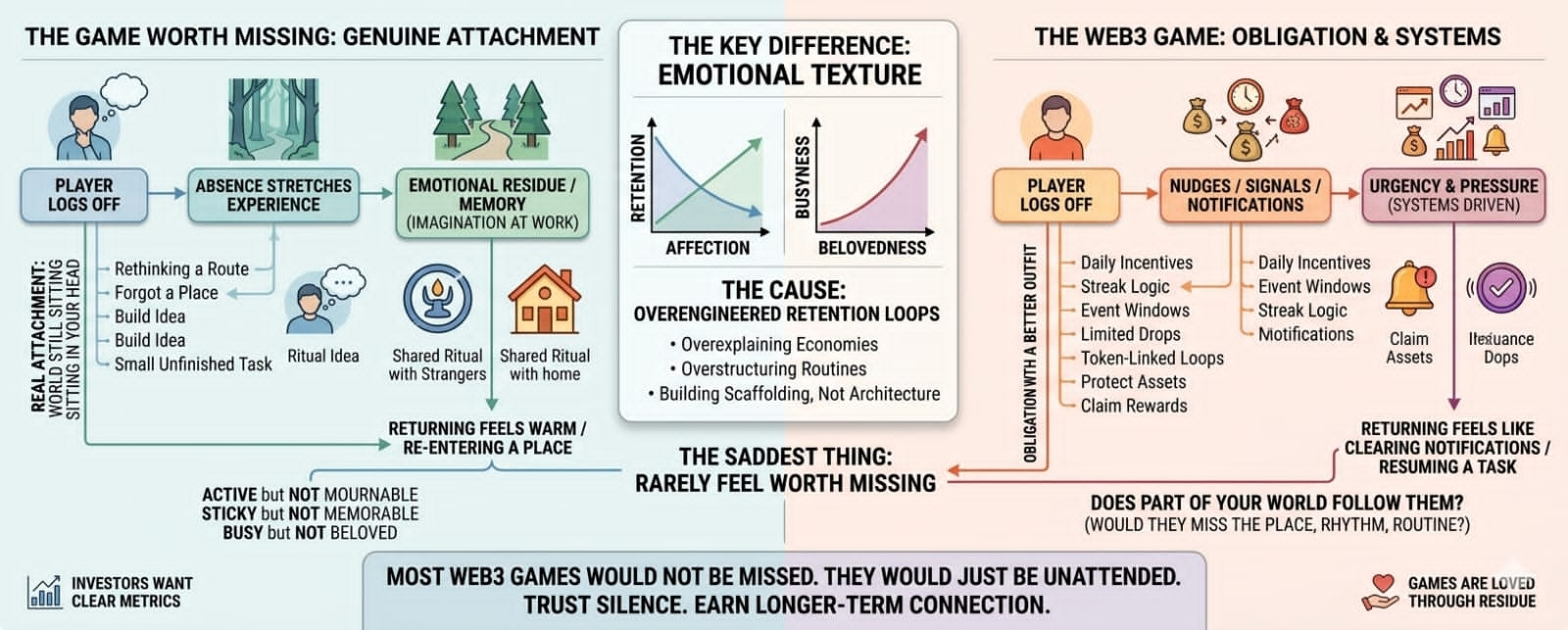
A good game leaves a weird mark on your day. That is probably the cleanest way to say it. You log off, do something else, maybe eat, maybe go outside, maybe pretend to be productive for a while, and then part of your brain drifts back to it anyway. Not because of rewards. Not because of a timer. Just because the world is still sitting there in your head. You think about a route you want to try again. A place you forgot to check. A build idea. A dumb mistake. Some small unfinished thing that keeps scratching at you. That is one of the best signs a game has actually landed. You miss it a little when you are away from it.
Web3 games almost never create that feeling.
They create urgency, sure. They create pressure. They create a reason to log back in because something might be earned, claimed, protected, flipped, maintained, or optimized. But that is not the same as being missed. That is obligation with a better outfit. And honestly, I think this is one of the biggest hidden weaknesses in the whole space. Too many Web3 games are built to keep people checking in, not to keep them caring when they are gone.
That difference matters more than people admit.
Because when a game is actually good, absence does something. It stretches the experience in your mind. It lets imagination do part of the work. You leave, but the game does not fully leave you. It keeps a little emotional residue. Maybe you wonder what your friends are doing in it. Maybe you think about the sound of a place, the rhythm of a task, the mood of a certain area at night. It sounds small. It is not small. That is attachment. Real attachment. The kind that does not need a loud announcement attached to it.
Web3 games keep trying to replace that feeling with systems.
Daily incentives. Streak logic. event windows. limited drops. token-linked loops. all this stuff designed to create return behavior without earning genuine longing. And yes, it can work for a while. People do come back. Numbers can look strong. Activity can stay alive longer than expected. But the emotional texture is different. When a game is worth missing, returning feels warm. When a game trains you through pressure, returning feels like clearing notifications.
That is bleak, but it is true.
A lot of this space has become very good at manufacturing reasons to re-enter and very bad at creating worlds that stay vivid after you close them. That is why so many Web3 games feel louder than they feel deep. They do not trust memory. They do not trust atmosphere. They do not trust the player to form attachment on their own. So they build external reasons to force continuity. Timers. rewards. claims. scarcity. maintenance. everything except that slower, harder thing where a player simply wants to come back because the world has started to matter.
And look, I get why it happens. Longing is hard to design for. It is vague. Messy. Not easy to measure. Investors do not want to hear that your main strategy is making people quietly miss a place. They want clearer metrics. Cleaner language. Retention, monetization, engagement, conversion. All the usual dead terms. But games are not loved through clean language. They are loved through residue. Through the small things that stick when they should not.
A path through a forest. A farming loop before bed. The sound a menu makes. A stupid shared ritual with strangers. A home base that somehow starts feeling like your home base. Those things are hard to put in a deck, but they are often the real reason players stay connected over time. Not because they are constantly inside the game, but because the game keeps echoing a little outside itself.
Web3 gaming seems weirdly impatient with that kind of connection. It wants proof of value too fast. It wants the relationship formalized. Owned. Tracked. Financialized. It wants to know what the player’s presence is worth before it has earned the player’s affection. That pushes design in a colder direction. A more managerial direction. The world becomes something to service instead of something to miss.
And that is when the soul goes thin.
Because the games that matter most usually know how to disappear from your screen without disappearing from your mind. They trust silence. They trust pauses. They trust that a world can stay alive through memory for a while. Web3 games often act terrified of silence. Terrified that if the player is not nudged back immediately, the bond is gone. So they keep poking. Keep signaling. Keep wrapping return in economic logic. It works mechanically, maybe, but it feels needy. Worse than needy. It feels like the game does not believe in itself.
That lack of belief leaks into everything.
You can feel it in the way many projects overexplain their economies, overstructure their routines, overengineer their retention loops. They are scared that simple enjoyment will not be enough, so they build scaffolding around every moment. But scaffolding is not architecture. A game should have enough shape that players carry part of it with them naturally. If it does not, no amount of token utility is going to create that missing emotional layer.
And this is where I think the space keeps misunderstanding what “stickiness” really means. Stickiness is not just frequency. It is not just how often someone returns. It is whether the game leaves an impression strong enough that coming back feels like re-entering something, not just resuming a task. That is a huge difference. One is behavioral. The other is emotional. Web3 gaming has spent a lot of time optimizing the first one while barely respecting the second.
That is why so much of it feels replaceable.
Not because the teams are untalented. Not because the ideas are always bad. But because too few of these games build the kind of inner pull that survives a break. Too few feel like worlds you would genuinely miss if they vanished tomorrow. And that should bother people more than it seems to. Because if your game is active but not mournable, sticky but not memorable, busy but not beloved, then what exactly have you built?
Maybe that is the real standard this space should be chasing. Not whether players can earn inside the game. Not whether assets can move across chains. Not whether the token has enough sinks. Something simpler. Harder, actually. If players stepped away for a week, would any part of your world follow them into real life? Would they miss a place, a rhythm, a routine, a feeling?
Most Web3 games, if we are being honest, would not be missed. They would just be unattended.
And that is a much uglier truth than the industry likes to admit.
