
I found Pixels the way I find a lot of projects now not through a loud announcement but through a quiet suggestion that stayed in the background until I finally opened it. A few years ago I would have treated that kind of visibility as a signal on its own. I used to trust the shine. Now I pay more attention to what is happening underneath. I care less about whether something looks busy and more about whether it can organize real participation without needing constant attention.
Pixels is one of those projects that feels simple at first and then slowly reveals more depth the longer you stay with it. On the surface it is a social casual Web3 game built on Ronin focused on farming exploration and creation. But the way it presents itself goes beyond just being a single game. It positions itself as a space where users can build their own experiences integrate digital assets and carry ownership forward instead of leaving it locked inside a closed system. The idea is that progress and rewards should live on chain rather than disappear when you log out.
That distinction matters because many crypto games end up looking active without actually being alive. A project can have strong visibility and still feel empty when you look closer at who is building who is spending and who is still around after the initial excitement fades. Pixels seems aware of that gap. Its messaging leans more toward collaboration ownership and shared world building rather than pure speculation. The tone suggests it wants to be a place where people do things not just a system where tokens move.
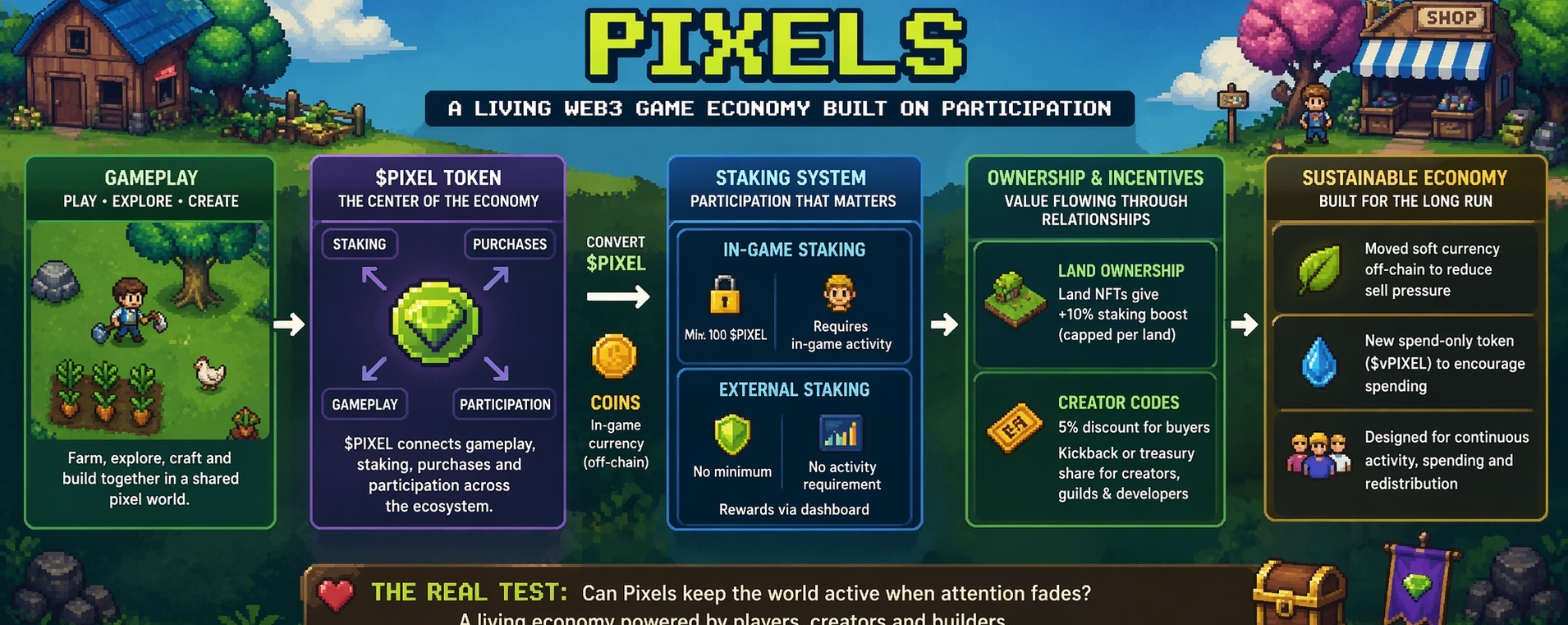
The token plays a central role in that structure. From the project’s own materials PIXEL is not treated as a simple reward or a decorative asset. It connects gameplay staking purchases and participation. Players can convert PIXEL into Coins which function as the in game currency and can also be bought using PIXEL directly inside the game. That shows an attempt to keep the token tied to actual use instead of leaving it floating outside as something only meant for trading.
Staking adds another layer to how the system is designed. There is a clear split between in game staking and external staking. In game staking requires a minimum amount and also depends on being active while external staking has fewer conditions and distributes rewards through a separate dashboard. That separation feels intentional. It draws a line between people who participate and people who simply hold. A healthier system needs both but it should not confuse one for the other. Pixels seems to recognize that holding value is not the same as contributing to the world itself.
Some of the smaller design choices are just as important. Land ownership increases staking power with limits in place and creator codes offer small incentives that reward both the buyer and the creator. These are not just features they are ways of directing value through relationships inside the system. Instead of everything flowing through speculation the structure tries to connect rewards to activity and interaction.
The sustainability side is where things become more delicate. The project has already adjusted parts of its economy by shifting certain currencies off chain to reduce pressure and simplify the system. There are also plans for new tokens that focus on spending rather than holding. These changes show an awareness of how easily value can leak out if everything is designed only around rewards. At the same time it highlights how dependent the system is on continued activity. It needs players to keep showing up spending interacting and creating. Without that movement the structure starts to weaken.
This is where my view settles into something more selective. The strongest signal is not attention or market noise. It is whether people keep finding reasons to stay involved after the initial curiosity fades. Does staking still feel meaningful when expectations calm down. Do creators keep using the tools because they actually benefit from them. Do players builders and holders remain connected or slowly drift apart into separate roles that no longer support each other.
Conviction would come from usage that feels natural rather than forced. A system that people return to because it works for them not because it is temporarily rewarding them. I would want to see the creative layer grow the staking layer stay active and the gameplay remain the core of the experience instead of becoming secondary to the token. Expanding beyond a single loop only matters if the original loop continues to hold people in place.
Caution would come from the opposite direction. A system that constantly needs adjustment or relies too heavily on incentives can lose its balance over time. Activity driven only by rewards tends to fade once those rewards lose their edge. The difference between real engagement and repeated extraction is not obvious at first but it becomes clear later
Pixels is still in that phase where it is proving what it can sustain. It is asking the right questions through its design but it has not fully answered them yet. The real test is whether it can keep the world active when attention is no longer doing the heavy lifting.