
I was not even planning to write about Pixels today… but after checking the loops again this morning, I couldn’t ignore it.
I logged in, did a few farming tasks, nothing crazy and caught myself thinking:
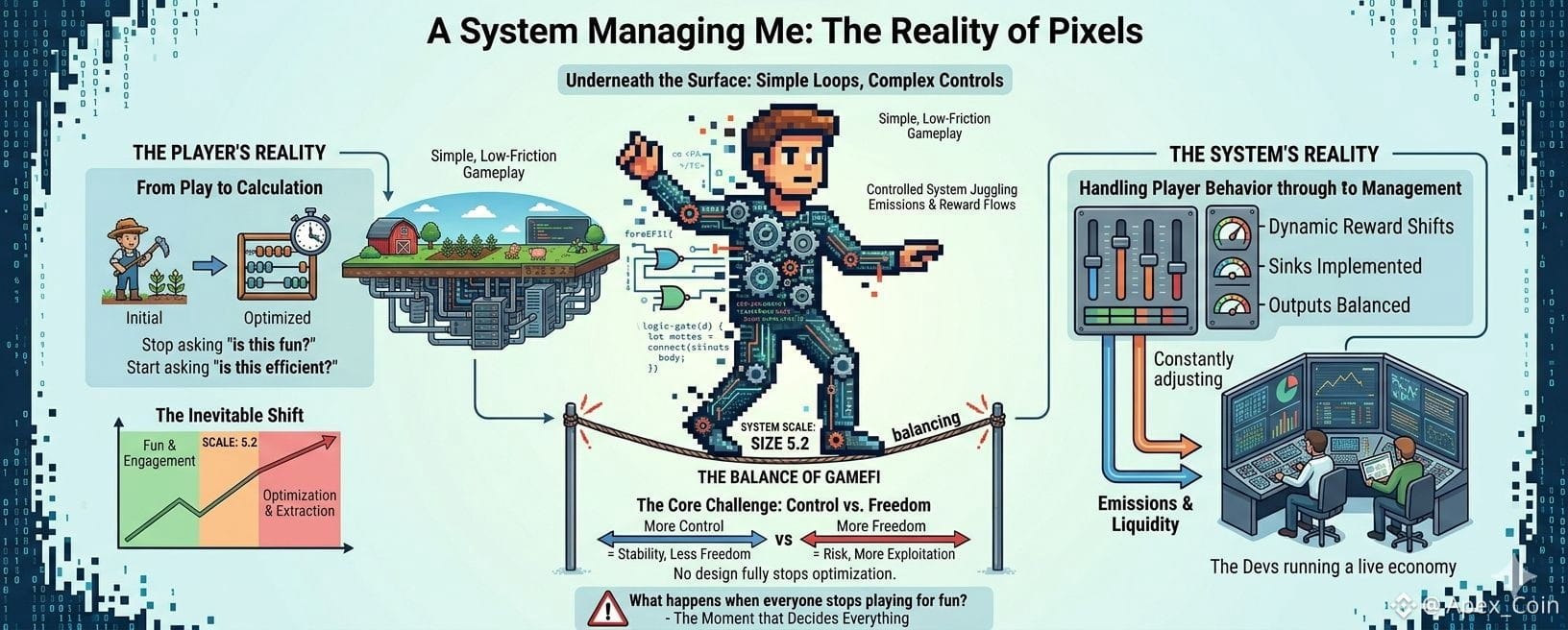
this does not feel like a game loop anymore… it feels like a system managing me.
That’s when it clicked.
Pixels isn’t really trying to fix GameFi with better tech. It’s trying to handle player behavior.
Because let’s be honest every reward system gets optimized. Always. You give players incentives, they don’t just play… they calculate. I have done it myself. You stop asking “is this fun?” and start asking “is this efficient?” That shift happens quietly, but once it does, the whole vibe changes.
Pixels knows this.
Instead of pretending it can stop that behavior, it keeps adjusting around it. Rewards shift. sinks get introduced. outputs get balanced. It’s not a one-time design it is ongoing management. Almost like the devs are running a live economy and we’re all part of the experiment whether we realize it or not.
And honestly… that’s both impressive and a bit uncomfortable.
What really stands out to me isn’t even the gameplay. It is what’s happening underneath.
On the surface, everything feels simple. Clean loops, easy actions, low friction. But behind that? There’s a tightly controlled system juggling emissions, liquidity, and reward flows. That separation is smart it hides the complexity from players.
But it also makes the whole thing fragile.
The more layers you stack cross device syncing, dynamic rewards, constant balancing the more chances things have to break or drift out of sync. Scaling isn’t just
“more players = more success.”
It’s keeping everything aligned when pressure builds… and that’s where most systems start cracking.
And people don’t talk enough about the infrastructure side.
When I see thousands of players interacting in real time, I’m not thinking about tokens I’m thinking about uptime, lag, data consistency. Because if those fail, the “economy” doesn’t even matter. Hybrid Web2-Web3 setups make onboarding smooth, sure… but they come with hidden headaches. Sync issues, fallback systems, delays you don’t notice them early, but at scale? They hit.
Hard.
Then there’s the market side of it, which I think Pixels handles better than most.
It doesn’t pretend stability exists. It reacts. Rewards get adjusted, liquidity shifts, emissions get controlled. That’s already a step ahead of older GameFi models that just… collapsed.
But here’s the catch: reaction takes time.
And markets don’t wait.
That gap between “what’s happening” and “system adjustment” is where smart players move. I’ve seen it before even small delays create opportunities. So sustainability here isn’t about avoiding chaos… it’s about surviving it longer than others.
Now the part that really stuck with me
Pixels is constantly balancing control vs freedom.
To keep things stable, it needs control. It has to manage rewards, regulate flow, keep the system in check. But at the same time, it wants to feel player-driven. Open. Decentralized.
Those two don’t fully work together.
More control = more stability, less freedom
More freedom = more risk, more exploitation
There’s no perfect balance. Just constant adjustment.
And that’s why I don’t see Pixels as a “solved” GameFi model.
I see it as something trying to hold the line.
Because the real problem hasn’t changed. At small scale, everything looks fine. At large scale? Players optimize. Speculation creeps in. And slowly… the game becomes less about playing and more about extracting.
No design fully stops that. Not even this one.
Pixels just slows it down. Adapts. Responds.
So yeah… it’s well designed. No doubt.
But the real question I keep coming back to is simple:
What happens when everyone stops playing for fun?
That’s the moment that decides everything.#pixel @Pixels $PIXEL