
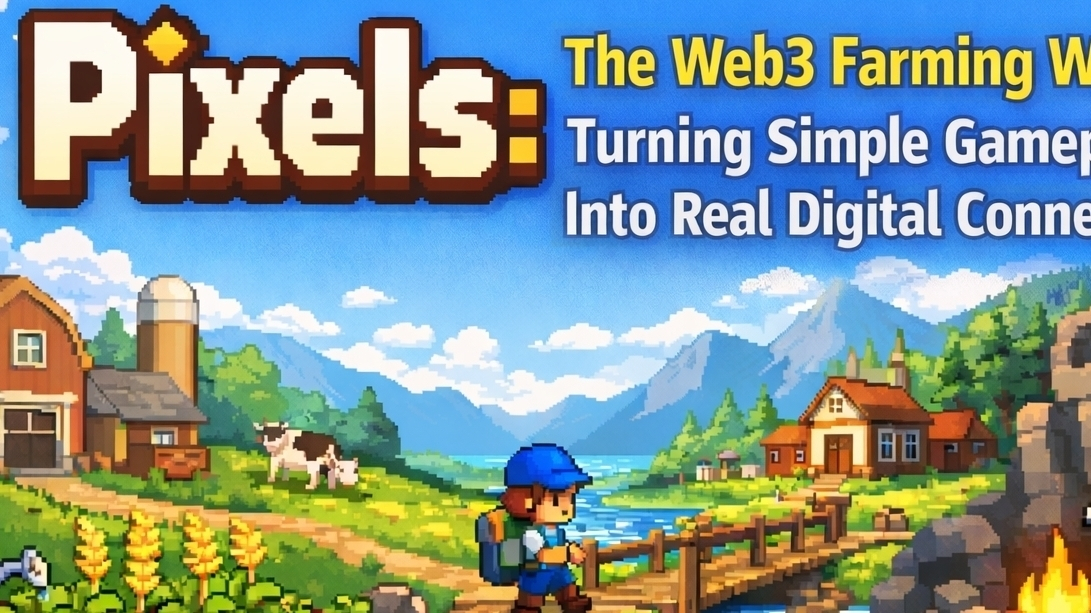
I didn’t walk into Pixels expecting to question anything about the real world. At first glance, it looked like a familiar loop plant crops, gather resources, build something small, repeat. The kind of experience that usually sits somewhere between relaxation and mild distraction. But the longer I stayed, the more I realized that Pixels isn’t just simulating a world it’s quietly experimenting with how we assign value, how we spend time, and what ownership really means when it’s no longer tied to physical reality.
What makes Pixels different isn’t just that it runs on blockchain infrastructure like the Ronin Network. That’s the surface layer, the part that gets mentioned in pitch decks and headlines. What’s more interesting is how that infrastructure changes player behavior in subtle ways. When I plant something in Pixels, it’s not just a mechanic it’s an action that can carry economic weight. The crops, the items, even the land itself can become assets. And once that shift happens, the psychology of play changes too. I’m no longer just playing for progress; I’m making decisions that feel closer to investment, even if the stakes are small.
This is where Pixels begins to blur lines that most games keep firmly separated. Traditional games give you a closed economy everything you earn stays inside. Pixels, like many Web3 experiments, opens that loop. Assets can move beyond the game, and that creates a strange tension between fun and financialization. I found myself asking questions I never ask in regular games: Is this activity worth my time in a measurable sense? Should I hold this resource or trade it? Am I playing, or am I optimizing?
Some players thrive in this environment. They treat Pixels like a micro-economy, studying trends, maximizing efficiency, and extracting value wherever possible. In a way, it mirrors real-world gig economies, where time is constantly evaluated against potential returns. There’s a certain brilliance in that design it reflects how people already think outside games. But it also raises a deeper concern: when every action can be monetized, does play lose its innocence?
Experts in game design have long argued that the magic of games comes from “meaningless meaning” actions that feel important within the game but don’t carry real-world consequences. Pixels challenges that idea. By attaching real value to in-game actions, it replaces “meaningless meaning” with something closer to “meaningful pressure.” And pressure changes how we behave. It can make the experience more engaging, but it can also make it more exhausting.
At the same time, there’s something undeniably empowering about owning what you create. In traditional games, I’ve spent countless hours building things that ultimately belong to the developer. When the servers shut down, everything disappears. Pixels offers a different promise: persistence beyond the platform. Ownership isn’t just a concept; it’s encoded into the system. That idea alone has massive implications, not just for gaming but for digital culture as a whole.
But ownership in Web3 isn’t as simple as it sounds. Just because something is technically owned doesn’t mean it holds lasting value. Markets fluctuate, attention shifts, and what feels valuable today can become irrelevant tomorrow. I’ve seen items in Pixels rise in demand and then quietly fade into obscurity. It’s a reminder that value in digital spaces is still driven by human perception, not just technology.
There’s also the question of accessibility. While Pixels presents itself as a casual, social game, the underlying systems can be complex. Wallets, tokens, transaction fees these are not concepts that most casual players are comfortable with. The onboarding process can feel like learning a new language before you even start playing. This creates a subtle barrier, one that separates those who are already familiar with Web3 from those who are not.
Interestingly, Pixels tries to soften that barrier through its design. The world is intentionally simple, almost nostalgic. The pixel art, the farming mechanics, the social interactions they all create a sense of familiarity. It’s as if the game is saying, “Don’t worry about the complexity underneath; just start here.” And for a while, that works. I found myself forgetting about the blockchain aspect entirely, just enjoying the rhythm of planting and exploring. But eventually, the underlying systems resurface, and I’m reminded that this isn’t just a game it’s an ecosystem.
What fascinates me most is how Pixels reflects broader shifts in how we think about work and leisure. In a traditional sense, games are an escape from productivity. But in Pixels, productivity becomes part of the game itself. The time I spend farming or crafting can translate into something tangible. It’s a subtle but powerful shift, one that aligns with the growing trend of “play-to-earn” models.
However, this model is not without criticism. Some analysts argue that play-to earn systems risk turning games into labor platforms, where enjoyment becomes secondary to profit. I can see that perspective. There were moments in Pixels where I caught myself optimizing my actions instead of enjoying them. The game started to feel less like a world to explore and more like a system to navigate.
Yet, it’s not entirely fair to reduce Pixels to that critique. There’s still genuine creativity and community within the game. Players build, collaborate, and share experiences in ways that go beyond pure economics. I’ve seen people create spaces that feel personal, almost like digital homes. That aspect reminds me that even in a system driven by value, human expression still finds a way to emerge.
Real-world parallels make this even more interesting. In many ways, Pixels mirrors the evolution of digital platforms like social media, where users create value but don’t always control it. Web3 games attempt to shift that balance, giving users more ownership and agency. But with that agency comes responsibility and risk. Not everyone wants to think about markets and assets while playing a game.
As I spent more time in Pixels, I realized that the game isn’t trying to provide answers. It’s posing questions. What does it mean to own something in a digital world? How do we value our time when it can be quantified so easily? Can a game be both fun and financially meaningful without compromising either?
I don’t think Pixels has fully solved these questions, and maybe that’s the point. It
