
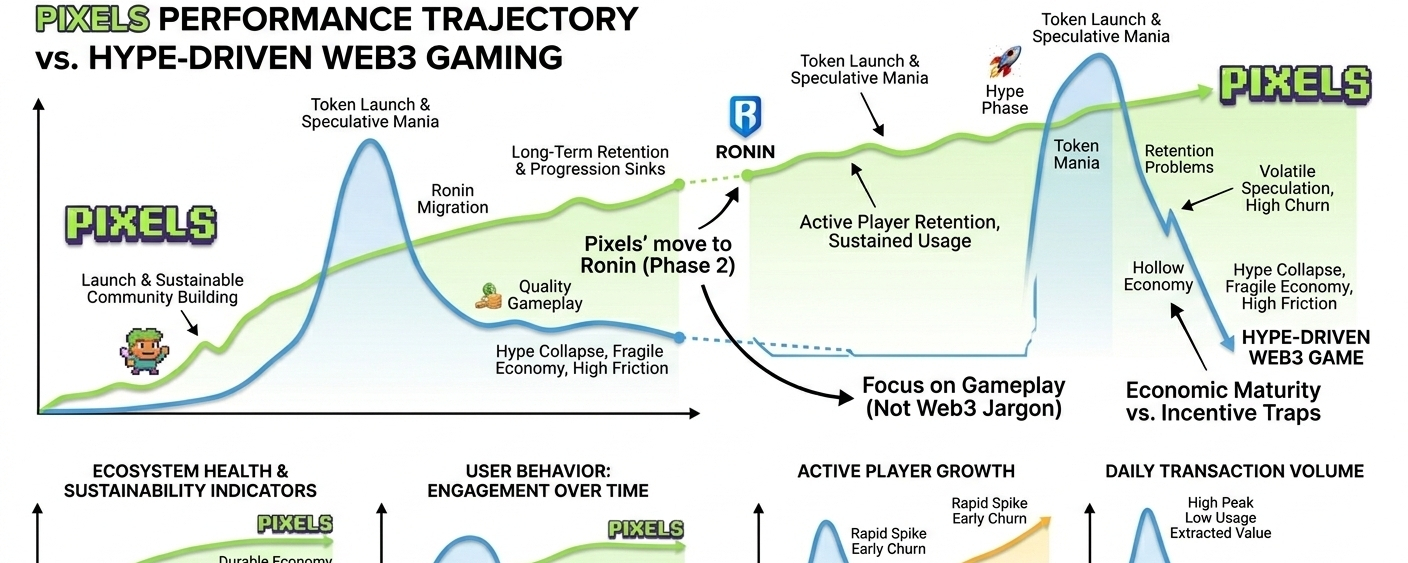
I’ve been watching Pixels for a while, mostly because it sits right on top of a pattern I’ve seen repeat across Web3 systems for years.
The pitch for blockchain gaming is always neat on paper. Ownership. Open economies. Player-controlled assets. Interoperability. Same language, same confidence, same promise that this time the model will hold. Then the product shows up and the usual cracks appear. Gameplay is shallow. Economies are brittle. Infrastructure does all the talking while the actual user experience absorbs the damage. I’ve seen this fail more than once.
That is why Pixels stood out to me.
Not because it solved the category. It hasn’t. But because it did not immediately feel like another case of infrastructure cosplay wearing a game-shaped mask. It felt closer to a game first, and in this sector that still counts as a meaningful step forward.
At the surface level, Pixels is easy to understand. Farming. Gathering. Crafting. Shared-world movement. Familiar pixel-art aesthetics. Nothing about that is especially radical, and that is part of the reason it works. The team did not begin by forcing users to care about wallets, bridges, or token abstractions before giving them a reason to care about the world itself. They started with something legible. Something approachable. More Web3 teams should have learned that lesson years ago.
I tend to look at products like this from the infrastructure side first, because that is usually where the real constraints live. Growth can hide a lot for a while. Infrastructure cannot. Infrastructure is what decides whether a live system remains usable once activity arrives, or whether every increase in traction gets converted into latency, friction, support burden, and operational noise.
That is one reason the move to Ronin mattered.
On paper, a chain migration looks like a back-end detail. In practice, it changes the operating conditions of the entire product. Transaction costs change. User flow changes. Onboarding changes. Asset movement changes. Support patterns change. Ecosystem fit changes. These are not cosmetic details. They shape the product whether players understand the underlying stack or not.
And yes, I know how teams like to frame these moves. Seamless. Scalable. Gaming-native. Optimized. Most of that language is useless. The reality is messier. What teams are really asking is whether the platform can support a live game without making ordinary user behavior feel expensive, fragile, or operationally annoying.
For Pixels, Ronin made sense because the network already had a gaming-native center of gravity. That matters more than most infrastructure conversations admit. A platform is not just a technical environment. It is a behavioral one. A chain with the right audience can absorb complexity that would kill adoption elsewhere. A chain with the wrong audience can make even a decent product feel misaligned.
Pixels benefited from that alignment.
Still, that was never the hard part. It just gave the project a better environment in which to run into its real problems.
And the real problems were always economic.
This is where I get skeptical fast. I’ve spent enough time around incentive systems to know how often they get mistaken for product-market fit. Reward loops can generate traffic. Tokens can generate urgency. Airdrops can generate narrative momentum. None of that guarantees durable usage. In a lot of cases, it teaches users to behave in ways that look healthy on a dashboard and collapse the moment the reward conditions change.
I’ve seen this fail. Repeatedly.
Pixels rode that wave better than most. The token launch, the surrounding attention, the growth spike — all of that pushed the project into a wider conversation. Fine. That part worked. But tokenized systems are easy to overread. The minute money enters the loop, every metric deserves more suspicion. Daily activity matters. Volume matters. Participation curves matter. But if you do not understand why users are present, then you are mostly staring at instrumentation and pretending it explains system health.
That is why Pixels became more interesting to me after the hype cycle cooled down.
The loud phase tells you very little. The quieter phase tells you what is actually holding the system together. Once the reward energy drops, the real questions start to matter. Are there enough sinks in the economy? Is progression coherent? Do social patterns survive without artificial pressure? Can the world keep people engaged without constantly bribing them to stay?
Those are not glamorous questions. They are systems questions. They are the ones that determine whether a live economy matures or gets hollowed out by extraction.
To Pixels’ credit, the project seems to understand at least part of that. Its more recent direction looks like an attempt to move away from the cruder version of play-to-earn design and toward something more stable: clearer progression, more deliberate utility, better economic flow, stronger reasons for players to remain in the system that are not purely financial.
That is the right direction.
Whether it is enough is a separate question.
I do not think most blockchain games fail because the technology is useless. I think they fail because teams keep treating infrastructure as if it can compensate for weak product judgment. It cannot. Better rails help. Lower fees help. Better throughput helps. More portable identity and asset ownership may help. Useful tools, all of it. But none of it makes a bad game good, and none of it repairs a broken economy once player incentives turn adversarial to the health of the world.
That is the real design burden in tokenized systems. The minute an in-game asset has market value, every design decision picks up economic weight. A crop is no longer just a crop. A material is no longer just a material. Time itself stops being neutral. It gets financialized. You are no longer balancing progression alone. You are balancing extraction pressure, speculation, behavioral distortion, market expectations, and player psychology at the same time.
It’s a mess.
Sometimes it is a manageable mess. Still a mess.
Pixels has not escaped that problem. No project has. What it has done better than many of its peers is avoid making the economy the only reason the product exists. That sounds like a low bar. It is a low bar. This sector earned that low bar.
I also think Pixels matters because of what it represents inside the Ronin ecosystem.
Infrastructure platforms love to talk about ecosystems as though they can be declared into existence with enough partner announcements and enough logo slides. They cannot. An ecosystem is not a deck. It is not a branding exercise. It is a set of working systems that reduce failure modes for builders instead of multiplying them. It attracts teams because the environment is usable, the incentives are coherent, and the operational burden is survivable.
That is a much higher standard.
For Ronin, Pixels helped show that the network could support more than one dominant narrative. That is healthy. A platform tied forever to a single breakout success starts to look fragile very quickly, especially in gaming, where attention is cyclical and loyalty is conditional. You do not want an ecosystem that depends on one story continuing forever.
From a systems perspective, I do not see Pixels as a final form. I see it as a live stress test with better-than-average design instincts.
That is useful.
It shows what can happen when a project starts with a softer user experience, plugs into infrastructure that is at least directionally aligned with the product, and then tries to mature its economy before the usual incentive traps consume it. That is not a solved model. I would not even call it stable yet. But it is more grounded than the first wave of Web3 gaming ever was.
I am still cautious. Early traction does not prove durability. Token activity does not explain user intent. Ownership alone was never the magic ingredient the sector claimed it was. Most users do not wake up wanting sovereign asset architecture. They want a product that works. They want a world that feels alive. They want a reason to come back tomorrow that does not feel like a financial obligation.
Pixels gets closer to that than many of its competitors. That is why I keep watching it.
Not because it confirms the old hype cycle. Because it pushes against it.
There may still be a version of blockchain gaming that works. If it happens, I doubt it will come from inflated language, token engineering, or infrastructure theater alone. It will come from teams that respect infrastructure, reduce friction, keep the system legible, and understand that user trust disappears the moment the economy becomes more interesting than the experience.
Pixels is not fully there.
But it is one of the few projects that seems to understand that getting there is the real job. #pixel $PIXEL
