
Sometimes the clearest sign that a digital world is weak is not that people leave. It is that they stay without forming any real attachment to it.
That has been one of the quiet problems inside crypto gaming for a long time. A project can keep users moving through tasks, collecting rewards, and showing daily activity, yet still fail to become a place that matters to them. The behavior remains, but the bond does not. This is why many Web3 games have often felt strangely temporary even while their communities looked busy. Players were present, but often only in the narrowest possible way. They arrived to complete a function, not to dwell, explore, or care. That difference may sound abstract, but it explains far more than token charts or user counts ever could.
This is the wider problem that makes @Pixels worth looking at with some seriousness. The project is often placed inside the usual crypto gaming conversation, but that framing can miss what is actually interesting about it. The more important issue around $PIXEL is not whether incentives can attract people. That is the easiest part. Almost any project can attract short-term attention if the reward structure is visible enough. The more difficult question is whether incentives can be arranged in a way that does not flatten the entire experience into routine extraction. That appears to be one of the central tensions that Pixels and its Stacked ecosystem are trying to engage with.
Before systems like this began appearing, many crypto games operated with a kind of false simplicity. They assumed that if users were given property rights, token exposure, and repeatable tasks, stronger communities would naturally emerge. But that assumption often failed because it confused access with belonging. Ownership does not automatically create attachment. Rewards do not automatically create meaning. Repetition does not automatically create habit in a healthy sense. Often it creates dependence, or at least a narrow form of participation that disappears when the immediate incentive weakens.
Older solutions did try to address these failures, but often in ways that remained trapped inside the same logic. Projects added anti-bot measures, more sinks, more layers of progression, more complex reward formulas, or tighter restrictions on movement and claiming. These interventions were meant to defend the ecosystem, but they rarely changed the basic relationship between player and platform. The user was still being taught, above all else, to ask one question: what is the most efficient thing I can do here today? Once that mindset becomes dominant, even a beautifully designed system starts to feel thin. The game becomes less a world than a sequence of optimizations.
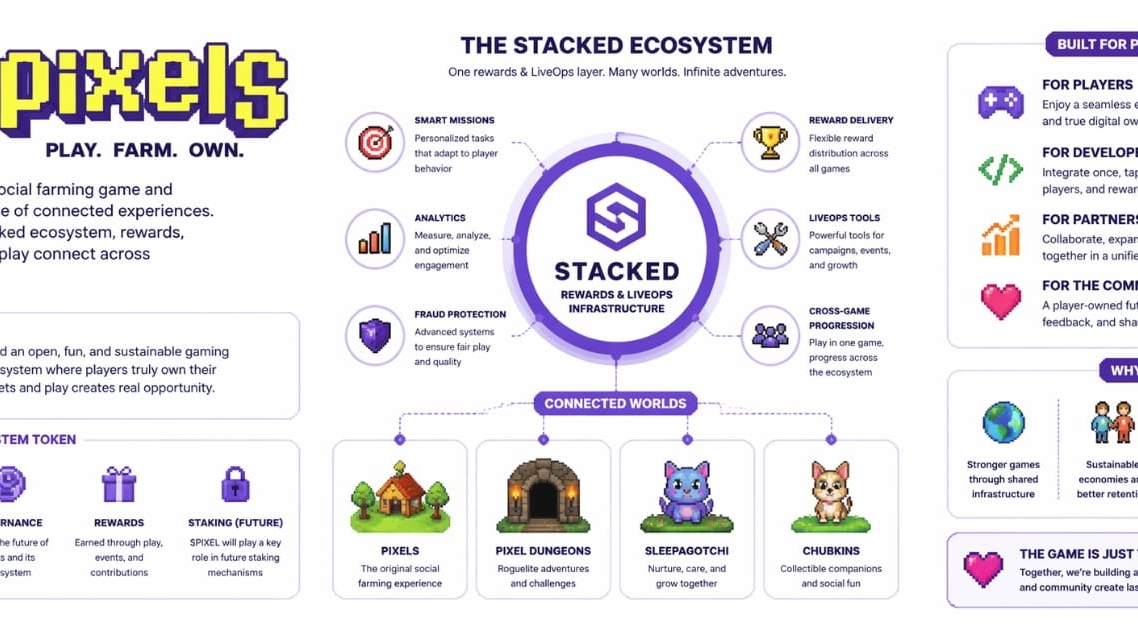
What seems notable about the Stacked ecosystem is that it shifts attention away from the visible reward and toward the architecture behind the reward. That is a more mature place to focus. Instead of treating rewards as occasional events or promotional hooks, the approach appears to treat them as infrastructure that can be calibrated across multiple experiences. In practical terms, that means the project is not only thinking about what users receive, but also when they receive it, under what conditions, and in connection with which behaviors across a wider network of games.
That matters because broad, one-size-fits-all reward systems have usually been part of the problem. They are simple to launch, but they tend to reward all activity as if it were equally valuable. A deeply engaged user and a purely extractive user can end up looking nearly the same to the system if both complete the right actions. Once that happens, the platform begins paying for motion rather than for commitment. It is an expensive mistake, and one that much of Web3 gaming has repeated.
If @Pixels is trying to move past that, then the real subject is not generosity but judgment. A reward system is always making judgments, whether openly or not. It decides which actions count, which users matter most, which rhythms should be encouraged, and what kind of participation the ecosystem wants to reproduce. The Stacked model suggests an attempt to make those judgments more deliberate and more connected across titles. That could help reduce wasteful incentives and create a more coherent path for users who move through the broader ecosystem. It could also help smaller connected experiences survive by linking them to a shared engagement framework rather than forcing each one to build its own separate reward gravity from nothing.
Still, there is a serious trade-off here. The more intelligent a reward system becomes, the less visible its logic may be to ordinary participants. A player can feel that the environment is guiding them without fully understanding how or why. One user may see better missions, more relevant incentives, or stronger progression opportunities, while another may experience a flatter version of the same ecosystem. From the operator’s perspective, this may be smart design. From the player’s perspective, it can introduce uncertainty. In crypto environments, where suspicion already runs high, that uncertainty is not a small issue. It touches trust, fairness, and the legitimacy of the system itself.
There is another uncomfortable point worth making. Systems built to improve retention and optimize engagement often claim to serve players, but they may serve managers, studios, and ecosystem planners even more. Better LiveOps, better targeting, better reward efficiency, and better fraud control are all useful outcomes. But those are also forms of institutional power. They allow the people running the ecosystem to shape behavior with greater precision. Sometimes that is necessary. Sometimes it is beneficial. But it also means that “better design” can quietly become “more controlled design.” That is not automatically harmful, yet it deserves scrutiny rather than applause.
Who benefits most from this kind of model, then? Dedicated users may benefit if the system becomes more stable and less flooded by low-quality farming behavior. Partner studios may benefit from shared infrastructure that helps them handle rewards and user retention more effectively. The ecosystem itself may benefit from being less wasteful and less chaotic. But some users may also be left at the edges. Casual players, inconsistent participants, or people who do not fit the preferred engagement pattern may find that the system has less room for them. That exclusion may not be intentional. It may simply be a consequence of designing around what can be measured and optimized most easily.
This is why @Pixels is more interesting as a test of judgment than as a story of growth. The project seems to be asking whether crypto gaming can become more durable by becoming more selective, more interconnected, and more operationally aware. That is a serious experiment. But it also risks producing a world where participation is increasingly shaped by invisible decision-making systems rather than by the simple pleasure of being there. If that happens, the ecosystem may become more stable while also becoming less spontaneous.
Perhaps that is the real tension inside the future of $PIXEL and the wider #pixel ecosystem. Maybe the challenge is not to make incentives stronger, but to stop them from becoming the entire emotional center of the experience. A good reward system should support a world without replacing the reasons people might care about that world in the first place.
So the more useful question may not be whether Pixels can build a smarter crypto gaming ecosystem. The more useful question is whether an ecosystem can become highly skilled at organizing participation without slowly teaching its users to mistake guidance for genuine belonging.