
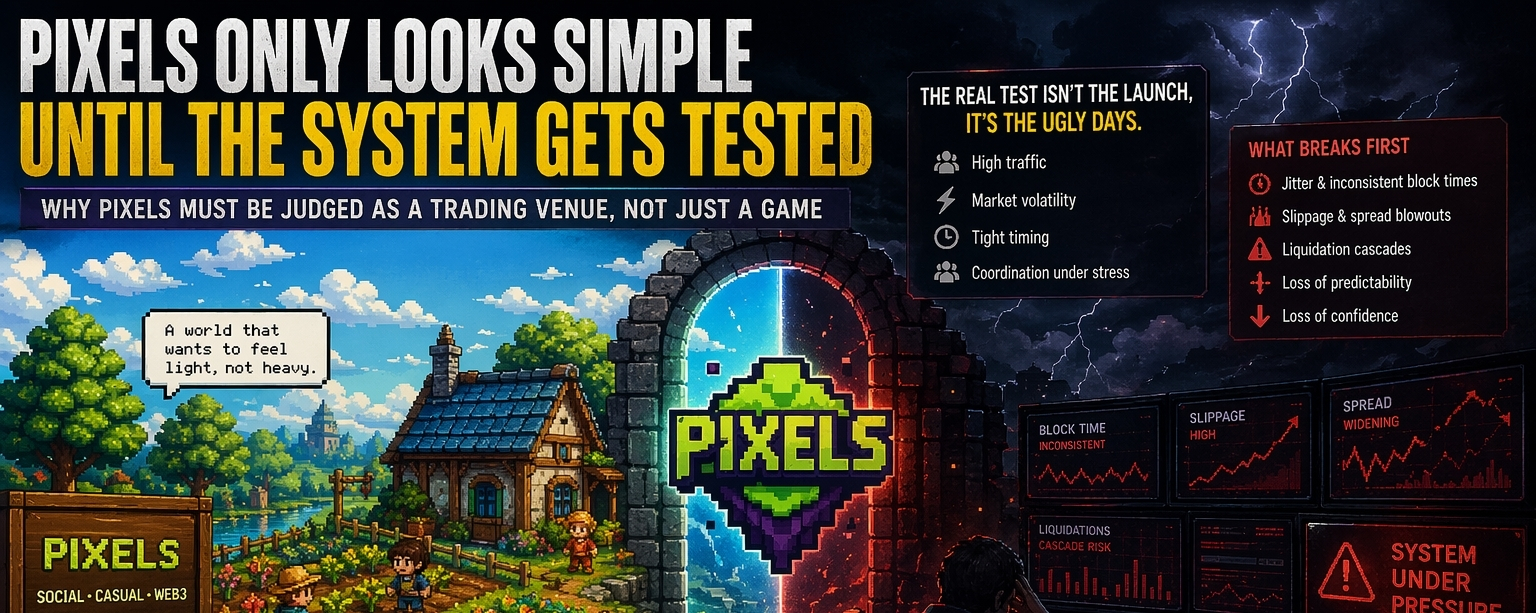
I’m waiting for the part that usually matters more than the launch. I’m watching how Pixels behaves when attention turns into pressure, when the easy days are gone, when the room gets crowded and the mood changes. I’m looking past the surface story, because I’ve learned that the real test is never the first impression. I focus on what holds up when timing gets messy, when coordination gets harder, and when a system has to stay useful without getting dramatic about it.
Pixels is easy to describe in a friendly way. A social casual Web3 game built around farming, exploration, and creation. It presents itself as something soft, something accessible, something that doesn’t try to overwhelm you. That framing works, especially early on. It lowers the barrier to entry. It creates a sense of calm. But that description, while accurate, misses the more important layer.
Because over time, systems like this stop being just experiences. They become venues.
Not in the traditional trading sense, but in how people depend on them. Actions begin to matter more. Timing becomes relevant. Outcomes start to carry weight. And once that shift happens, the expectations change quietly but completely. People stop asking whether it’s enjoyable and start noticing whether it’s reliable.
That’s where most projects get exposed.
The average case always looks fine. When activity is low and coordination is easy, almost any system can feel smooth. Latency looks manageable. Actions feel predictable. Nothing feels urgent enough to break. But that environment is misleading. It flatters the system. It hides the edges.
Stress removes that illusion.
When usage spikes, when more users act at once, when timing becomes tighter, small inefficiencies stop being small. Variance increases. Jitter becomes visible. Actions that used to land cleanly start arriving unevenly. And once that inconsistency enters the experience, users begin to feel it immediately.
This is why average speed is not the metric that matters. Predictability is.
A system can be fast and still fail its users if the variance is too high. If response times fluctuate too much, if block timing becomes inconsistent, if outcomes feel slightly random, then the system stops being something people can plan around. And once that happens, confidence begins to erode—not through one major failure, but through repeated minor uncertainties.
Those uncertainties compound.
Slippage is one form of that. Not just in the trading sense, but in how expected outcomes drift from actual results. Spread widening is another. It reflects how well the system absorbs pressure. If spreads blow out under stress, it signals fragility. And in more extreme cases, you start to see cascading effects—where one failure or delay triggers another, amplifying the instability instead of containing it.
That’s the real test. Not whether the system works, but whether it continues to work cleanly when conditions are no longer controlled.
Pixels, like many Web3 systems, also operates within a tension that is easy to ignore at first. Openness versus control. On one side, there’s the desire to remain accessible, decentralized, and permissionless. On the other, there’s the need to maintain quality, usability, and consistency.
Curation sits right in the middle of that tension.
Used carefully, it improves the experience. It filters noise. It keeps things manageable. But it also introduces subjectivity. And subjectivity, over time, can shift perception. What starts as quality control can begin to look like preference. What feels neutral can begin to feel guided.
That shift is subtle, but once it happens, it’s hard to reverse.
Trust doesn’t disappear immediately. It weakens gradually. Users start questioning decisions. They start wondering whether outcomes are shaped by rules or by discretion. And once that doubt exists, every future decision carries extra weight.
If the system involves validator coordination or any form of managed participation, the pressure increases further. Because in these setups, performance is not just about capability—it’s about the weakest link.
Laggards define the ceiling.
It doesn’t matter how strong the best participants are if the slowest ones introduce delay or inconsistency. Users don’t experience the average—they experience the limit. They feel hesitation. They notice when finality takes longer than expected. They adjust their behavior around those inconsistencies.
Improving that ceiling requires action. But action carries risk.
Removing underperforming participants can strengthen the system technically. But if those decisions feel selective or convenient, they introduce a different kind of instability—social instability. The system begins to look curated not just for performance, but for alignment. And that perception shifts the entire narrative from engineering to governance.
Once that line is crossed, every change must justify itself twice.
Some systems try to manage these challenges through structural design. Geographic distribution, regional zones, rotating responsibilities. These ideas can help spread load and reduce pressure points. They can improve consistency if implemented with discipline.
But they also increase complexity.
Coordination becomes harder. Operational costs rise. Timing across regions must stay aligned. And the system becomes more dependent on routine execution. Not innovation, not clever design—routine.
Because routine is what prevents complexity from turning into chaos.
If a system only works when everything is carefully managed, then management itself becomes part of the product. And that’s not necessarily a problem, but it must be acknowledged. A system that depends on coordination must prove that coordination is reliable, not fragile.
Otherwise, it behaves less like infrastructure and more like an ongoing negotiation.
The same logic applies to performance optimizations at the client level. A fast, well-designed client can improve responsiveness and reduce friction. It can make the system feel better to use. But it doesn’t solve deeper issues.
If the underlying system lacks consistency, the client only hides it temporarily.
Worse, it can create dependency. If too much of the experience relies on a single optimized pathway, then the system becomes less resilient. Diversity decreases. Flexibility disappears. And what looked like an advantage becomes a concentration of risk.
The same pattern repeats in user experience enhancements. Features like sessions, sponsored transactions, or simplified onboarding flows reduce friction significantly. They make the system more approachable. They remove unnecessary complexity.
But they also centralize certain functions.
And centralized functions behave differently under stress.
If a session fails, the user is blocked. If sponsorship is withdrawn, the cost structure changes instantly. If a supporting service goes down, the experience breaks in a way that users cannot easily work around. Convenience is valuable, but it introduces hidden dependencies. And those dependencies only become visible when something goes wrong.
That’s why the real evaluation cannot happen during normal conditions.
It has to happen when the system is under pressure. When activity spikes. When coordination becomes harder. When users expect precision, not tolerance. Those moments reveal whether the system is truly reliable or just temporarily stable.
Pixels has a natural advantage in how it presents itself. It doesn’t overpromise. It doesn’t rely on aggressive narratives. It grows quietly. That gives it room to build without constant scrutiny.
But that same quietness raises the bar.
Because when the pressure eventually arrives, there’s no narrative to hide behind. Only behavior.
If the system remains consistent, trust builds. Slowly, steadily. Users stop questioning it. They rely on it without thinking. That’s the strongest position any system can reach.
If it becomes inconsistent, even slightly, the effect spreads.
Users hesitate. Activity slows. Confidence weakens. And once that process begins, it is difficult to reverse. Not because the system stops working, but because it stops feeling dependable.
Success in this context does not look dramatic. It looks uneventful. The system behaves the same way every day, regardless of conditions. Variance stays low. Timing remains predictable. Users don’t notice the infrastructure because it doesn’t demand attention.
Failure looks different. It doesn’t happen all at once. It builds through small inconsistencies. Through decisions that feel selective. Through performance that feels uneven. Through moments where the system behaves differently under pressure than it does in calm conditions.
Eventually, the perception shifts.
Curation starts to look like a closed circle. Governance starts to feel like influence. Speed loses its value because it cannot be trusted. And liquidity—whether social, economic, or behavioral—stops compounding because the environment no longer feels stable.
And once that shift happens, the system doesn’t collapse instantly.
It just stops being a place people rely on.