
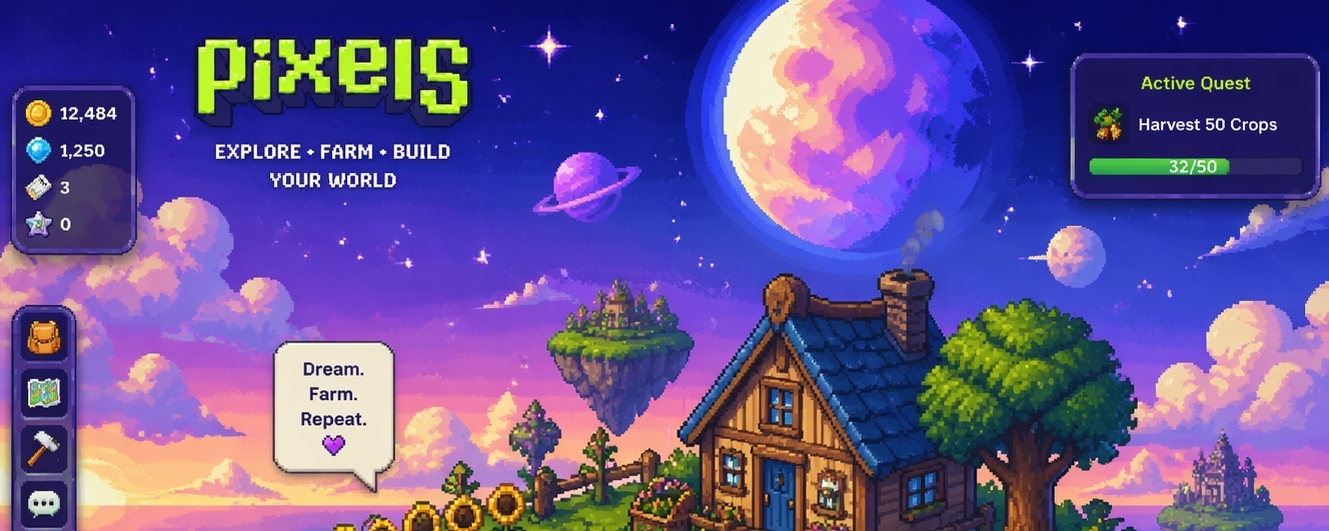

I’m not gonna lie.... Pixels gives me lucid dreaming vibes more than most people realize. On the surface, it looks like a farming game..plant crops, gather resources, upgrade land, repeat. Pretty simple, right? But once you actually spend time inside it, the experience feels deeper. You know it’s a virtual world, you know the land and crops are digital, yet your brain still locks in like the progress matters. That’s exactly why I call it dream farming. It feels like stepping into a space that isn’t real, while still caring about every move you make inside it.$PIXEL
I noticed this myself during a session recently. I opened the game just to do a quick harvest and maybe check some tasks. That was the plan. Twenty minutes later, I was optimizing crop placement, comparing resource values, checking player movement, and thinking about what route would be most efficient next. That shift happens fast. You enter casually, then suddenly your focus is fully inside the world 😅 ...That’s similar to lucid dreaming, where you know you’re dreaming but still choose to explore because the environment responds to you.
That’s the key difference between watching a game and living in one. Pixels lets players shape outcomes instead of following a fixed script. Some days I’m in full grind mode collecting materials. Other days I’m slower, just checking prices, watching what other players are doing, and deciding if I should hold resources or sell them. Even that mindset feels closer to managing a mini economy than “just gaming.” When a project creates that level of involvement, players stop being users and start becoming participants.
The visual side matters too. Pixels uses a bright, clean world that feels relaxing instead of stressful. That design is smarter than it looks. Soft visuals, simple movement, clear land spaces, recognizable resources..everything lowers friction for the brain. You don’t need to fight the interface, so more mental energy goes into planning and progress. That’s why long sessions happen so easily. If the world felt cluttered or confusing, people would bounce faster. Instead, it feels inviting, almost like a place you don’t mind revisiting daily.
Then there’s the reward loop. Harvest something, gain something, improve something. Tiny actions keep leading to visible outcomes. I think that’s where the dream comparison gets strongest. In real life, effort can take weeks or months to show results. In Pixels, one session can visibly improve your land, inventory, or efficiency. The mind loves that. It connects effort with reward quickly, which keeps motivation alive. Honestly, that’s why even short sessions can feel satisfying.
Trade sharing is another underrated angle here. I’ve caught myself treating resources like market positions. There were times I held items because I felt demand would rise later, and other times I sold too early just to lock gains. One small mistake I made was dumping materials after a grind session, then watching values improve later the same day 😅 That’s not just gameplay..that’s emotional decision-making, patience, timing, and market psychology in miniature form. Projects that create those moments keep people engaged longer because every choice feels personal.
My hot take is that Pixels isn’t only a farming game—it’s training people to enjoy systems. It rewards planning, repetition, timing, and adaptation. Those same traits matter in trading, business, and real-world strategy. A lot of players probably think they’re only farming crops, but they’re also learning how to react to incentives and manage resources. That’s more powerful than it sounds.
Another reason dream farming fits is time distortion. I’ve gone in thinking, “I’ll just do ten minutes,” then looked up nearly an hour later. That usually means the loop is strong. One action naturally leads into another: harvest crops, check inventory, move items, see a new opportunity, adjust land, repeat. There’s no hard stop, so the brain keeps flowing forward. Good games create momentum. Great games hide it so naturally you barely notice it happening.
Community adds another layer too. When thousands of players agree that certain resources, land setups, and progress paths matter, the world gains weight. Suddenly strategies matter. Reputation matters. Efficiency matters. Even simple decisions can feel meaningful because you’re operating inside a shared economy. That’s when a virtual world stops feeling fake and starts feeling socially real.
My personal opinion....Pixels mirrors lucid dreaming because both experiences give something people crave: a world where your actions clearly shape results. You know it’s constructed, but you still care because your choices matter inside it. That’s rare. Real life can be messy, delayed, and uncertain. Pixels gives cleaner feedback...do the work, see the gain, improve the setup.
So yeah... dream farming isn’t just a catchy phrase. It explains why people keep coming back. It’s not only about crops or land. It’s about entering a controllable world, making decisions, seeing progress, and feeling ownership. Once a project creates that feeling, it becomes more than a game. It becomes a place players mentally return to, even after logging out...@Pixels #pixel $PIXEL