
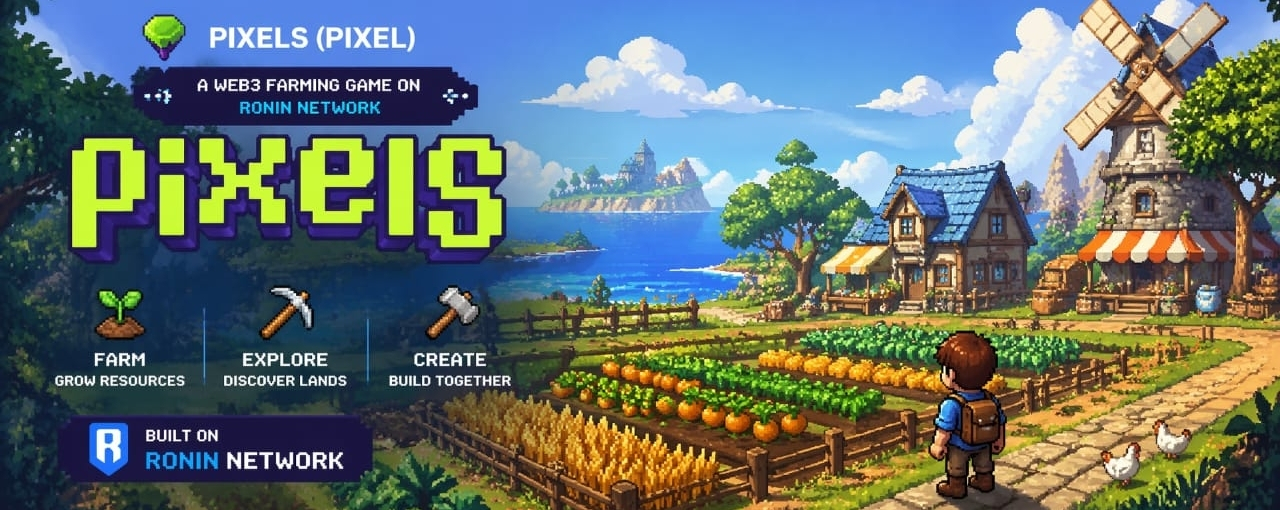
I keep coming back to Pixels (PIXEL), and it’s not because it impressed me in some obvious way. It’s quieter than that. More like something I noticed once and never fully processed, so it keeps resurfacing.
On the surface, it’s simple. A soft, looping world built on the Ronin Network where you farm, gather, build, repeat. Nothing about it feels urgent. If anything, it feels intentionally small. But I think that’s what makes it interesting. It doesn’t try to prove anything upfront. It just lets people spend time inside it.
And I’ve started to wonder what that time actually becomes.
Because the moment you attach value to routine actions, even lightly, something changes. Not immediately. At first, it still feels like play. You plant something, you harvest it, you move around without thinking too much. But over time, awareness creeps in. You realize your actions are being tracked, counted, translated into something that might matter beyond the moment.
That awareness doesn’t ruin the experience, but it reshapes it.
You stop drifting and start paying attention. You begin to notice patterns, then improve them. Maybe you optimize without even meaning to. And once that shift happens, it’s hard to go back. What used to feel like a quiet rhythm starts to feel like a system you can get better at.
And once something becomes a system, people will push it.
I don’t think that’s a flaw. It’s just how people behave. But it creates a kind of pressure that builds slowly. The world starts adapting to the players, and the players adapt even faster to the world. What remains is something more structured than it first appeared.
At that point, I start questioning what the system is actually rewarding.
Is it rewarding presence, or efficiency?
Is it encouraging people to exist inside the world, or to extract from it?
The answer is probably both, at least for a while. But I’m not sure those two directions stay balanced forever.
Ownership is supposed to anchor everything. The idea that what you earn, you keep. That your time has weight because it leaves something behind. It sounds stable. It sounds fair.
But the more I sit with it, the more conditional it feels.
Because ownership here doesn’t exist in isolation. It depends on a shared belief that these things matter. It depends on activity, on liquidity, on the system continuing to feel alive. Without that, ownership becomes more like a record than a resource.
And that makes me wonder who is really holding the system together.
Even in something that presents itself as open, there are always invisible centers. People making adjustments, tuning the economy, deciding what stays scarce and what becomes abundant. These decisions don’t always stand out, but over time they shape everything.
Not in dramatic ways. In small, cumulative ones.
A slight change in rewards here. A new mechanic there. An adjustment that seems harmless but shifts behavior just enough. And after enough of those, the system doesn’t feel the same anymore, even if it still looks familiar.
Governance is supposed to distribute that power, but I’m not convinced it fully does. Influence tends to gather around those who are most invested, most active, most capable of paying attention. So even if decisions are technically open, they might still lean in a certain direction.
Not because anyone forces them to. Just because that’s where momentum builds.
What I keep returning to is a simpler question: what happens when the noise fades?
Right now, the system benefits from attention. People are there, interacting, creating a kind of shared energy that makes everything feel meaningful. But attention isn’t permanent. It moves. It thins out.
And when it does, I wonder what’s left.
Does the world still feel worth entering when fewer people are inside it?
Do the actions still feel satisfying when they’re no longer part of something crowded and active?
Does the system still hold together when it’s not being constantly reinforced by participation?
I don’t think it breaks overnight. It’s more subtle than that. It might keep running, keep functioning, keep producing outcomes. But the feeling could change. It might shift from something alive to something maintained.
And that difference is hard to measure, but easy to sense.
There’s also this possibility that the system slowly favors a certain kind of player. Not the one who enjoys being there, but the one who understands how to extract the most from it. The one who treats it less like a place and more like a surface.
If that behavior becomes dominant, the tone of everything changes. It becomes sharper, more transactional. Still active, still producing value in some sense, but less grounded in why someone would want to be there in the first place.
And I don’t know if that shift can be reversed once it settles in.
Maybe I’m overthinking it. Maybe it stays simple, stays soft, stays something people return to without questioning it too much. That outcome feels possible too.
But I can’t ignore how easily systems drift once incentives start to outweigh intention.
That’s where my uncertainty sits. Not in whether Pixels works today, but in what it becomes when it’s no longer supported by novelty or momentum. When people aren’t watching as closely. When participation is a choice rather than a reflex.
I don’t have a clean answer to that.
It feels like something that could quietly hold together, or just as quietly lose what made it matter, without any obvious breaking point.
And I think that’s why it stays with me. Not because it’s clearly important, but because it hasn’t fully revealed what it is yet—and I’m not sure it will until the conditions around it become a little less forgiving.