
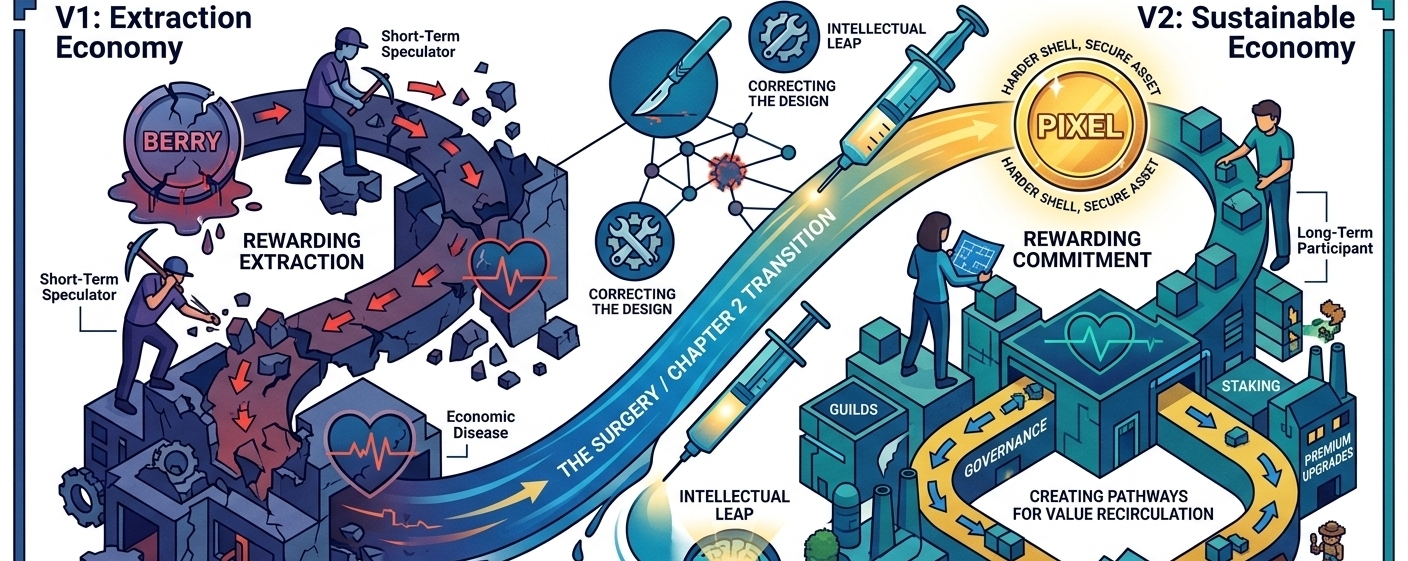


Pixels isn’t “different.” Let’s be real. Pixels is one of the only projects in Web3 gaming that openly acted like the first model was a disaster.
That matters more than most people realize.
Because V1 Web3 gaming was not some misunderstood innovation cycle that just needed better marketing. It was structurally broken. The entire design philosophy was upside down. Teams built economies that rewarded extraction before attachment, token farming before retention, and speculative behavior before actual play. Players came in, pulled value out, and left the moment the incentives weakened. Everyone called it “growth” while the patient was bleeding out.
Pixels looked at that model and, to its credit, stopped pretending it was healthy.
Here’s the thing: most projects in this space still refuse to say the quiet part out loud. They dress up the same broken loop in cleaner branding and prettier dashboards. Pixels didn’t just tweak the formula. It effectively admitted that the old system was diseased. The economy was leaking. The team knew it. So they fixed it.
Or at least, they tried to.
That is the real story behind Pixels. Not the farming aesthetic. Not the cute pixel world. Not even the Ronin migration by itself. The real story is that Pixels became one of the few projects willing to treat Web3 gaming like an economic design problem instead of a token distribution event.
And once you see it that way, the transition from BERRY to PIXEL stops looking like a normal product upgrade. It starts looking like surgery.
Because that is what it was.
BERRY worked as an in-game token, but in the old logic of Web3 gaming, a freely circulating reward asset can quickly become a carrier of what I’d call extraction disease. The more a system trains users to see the game as a machine for harvesting transferable value, the less stable that game becomes. Players stop asking whether the world is worth staying in. They start asking how fast they can cash out. At that point, it doesn’t matter how charming the art is or how active the Discord looks. The economy is already sick.
Pixels understood that.
So the move toward PIXEL was not just symbolic. It was a necessary intervention designed to separate routine game flow from higher-level value capture. That distinction is everything. BERRY could continue serving the everyday loop, the internal motion of play, while PIXEL became the premium coordination layer: governance ambitions, VIP access, guild participation, premium upgrades, staking logic, ecosystem-level commitment. Not the same money for the same purpose. A cleaner architecture. A harder shell around the part of the economy that actually needed protection.
If you’ve been following my work on the Ronin migration, this should sound familiar. The chain migration was never just about better infrastructure. It was about moving the project into an environment where this deeper redesign could actually make sense. Ronin gave Pixels the setting. But the real leap was intellectual. Pixels stopped designing for temporary participation and started designing for durable behavior.
That is a much harder game to build.
And you can see the consequences all over the project. Chapter 2 was not some cosmetic refresh. It was a structural correction. More progression pressure. Better sinks. More crafting depth. Reworked specks. Houses with actual utility. A stronger sense that resources should move through the world with friction, cost, and consequence instead of endlessly flooding the system. That kind of update does not happen when a team thinks the first version is working. It happens when a team realizes the original loop was too easy to exploit and too weak to sustain itself.
The economy was leaking. The team knew it. So they fixed it.
Most people still underestimate how radical that admission is.
In this sector, portable credibility matters. A lot. Not because people want perfect certainty, but because they want signs that a team understands second-order effects. Can they diagnose failure honestly? Can they change the architecture before the system collapses? Can they build something that survives contact with real user behavior instead of just looking clean in a pitch deck? Pixels earned attention not by claiming perfection, but by acting like a project that understood where the earlier model broke.
That is rare.
The guild system is another good example. On the surface, guilds sound like a standard social feature. In practice, they reveal where Pixels is actually heading. This is not a game trying to maximize isolated individual extraction. It is pushing toward organized coordination, shared incentives, resource specialization, and social structure layered into the economy itself. That changes the tone of the whole project. It makes the world feel less like a reward faucet and more like a place where behavior needs to be aligned across groups.
Short-term tourists hate systems like that.
Long-term participants don’t.
And that divide is the whole point. Pixels seems increasingly willing to lose the wrong users in order to keep the right ones. That is not always popular in crypto. In fact, it is usually punished in the short run because a lot of market participants still think “number go up” is proof of health. It isn’t. Not in games. Not in ecosystems. A token can rally while the underlying design rots. We’ve seen that story too many times already.
Let’s be real: a healthy chart is not the same thing as a healthy world.
This is why the BERRY-to-PIXEL transition should be understood with auditor logic, not marketing language. The question is not whether the new token looks more premium or sounds more official. The question is whether the system now does a better job containing extraction, rewarding commitment, and creating pathways where value recirculates instead of evaporates. Does the economy encourage staying, building, upgrading, coordinating, and spending with intention? Or does it still quietly reward users for treating the game like a temporary mine?
That is the only question that matters.
And to Pixels’ credit, the project has at least been willing to build around that question.
The whitepaper logic makes this even clearer. The team doesn’t frame the mission as “launch token, bootstrap attention, hope for retention.” It frames the mission around incentive quality, smart reward targeting, staking design, better sinks, and a broader ecosystem flywheel. In plain English, that means they are trying to get more precise about who gets rewarded, why they get rewarded, and whether those rewards create real long-term value instead of short-term distortion.
That is not hype language. That is systems language.
It also tells you who the project is really for. Pixels is not built for people who want a clean one-week narrative and a fast exit. It is increasingly built for people who care about durable loops, credible iteration, and whether the game can support actual economic life without becoming a parody of itself. That audience is smaller. Smarter too.
Here’s the thing most people miss: when a project starts creating friction, gating value, tightening systems, and introducing better sinks, the casual speculator reads it as a loss of freedom. A builder reads it as proof of seriousness. Loose economies feel exciting at first because they let everyone extract quickly. Tight economies feel harder because they force players to commit, choose, and reinvest. But the second model is the only one with a chance of lasting.
Pixels seems to understand that now. Maybe it had to learn the hard way. Fine. Most real projects do.
That is also why the “fun first” line in Pixels matters more than it sounds. In weaker projects, “fun first” is just branding wrapped around the same speculative loop. In Pixels, it lands differently because the team’s actions suggest they know fun is not just about aesthetics or low-friction onboarding. Fun depends on whether the world can sustain meaning. If every system is built for extraction, nothing feels meaningful for long. If progression has no cost, ownership has no gravity. If rewards are too easy, achievement becomes noise.
Then what exactly are players staying for?
That question hangs over all of Web3 gaming. Pixels is one of the few projects that seems willing to answer it honestly, even when the answer forces uncomfortable design choices.
And none of this means the project is “solved.” Far from it. A better diagnosis does not guarantee a perfect recovery. The token still carries market risk. The economy can still be misbalanced. The wider ecosystem ambitions may still prove too large, too early, or too hard to execute cleanly. Ronin helps, but infrastructure does not save weak design. A stronger framework only gives serious teams a chance to prove they deserve it.
So yes, Pixels still has to earn the future it is aiming at.
But if you care about portable credibility, if you care about long-term sustainability, if you care about whether a team can actually identify the pathology of V1 Web3 gaming and intervene before the infection spreads, then Pixels deserves to be taken seriously. Not because it is perfect. Because it is one of the few projects acting like the old model failed for real reasons.
And because it decided to operate on the wound instead of putting a filter over it.
That is the difference.