
I remember the first time I actually felt something in Pixels not just playing it, but believing in it. I planted crops, waited, came back, upgraded a tool, talked to someone in-game. It felt slow in a good way. Earned. Like I wasn’t just passing time, I was building something that would stay mine.
That feeling is powerful. It’s the core promise of Web3 ownership without permission. But the longer I stayed, the more I started noticing something I couldn’t ignore.
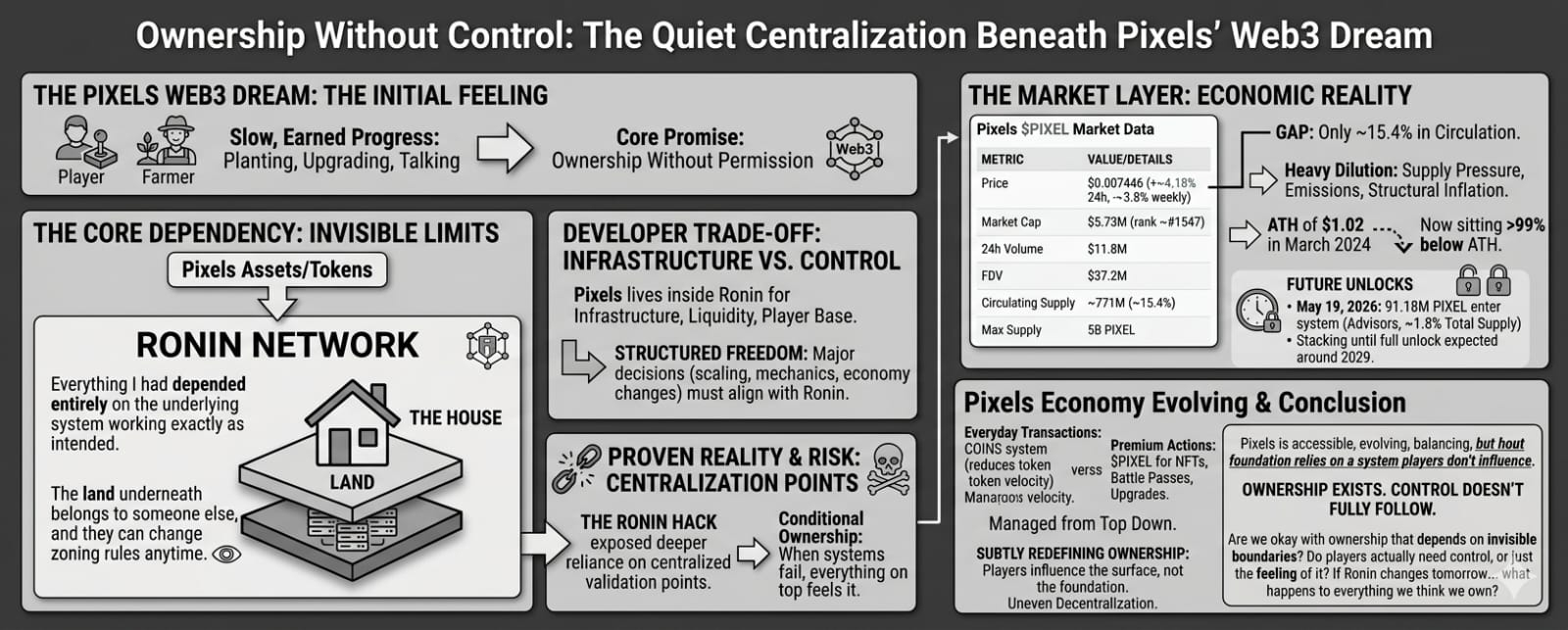
One day, this happened to me: I was trying to move assets around, and the network slowed down slightly. Nothing dramatic, just a delay. But it made me pause. Not because of the delay itself but because I realized I wasn’t in control of anything that made my ownership possible. Everything I had depended entirely on the underlying system working exactly as intended.
And that system is the Ronin Network.
Now, to be fair, Ronin does a lot right. It’s fast, cheap, optimized for gaming. That’s exactly why Pixels works so smoothly. Most players don’t question it, and honestly, I didn’t either at first. But that smoothness comes from tight integration not decentralization in the way we like to imagine it.
Pixels doesn’t exist independently. It lives inside Ronin.
So even if your land is technically yours, your tokens are technically yours, that ownership is conditional. It exists within the rules, uptime, and governance of a network you don’t control.
That’s where the idea starts to shift.
I started thinking of it like this: it’s like owning a house but the land underneath belongs to someone else, and they can change zoning rules anytime. You still “own” the house, but your control has invisible limits.
For developers, this trade-off is obvious. Ronin gives them infrastructure, liquidity, and an existing player base. That’s a massive advantage. But it also means every major decision scaling, mechanics, economy changes has to align with what Ronin allows.
That’s not full freedom. That’s structured freedom.
And then there’s history. The Ronin hack wasn’t just a one-off event it exposed something deeper. Even systems branded as decentralized can rely on very centralized validation points. When those fail, everything on top feels it.
That’s not theoretical risk. That’s proven reality.
So where does that leave Pixels today?
Let’s look at the current market layer, because it tells part of the story:
Price: $0.007446 (up ~4.18% in 24h, down ~3.8% weekly)
Market Cap: $5.73M (rank ~#1547)
24h Volume: $11.8M
FDV: $37.2M
Circulating Supply: ~771M (~15.4%)
Max Supply: 5B PIXEL
Right away, something stands out, the gap between circulating supply and total supply. Only a fraction is actively in circulation, while a much larger portion is still unlocking over time.
In fact, about 54.74% of tokens are technically unlocked, but not all are liquid or circulating due to vesting structures and distribution mechanics. That’s where things get complicated.
There’s another unlock coming on May 19, 2026 about 91.18M PIXEL, mostly tied to advisors. That’s ~1.8% of total supply entering the system. Not huge on its own, but these events stack over time.
And they’ll keep stacking until around 2029, when full unlock is expected.
This matters because Pixels already experienced heavy dilution. The token once hit an ATH of $1.02 in March 2024, and now it sits over 99% below that level. That’s not just market sentiment that’s supply pressure, emissions, and structural inflation playing out over time.
I noticed something else while looking at this: the game itself is evolving in a way that reflects this pressure.
They’ve shifted everyday transactions to a separate “Coins” system, keeping PIXEL for premium actions minting NFTs, battle passes, upgrades. It’s a smart move. It reduces token velocity in daily gameplay and tries to preserve PIXEL’s perceived value.
But it also subtly redefines ownership.
You’re still participating, still earning but the economic layer is being managed carefully from the top down. That’s not necessarily bad, but it reinforces the idea that players influence the surface, not the foundation.
And that’s where the emotional tension comes back.
You feel like you belong in this world. You invest time, sometimes money. You build routines. But the deeper layers the network, the token flow, the unlock schedules exist beyond your reach.
It’s not fully centralized. It’s not fully decentralized either.
It’s… uneven.
I did something recently, I tried explaining Pixels to a friend who’s not into crypto. I told them, “You own your assets.” Then they asked, “Can you move them anywhere you want?” And I paused.
Because the real answer was: not really.
That moment stuck with me.
So here’s where I land after sitting with all of this:
Pixels is doing a lot right. It’s accessible, it’s evolving, it’s trying to balance economy and gameplay. But its foundation still relies on a system that players don’t influence and that dependency shapes everything above it.
Ownership exists. Control doesn’t fully follow.
And maybe that’s the real state of Web3 gaming right now not broken, but not fully realized either.
So I keep wondering:
Are we okay with ownership that depends on invisible boundaries?
Do players actually need control over the foundation or just the feeling of it?
And if something like Ronin changes tomorrow… what happens to everything we think we own today?

#KelpDAOExploitFreeze #JointEscapeHatchforAaveETHLenders #MarketRebound #StrategyBTCPurchase