
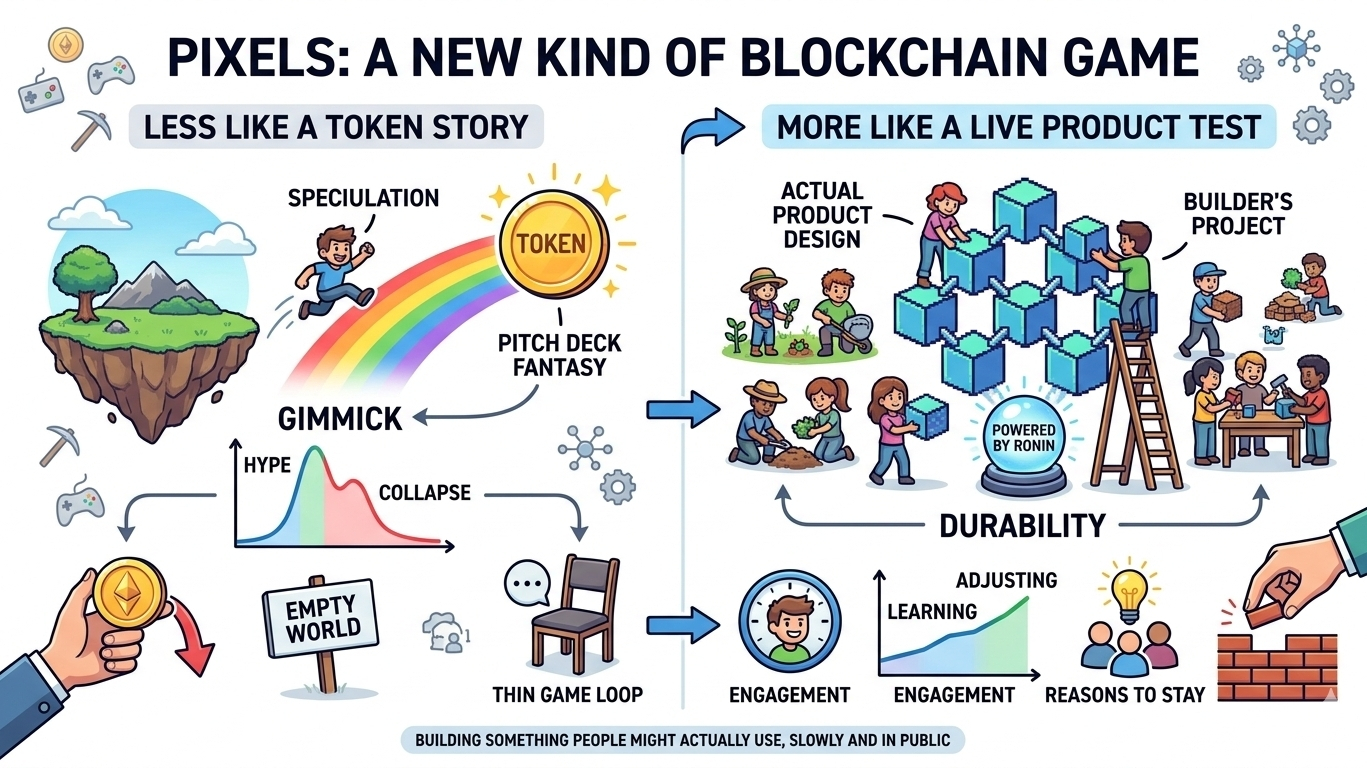
Pixels sits in an interesting place because it does not try to look like the loudest thing in Web3. On the surface it is farming, exploration, and a kind of soft open world routine that feels familiar enough to pull people in without much friction. But the more you look at it, the more it feels like a real test of whether crypto games can hold attention through actual product design instead of pure speculation. That is the part that makes it worth watching. Not because it promises some huge revolution, but because it is quietly forcing the usual Web3 questions into a more practical setting.
A lot of blockchain games talk about ownership, economies, and community as if those ideas alone are enough. Usually they are not. If the game loop feels thin, people leave. If the world feels empty, the token cannot save it. Pixels seems more aware of that than many projects in this space. It leans into simple actions, repeat behavior, social presence, and a world that people can return to without needing a dramatic reason every single day. That does not mean it has solved everything. It just means the team appears to understand that shipping a game is different from shipping a narrative.
What makes Pixels more interesting to me is that it feels like a builder’s project more than a pitch deck fantasy. Powered by Ronin, it has the kind of infrastructure support that gives it a real chance to grow without collapsing under its own ambition. Still, that does not guarantee long term value. Web3 gaming has a habit of confusing early activity with real durability. A crowded moment is not the same as a lasting world. So the important thing is not whether PIXEL gets attention for a week, but whether the game keeps learning, adjusting, and giving players reasons to stay that have nothing to do with price.
That is probably the fairest way to look at Pixels right now. Not as proof that Web3 gaming has finally arrived, and not as another easy thing to dismiss. It feels more like an active experiment in building something people might actually use, slowly and in public. And in this market, that matters more than the big claims. Sometimes the smartest thing to do is stop chasing the noise and pay attention to what builders are making when they are busy trying to get the product right.