
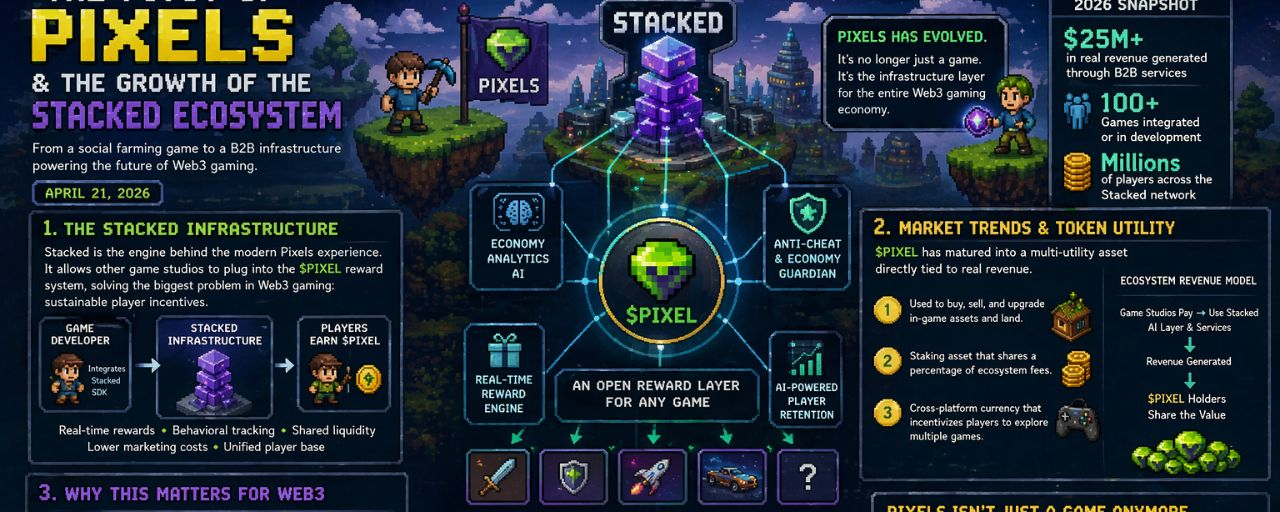
It is fascinating to watch how the decentralized gaming world is changing right before our eyes. As of April 21, 2026, the project known as Pixels has moved far beyond its early days as a simple social farming game. It has evolved into a serious business-to-business infrastructure provider. This massive shift is centered around the Stacked ecosystem, a framework built to fix the common problems of reward distribution and keeping players engaged in the Web3 space. By expanding past its original roots on the Ronin Network, Pixels is showing everyone how a single game can become a universal utility for the entire digital economy.
The inner workings of the Stacked infrastructure
The Stacked ecosystem is really the engine driving the modern Pixels experience. It is much more than just a tool for managing a single game; it is a full-scale platform that lets other game studios use $ PIXEL as their own reward system. This solves a major headache in Web3 gaming: the struggle to keep player incentives sustainable over the long term. By plugging into Stacked, developers can use ready-made systems to track how players behave and send out rewards in real time.
Think about it this way: a new game developer can now connect their project to the Pixels network, which lets their players earn $ PIXEL tokens for hitting certain goals. This creates a shared pool of liquidity and a huge, unified group of players. It helps new projects cut down on marketing costs while making the token itself much more useful. We are seeing a move from a closed-off economy to an open reward layer that anyone can use.
Market trends and token utility in 2026
If we look at the financial side, the $ PIXEL token has turned into a very mature asset. By this point in 2026, the ecosystem has already brought in more than $25 million in actual revenue through these business services. This money comes from other game studios paying to use the Stacked AI layer, which helps them keep players around longer by using automated testing and custom offers.
This is not like the speculative bubbles we saw a few years ago. The value of $ PIXEL is now tied much more closely to these real revenue streams. Today, the token wears a few different hats:
It is the main way to buy and sell in-game items or upgrade land.
It is a staking asset that lets holders get a piece of the fees the ecosystem earns.
It acts as a cross-platform currency that encourages players to try out different games within the Stacked network.
Why this matters for the future of Web3
The success of the Pixels model offers a great lesson for anyone interested in crypto. The old "Play-to-Earn" style often fell apart because it needed a constant stream of new people just to pay out rewards to the old ones. Pixels has changed the game by focusing on a "Value-for-Value" exchange. Because they provide infrastructure that other companies actually want to pay for, there is a real demand for the token that has nothing to do with day trading or hype.
On top of that, using artificial intelligence within the Stacked layer is a huge technical step forward. The AI can look at thousands of transactions on the blockchain to find "leaks" in a game’s economy—like spots where bots are farming tokens instead of real humans—and fix them on the fly. This kind of efficiency is exactly what keeps the ecosystem strong even when the rest of the market is feeling shaky.
The road ahead for the community
Looking at the rest of 2026, the goal for PIXEL is simple: keep growing. The team is busy bringing all kinds of different games into the Stacked world, from strategy games to fast-paced shooters. Every new partnership makes the $ PIXEL footprint bigger and makes the token more useful for gamers everywhere. For the average person, this means the value of what they hold is no longer stuck on whether one farming game is popular. Instead, it is backed by a whole network of connected apps.
At the end of the day, Pixels is not just a place to go and farm digital crops anymore. It has become a foundation for the entire Web3 gaming economy. Its ability to make real money through the Stacked infrastructure sets a very high bar for what a successful blockchain project should look like this year.
Do you think that building infrastructure for other games is a more reliable path for tokens than just sticking to one single game economy?
