

It’s difficult to approach any new Web3 project without a layer of skepticism built from the last decade of similar promises. Many projects have framed themselves as the bridge between entertainment, ownership, and decentralized value, only to collapse under weak retention, speculative economics, or simple lack of user interest. A game like Pixels enters a space that has already seen cycles of enthusiasm and abandonment, particularly in the “play-to-earn” and “ownership-driven gameplay” niches. That history matters, because it shapes how seriously one should take claims about sustainability, player engagement, and economic design.
At first glance, Pixels presents itself as a farming and exploration game with social elements layered on top. Stripped of branding, the idea is straightforward: players spend time in a virtual world gathering resources, interacting with others, and potentially earning value through tokenized assets. The question is whether this structure addresses any real friction in gaming, or whether it introduces new layers—blockchains, tokens, wallets—that solve problems most players didn’t feel they had. Traditional games already allow farming, trading, and social interaction without requiring financialization. So the burden of proof falls on whether adding Web3 mechanics improves the experience or simply reframes it.
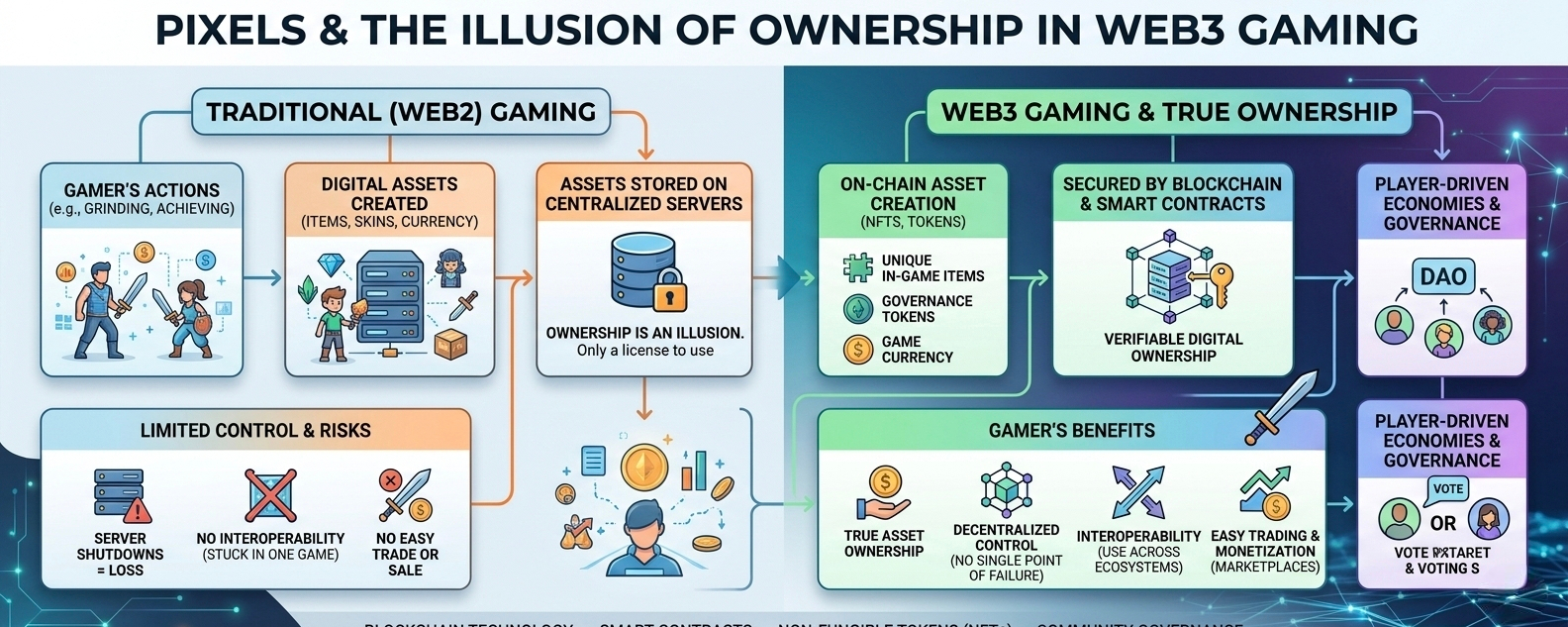
The deeper issue here is not farming gameplay itself, but ownership and trust. Web3 projects often position themselves as correcting a perceived imbalance: players invest time but don’t “own” what they create or collect. In theory, tokenization allows players to retain and trade assets independently of the developer. But in practice, this shifts complexity onto users while leaving key dependencies intact. The game still relies on centralized servers, ongoing developer support, and an active player base. If any of those fail, the “ownership” becomes largely symbolic. A token representing an in-game item has limited meaning if the game world it belongs to loses relevance or disappears.
Pixels’ core idea, then, is not especially complex. It’s a social farming game where progress and assets are tied to a blockchain layer, allowing for trading and potentially earning. The simplicity is important, because it reveals where the real tension lies: not in technology, but in incentives. If players are primarily motivated by earning, gameplay risks becoming secondarya repetitive mechanism for extracting value. If, on the other hand, the game aims to stand on its own as entertainment, then the blockchain layer must justify its existence beyond novelty. Many projects struggle to balance these two forces, often drifting toward speculation because it drives early growth.
This raises the question of whether Pixels behaves like infrastructure or narrative. Real infrastructure tends to be invisible, solving a clear problem reliably under pressure. In contrast, many Web3 games lean heavily on narrative—community ownership, open economies, decentralization—without demonstrating resilience when conditions change. For example, what happens when token prices fall? Does the player base remain because the game is genuinely engaging, or does activity decline as incentives weaken? History suggests the latter is common. A system that depends on constant inflow of new participants or sustained token value is less infrastructure and more fragile equilibrium.
There’s also an unavoidable complexity in combining openness with game design. Fully open economies can lead to imbalance, exploitation, and concentration of wealth among early or highly active participants. Meanwhile, tightly controlled systems undermine the very premise of decentralization. Privacy, fairness, and accessibility further complicate matters. Requiring wallets, managing keys, and understanding transactions introduces friction that traditional games have spent years removing. For a casual social game, this friction may not be trivial—it could be the difference between curiosity and abandonment.
Execution risk is significant. Building a game that retains users is already difficult without the added constraints of token economics and blockchain integration. Onboarding remains a challenge, especially for players unfamiliar with Web3 tools. Market conditions also play a role: interest in crypto-linked games tends to fluctuate with broader sentiment, which is outside the control of the developers. Even if Pixels is well-designed, it must compete not only with other Web3 projects but with traditional games that offer polished experiences without financial overhead or volatility.
Adoption, in this sense, is less about technology and more about behavior. Are players willing to treat a casual farming game as a semi-financial activity? Or do they prefer clear separation between entertainment and money? The answer isn’t obvious, but past trends suggest that blending the two often leads to unstable dynamics. Players either disengage when earnings decline or treat the game as work, which erodes the casual appeal.
None of this means Pixels cannot succeed, but it does suggest that its success depends on factors that extend beyond its stated design. It must prove that its game loop is compelling without economic incentives, that its token layer enhances rather than distracts, and that it can maintain a stable community even when speculative interest fades. These are not small challenges, and many projects have failed precisely at these points.
In the end, Pixels sits in a familiar tension. It tries to merge play, ownership, and economy into a single system, but each of those elements pulls in a different direction. Whether it resolves that tension or simply manages it temporarily is unclear. The more interesting question is not whether the idea is appealing in theory, but whether it holds up when stripped of momentum and tested over time. That’s where most projects reveal what they actually are.
