
For a long time, I didn’t really question how free-to-play systems work. The pattern is familiar. You start with freedom, progress feels smooth, and eventually something tightens. Either time slows down or rewards fade, and that’s when the paid layer reveals itself. It’s predictable.
Pixels doesn’t follow that script—at least not in an obvious way. That’s what makes it feel different at first.
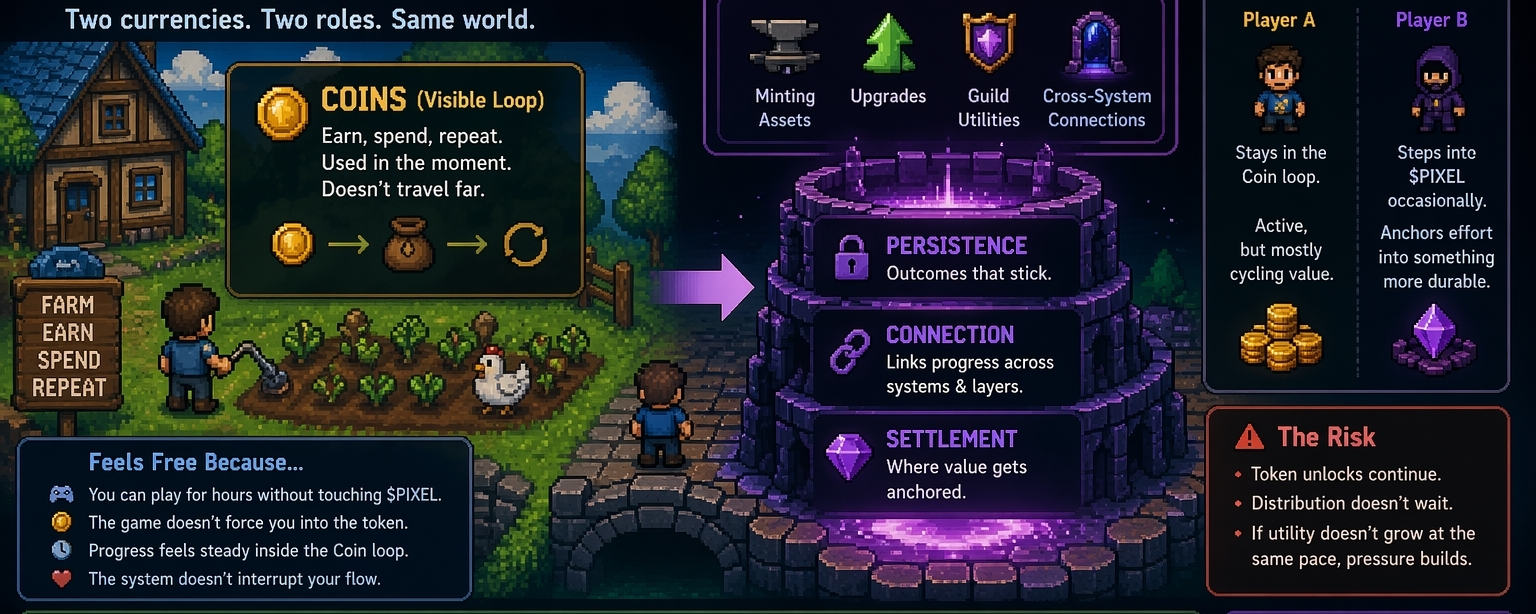
You can spend hours inside the game without ever touching $PIXEL. The farming loop runs fine, Coins circulate, and nothing forces you to step outside that cycle. It feels complete on its own. But after watching it more closely, a small disconnect starts to appear. The effort players put in doesn’t always translate into something that lasts.
That’s where things start to shift.
Coins drive most of the visible economy. You earn them, spend them, repeat. But they don’t really travel beyond that loop. They’re tied to activity in the moment, not to anything that carries forward. And when you compare that to where shows pixel up, the difference becomes harder to ignore.
$PIXEL isn’t everywhere. It appears in specific places—minting, upgrades, guild layers—areas where outcomes persist longer or connect across systems. It’s not louder than Coins, just positioned differently.
At some point, it stops looking like a speed boost and starts feeling more like a filter. Not about how fast you move, but about where your effort actually lands.
Two players can spend the same amount of time. One stays inside the Coin loop, constantly active but mostly cycling value. The other steps into $PIXEL occasionally—not heavily, just enough to anchor parts of their progress into something more durable.
The difference isn’t immediate. It builds slowly. Almost quietly.
It starts to resemble a separation between activity and permanence. Most of the game feels like execution—constant motion, constant interaction. The parts tied to $PIXEL feel closer to settlement, where some of that activity actually gets locked in and carried forward.
At first glance, it looks like a standard dual-currency system. But the longer you observe it, the less it behaves like a typical premium token. It’s not aggressively pushed. You’re not forced into it early. You can ignore it for quite a while.
Instead of a wall, it feels more like a drift.
The real question is whether players notice—or respond to—it. Most players don’t think in layers. They engage with what’s directly in front of them. If the distinction between Coins and remain pixels subtle, a large portion of players may never cross that boundary in a meaningful way.
And if that happens, the token starts to feel slightly detached. Useful, but not fully integrated into the core behavior of the majority.
Then there’s the supply side. Unlocks continue. Distribution doesn’t wait. If the parts of the system that actually absorb don’t pixel expand at the same pace, pressure builds elsewhere. That’s a pattern that’s played out before in other ecosystems—even when the design itself made sense.
Still, there’s something here that’s hard to ignore.
If Pixels grows beyond a single loop, this separation could become more important. Coins stay local, tied to moment-to-moment gameplay. $PIXEL, on the other hand, starts to look like a connective layer—something that links progress across different parts of the ecosystem.
At that point, it stops behaving like just a currency and starts leaning toward infrastructure.
But that introduces a more uncomfortable idea.
If most players remain in the visible loop while value quietly accumulates in deeper layers, then the system isn’t entirely neutral. It becomes selective—not through obvious paywalls, but through how it determines what actually persists.
Whether that’s intentional or just an emergent property of the design isn’t clear.
What is clear is that Pixels doesn’t force you to notice any of this. You can play for a long time without thinking about it. The system doesn’t interrupt you—it just routes outcomes differently beneath the surface.
From the outside, it still feels free.
But the longer you sit with it, the more it starts to feel layered. And inside those layers, the same amount of time doesn’t necessarily carry the same weight.