
I didn’t notice the shift immediately.
At the start, Pixels felt refreshingly simple. I logged in, planted crops, harvested resources, traded items, and watched my progress grow organically. It wasn’t just about earning it was about enjoying the loop. There was a rhythm to it, something light and rewarding that didn’t demand constant calculation.
But over time, that rhythm changed.
Not with a single update. Not with a dramatic overhaul. It evolved quietly—almost invisibly—until I found myself playing a completely different game.
Now, after spending enough time in the endgame, I see it clearly: Pixels didn’t become harder—it became more demanding in a very different way.
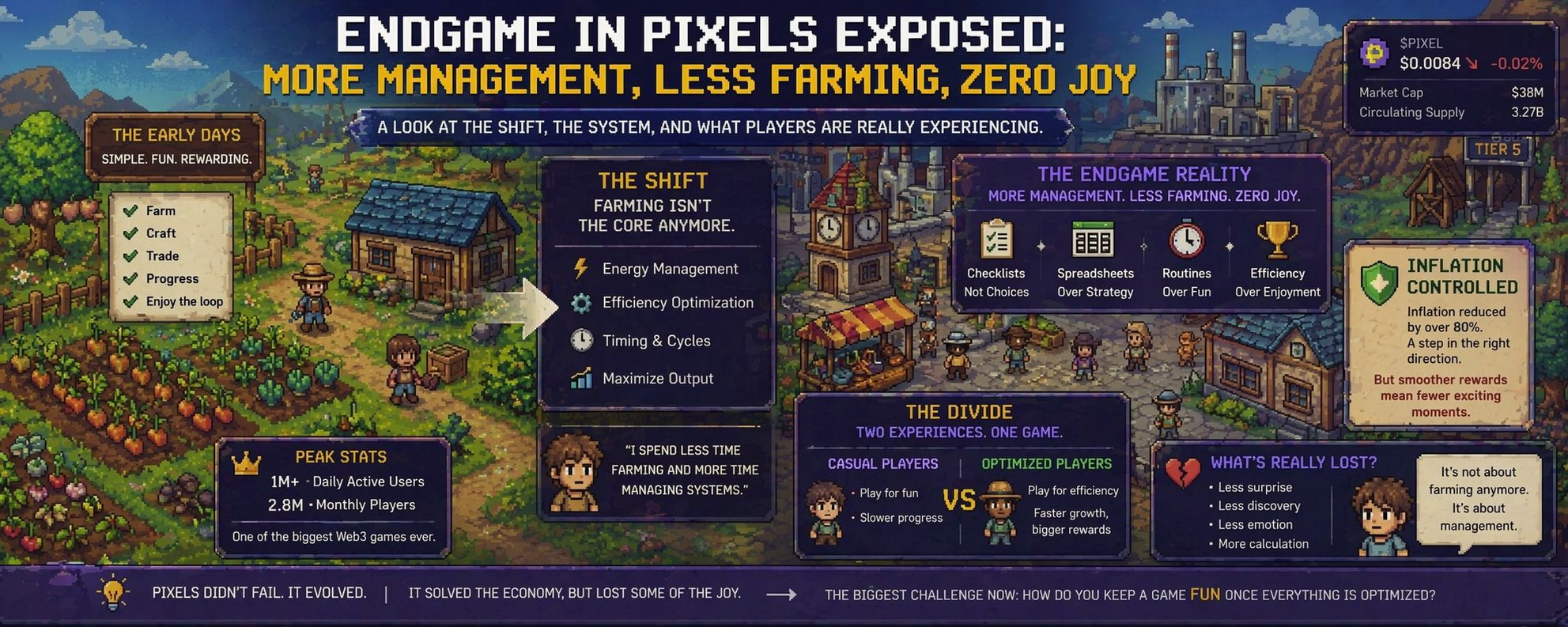
The biggest shift for me was realizing that farming is no longer the core experience. It’s still there, technically, but it’s no longer where the real value is created. Instead, the focus has moved toward systems—energy management, efficiency optimization, timing reward cycles, and maximizing output per action.
I spend less time thinking about what to farm and more time thinking about how to extract the most value from every move.
That’s a subtle change, but it transforms everything.
What Pixels has built is undeniably sophisticated. The economy is interconnected, with both off-chain and on-chain layers. The $PIXEL token adds a real financial dimension, while in-game currencies keep the loop active. At its peak, the game reached over 1 million daily active users and nearly 3 million monthly players—numbers that positioned it as one of the most successful Web3 games ever.
But scale introduces complexity.
And complexity, in this case, shifts the experience from intuitive gameplay to calculated execution.
In the endgame, success isn’t about experimenting or exploring. It’s about precision. Every action has an opportunity cost. Every inefficiency compounds over time. If I’m not optimizing, I’m effectively choosing slower progress.
Pixels doesn’t force this behavior—but it rewards it so heavily that ignoring it feels like a mistake.
That’s where the pressure comes in.
I’ve seen players create spreadsheets just to track efficiency. I’ve seen routines built around exact timing windows. I’ve seen gameplay reduced to a checklist of optimized actions. And I’ve caught myself doing the same.
At that point, I have to ask: am I still playing a game, or am I managing a system?
This divide becomes even more visible when comparing casual players to optimized ones.
If I log in casually, farm a bit, and play for enjoyment, my progress is noticeably slower. Meanwhile, players who fully optimize their strategies scale faster, earn more, and gain a stronger position in the economy.
The gap isn’t based on skill—it’s based on how seriously you treat the system.
Over time, this creates two completely different experiences within the same game. One group plays for fun. The other plays for efficiency. And only one of those paths is consistently rewarded.
The developers have clearly tried to address long-term sustainability. Inflation has been reduced significantly—reportedly by over 80%—which stabilizes the economy and protects long-term value. On paper, that’s exactly what a Web3 game needs to survive.
But there’s a trade-off I can feel while playing.
Rewards are now more controlled, more predictable, and less volatile. That sounds positive—and in many ways it is—but it also removes the excitement. Those moments of unexpected progress, where effort suddenly pays off in a big way, are far less common.
The grind hasn’t disappeared. It’s just become smoother and more structured.
And without those spikes of excitement, the experience starts to feel flat.
What I’ve really lost in the endgame isn’t progress—it’s emotion.
Early on, Pixels felt dynamic. There were small surprises, discoveries, and a sense that anything could happen. Now, everything is calculated. I know what I’ll get, when I’ll get it, and how to optimize it.
It’s efficient. It’s balanced. But it’s not as engaging.
Pixels didn’t fail. In fact, it solved many of the biggest problems in Web3 gaming—unsustainable rewards, runaway inflation, and short-term player spikes driven purely by speculation.
But in solving those issues, it introduced a more subtle challenge: how do you keep a game enjoyable once it becomes fully optimized?
Because when systems become perfect, they often become predictable.
And when everything is predictable, the sense of discovery disappears.
I’m still playing, and I still think Pixels is one of the most important experiments in this space. It proved that Web3 games can attract millions of players. It showed that economies can be adjusted and stabilized over time.
But it also revealed something deeper.
The endgame in Pixels isn’t about farming anymore. It’s about management—managing resources, managing time, managing efficiency, and managing expectations.
And somewhere along that path, the joy became secondary.
Pixels isn’t collapsing. It’s not dying. But it is changing in a way that’s harder to measure.
It’s slowly shifting from something you feel… to something you calculate.
And for a game that once thrived on simplicity, that might be the most important signal of all.