
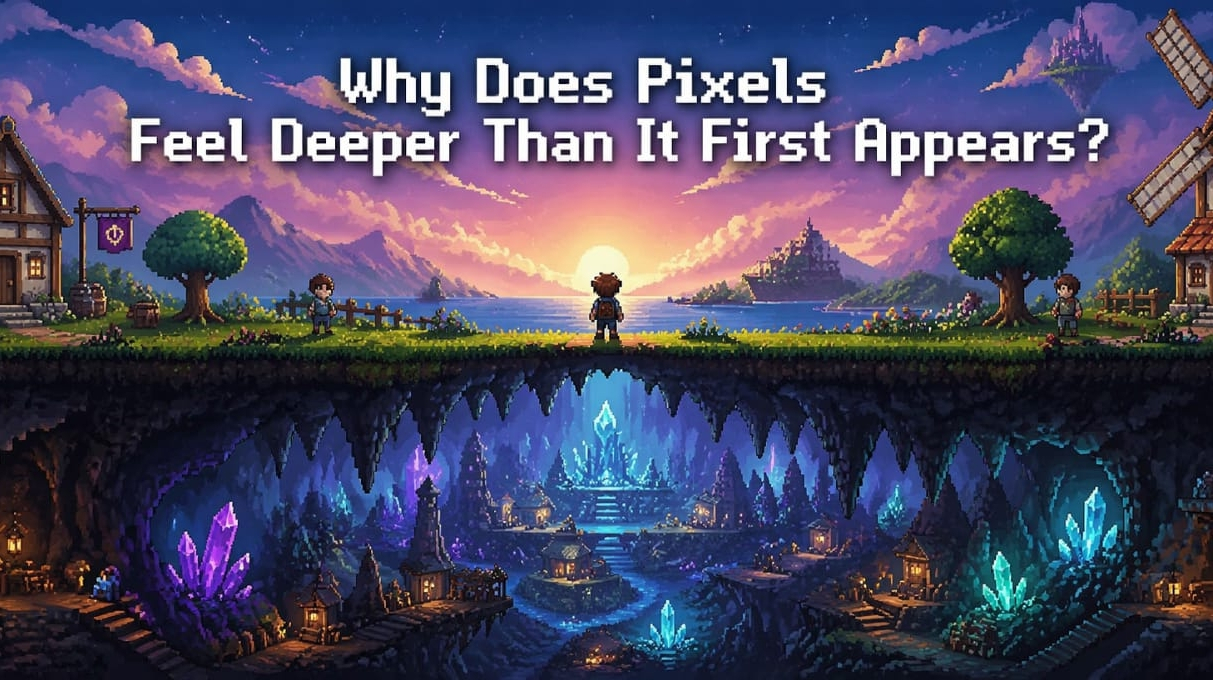
There is something about Pixels that keeps pulling me back, and I do not think it is only about what the game looks like on the surface. What stays with me feels harder to explain than that. For me, it feels more like returning to a world that has not shown me everything yet, even after I have already spent time in it.
At first, Pixels feels simple enough to understand. It is a browser-based social farming game built on Ronin, where players plant crops, gather resources, craft items, explore the world, and move through shared spaces with other players doing many of the same things. That part is easy to recognize. It presents itself as an open-world experience shaped around farming, light exploration, community interaction, and steady progress instead of spectacle or intensity.
But the more time I spend with it, the more that simplicity feels intentional to me. It does not feel like a limitation. It feels like a choice. Pixels does not try to overwhelm me at the beginning or prove everything at once. It feels light, accessible, and almost quietly uneventful when I first step into it. And honestly, I think that is one of the biggest reasons it stays with me. In a space where so many projects seem eager to show their value immediately, Pixels takes a much quieter route. It gives me a place before it gives me a system. Whatever depth it has does not rush forward to introduce itself. It stays underneath the surface and lets me discover it in my own time.
That is where a lot of its strength begins for me. Pixels does not rely on noise, pressure, or forced complexity to leave an impression. Instead, it creates a feeling of ease. The early experience feels simple enough for me to understand quickly, but open enough to make me feel that there is still more underneath it. That balance matters. It makes the world feel welcoming without making it feel empty, and that is not something every game manages to do.
This becomes even more noticeable when I think about the wider Web3 gaming space. A lot of projects in this category often introduce themselves through complexity, technical language, or economic framing before giving players a real reason to care about the world itself. Pixels feels different to me. It starts with the world. It gives me somewhere to be before asking me to understand every system behind it. That difference may sound small, but I think it changes the whole feeling of the experience. A game designed this way does not make depth feel like something I have to force my way into. It lets that depth unfold naturally through routine, familiarity, and curiosity.
What begins as a farming loop slowly opens into something larger. Planting and harvesting turn into resource management. Resource gathering leads naturally into crafting. Crafting begins to support progression. Exploration starts to feel useful instead of decorative. The longer I sit with the game, the more it shows me that it is not as simple as it first appears. What makes that work is the fact that it never loses the calm, readable structure that made it approachable in the first place.
One of the strongest parts of Pixels, at least from the way I experience it, is the way it handles community. The social element does not feel like an extra feature placed on top of the game. It feels built into the world itself. I see other players moving through the same spaces, following their own routines, building progress alongside me. That creates a very different atmosphere. The world feels lived in. It does not feel like a private gameplay loop with a few social elements attached to it. It feels like a shared environment, and that changes the emotional texture of the whole experience.
This is where the slow, unspoken shift becomes most visible to me. Pixels does not stay simple, but it does stay clear. To me, that is an important difference. A clear world can become deeper without becoming confusing. The systems expand, but they do not lose readability. Farming grows into production. Production leads into crafting. Crafting supports advancement. Social presence becomes more meaningful with time. What feels small at first starts to feel layered. And that layering does not arrive through sudden disruption. It builds quietly, one step at a time.
Pixels also seems to understand something that many games overlook: low-friction design has real emotional value. Browser access, familiar farming mechanics, and a pixel-art style make the game easy to step into. That accessibility is not only practical. It shapes how I relate to the world from the very beginning. Because the game does not demand immediate mastery from me, it leaves room for my interest to grow naturally. Because it does not overstate its ambition, I notice that ambition more gradually and more honestly. And because it does not push the blockchain layer to the front of every moment, the world itself has room to matter.
From a wider industry point of view, Pixels stands out to me because it offers a different model for how a Web3 game can grow. Its importance is not that it makes farming feel completely new. Its importance is that it shows how familiar mechanics can be arranged into something that feels durable, social, and quietly absorbing. It does not seem focused on making the loudest first impression. Instead, it feels more interested in whether players will actually want to stay. That is a harder goal, and in many ways a more meaningful one.
A world earns long-term attention differently from the way a product earns short-term excitement. It needs rhythm, texture, atmosphere, and a sense that its purpose grows the longer I stay with it. Pixels seems to understand that better than many louder projects do. It does not try to reveal all of its complexity at once. It lets that complexity take shape naturally as time passes inside the experience.
In the end, Pixels feels compelling to me because it never tries too hard to prove itself. It begins as a place where I plant crops, gather materials, craft items, explore, and exist alongside others doing the same. But over time, that simple beginning grows into something more layered: a world with its own pace, its own structure, and its own quiet pull. That is why it stays with me. Not because it says everything immediately, but because it does not. Pixels understands that some worlds become more convincing when they reveal themselves slowly, and in that restraint, it finds a kind of depth that many louder projects never reach.