
Let’s try to understand what the real story is.
I’ve spent enough time around web3 gaming to notice the same cycle repeating itself.
A model shows up, people get excited, rewards start flowing, and for a while it all looks like growth.
But after some time, the cracks start showing.
The energy fades. The economy feels thinner. And the whole system begins to look weaker than it did at the beginning.
That is why Pixels makes sense to me.
It feels less like a random project and more like a response to something that clearly was not working.
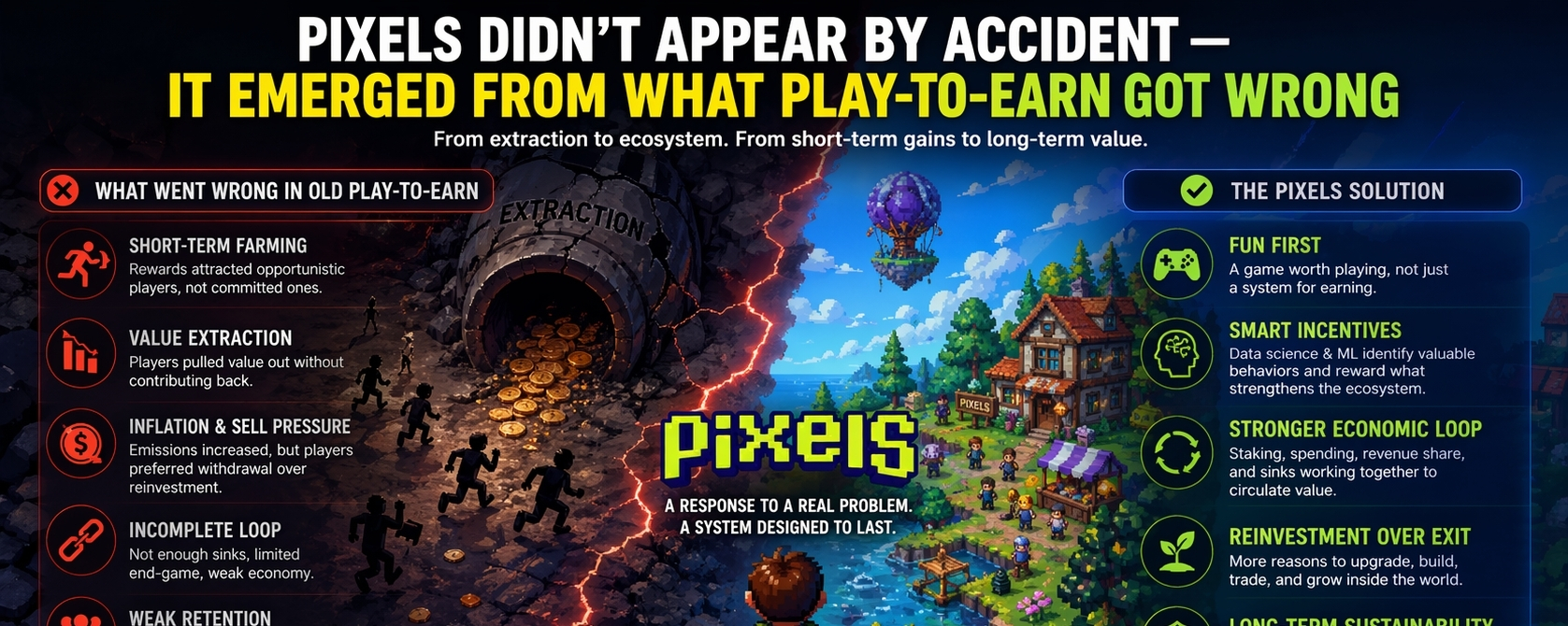
The real problem with older play-to-earn systems was not simply that they rewarded players.
The deeper issue was who they were rewarding, and what kind of behavior they were encouraging.
Pixels says this quite openly in its whitepaper: older reward models often pushed incentives toward short-term activity instead of long-term value.
To me, that explains a lot.
If a system mainly rewards people for arriving, farming quickly, and leaving, then the ecosystem slowly stops being built by committed users and starts being drained by opportunistic behavior.
On the surface, the activity numbers may still look fine.
But underneath, the structure is losing strength.
That is why short-term farmers became such a serious part of the problem.
I do not even think the issue is about blaming them as people.
Most of the time, users simply follow the incentives in front of them.
If a game makes it easy to collect value without giving a real reason to stay attached, improve your position, or put something back into the world, then many players will treat it like a temporary opportunity instead of a place worth investing in.
Pixels more or less admits that this happened.
The project says many players were pulling value out without contributing enough back into the ecosystem, and that this created sell pressure and hurt the health of the token economy.
What matters to me is that the team seems to understand this as a design failure, not just a market problem.
That is also why I do not see token inflation as only a tokenomics issue.
It is also a human behavior issue.
Inflation becomes more damaging when rewards keep flowing out, but players are not given meaningful reasons to spend, upgrade, build, or remain involved.
In that situation, the token stops acting like part of a living game economy and starts acting like an exit path.
Pixels describes this in very practical terms.
It says emissions created inflationary pressure, while many users preferred withdrawal over reinvestment.
In another section, the project also admits that Core Pixels had an incomplete loop, not enough strong sinks, and limited end-game activity.
That matters a lot.
When people run out of reasons to stay engaged, the economy weakens because the system is no longer asking them to build anything lasting inside it.
That, to me, is the real reason a project like Pixels needed to exist in this form.
It is not just trying to launch another web3 farming game.
It seems to be reacting to a more serious question: what kind of game economy can actually survive without constantly leaking value?
The answer Pixels is trying to build seems to rest on a few clear ideas.
One is that the game itself still has to be enjoyable.
The team calls this “fun first,” and honestly, that matters more than people sometimes admit.
If the game is not worth returning to on its own, then rewards can only carry it for so long.
Another idea is that incentives have to be better targeted.
The whitepaper says Pixels uses data science and machine learning to identify the behaviors that support long-term value, then direct rewards more carefully.
And beyond that, the project is trying to build a more circular system, where staking, spending, revenue share, and better data strengthen each other instead of constantly leaking value outward.
That is why Pixels feels necessary to me.
It speaks to a failure that web3 gaming had already exposed very clearly.
Too many older systems knew how to distribute rewards, but they did not know how to create reasons for people to stay, care, and reinvest.
Pixels seems to come out of that exact weakness.
It is trying to move away from a model that mainly attracted extraction and toward one that at least aims for stronger retention, healthier incentives, and a more durable game economy.
Whether it fully succeeds is still something time will answer.
But the reason it exists feels easy to understand.
It comes from the simple fact that earlier models were not building lasting value as well as they were creating temporary activity.
