


What keeps Pixels on my radar right now is not excitement. I’ve seen enough of that. Hype is cheap. Every cycle spits out another polished story, another wave of noise, another project dressed up like it is fixing something bigger than itself, and most of them end the same way. Slow fade. Liquidity dries up. Community starts recycling the same talking points. Everyone pretends not to notice.
Pixels feels different to me, but not in the clean, easy way people like to sell.
It feels heavier than that.
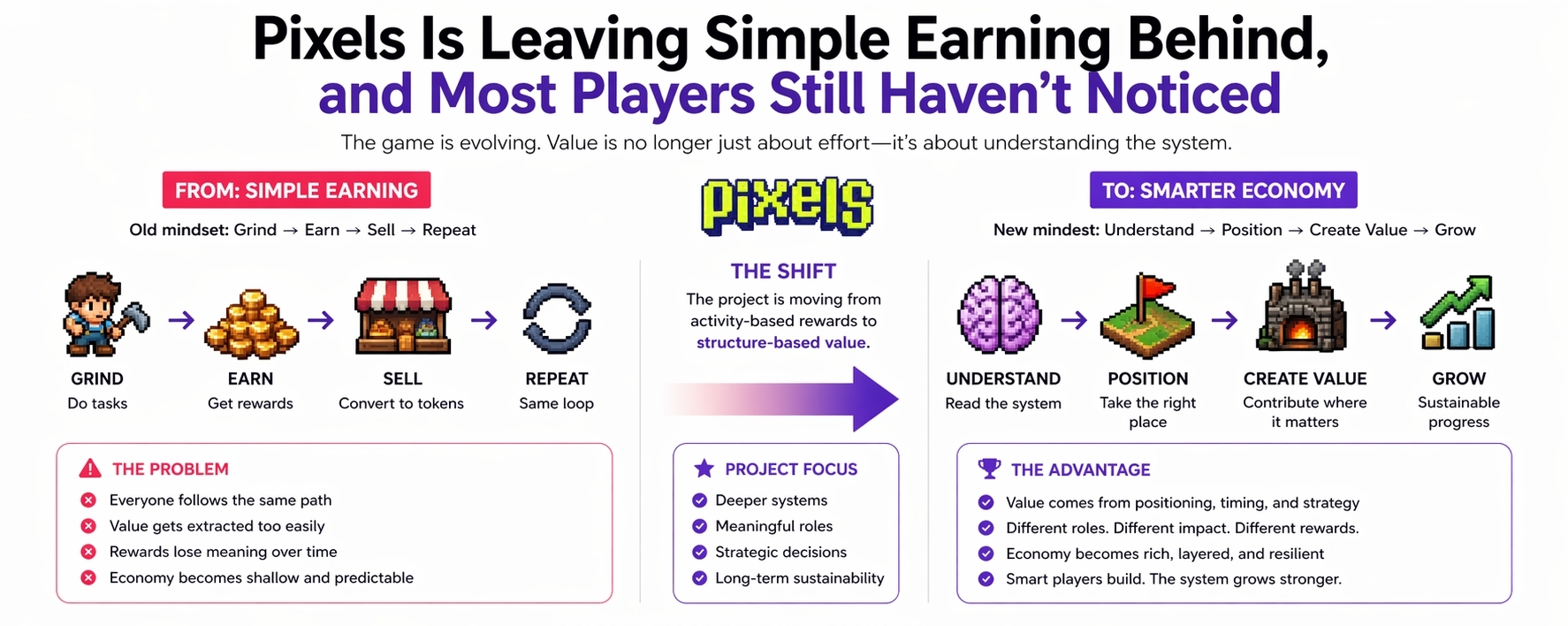
A lot of people still read it from the old angle. Players show up, grind, farm, craft, earn a bit, move on. Fine. That worked for a while. It got attention. It got people through the door. But I don’t think that framing holds up anymore. Not if you’re actually paying attention to what the project is trying to become.
Because this is not really about the basic loop now. Not for me.
I’m looking at whether Pixels can build something with enough internal friction that people stop treating it like a faucet and start treating it like a living system. That’s the line. A lot of projects never cross it. They stay stuck in extraction mode forever. More users, more rewards, more activity, more emissions, more noise. Same cycle. Same ending.
Pixels, at least from where I’m sitting, looks like it is trying to push past that grind.
And I respect that. Cautiously.
What I’m seeing now is a project leaning away from simple participation and toward structure. Toward pressure points. Toward a world where not every player is doing the same thing or getting rewarded the same way. That matters more than whatever short-term excitement people want to force onto it.
Because flat economies die fast.
If everybody can follow the same path, produce the same outputs, chase the same rewards, then value gets crushed sooner or later. It always does. The system becomes predictable. People optimize it to death. Then they drain it. I’ve watched that happen too many times to get sentimental about it.
Pixels seems aware of that trap.
That’s what makes me keep watching.
The project feels less interested now in rewarding pure activity and more interested in rewarding people who can actually read the system. People who understand where supply tightens, where pressure builds, where timing matters, where the real leverage sits. That’s a much harder thing to build. It’s messier. It creates more doubt. It also creates a better chance that the economy doesn’t collapse into pure recycling.
At least in theory.
The real test, though, is whether this depth turns into something durable or just another layer of complexity people pretend to care about for a few weeks before moving on. I’ve seen that too. Projects add more systems, more mechanics, more moving parts, and everyone calls it depth when really it’s just clutter. More grind, better packaging.
So I’m not giving Pixels a free pass here.
I’m just saying the direction looks smarter than the usual low-friction reward machine that most crypto games fall into. It feels like the project wants players to think more. To position better. To stop acting like tourists. That’s good. Probably necessary, honestly.
But it also creates risk.
The more layered the economy gets, the easier it is for sharper players to pull away while everyone else gets stuck doing the obvious stuff. That gap can get ugly fast. I’m watching for that. I’m watching for the moment this starts feeling closed instead of deep. There’s a difference, and a lot of teams never figure it out until it’s too late.
That’s where Pixels still has something to prove.
I don’t care if a project can make people busy. Plenty of projects can do that. I care whether it gives people room to evolve inside the system. Whether someone can come in small, learn, adapt, and move into better positions over time. Whether understanding actually matters more than raw repetition. Whether the project rewards growth instead of just endurance.
That’s a much harder ask.
And honestly, that’s why I find Pixels more interesting now than I did when the story was simpler. Back then it was easier to explain, sure. Easier to market too. But simple stories in this market usually age badly. They get repeated until they turn into background noise.
This feels less clean. Less marketable. Better.
I’m not watching Pixels because I think it is perfect. Far from it. I’m watching because it looks like a project that understands the old model runs out of road eventually, and now it has to prove it can build something with more weight behind it.
Maybe that works. Maybe it just adds more friction and burns people out.
I’m still watching. That’s probably the most honest thing I can say.