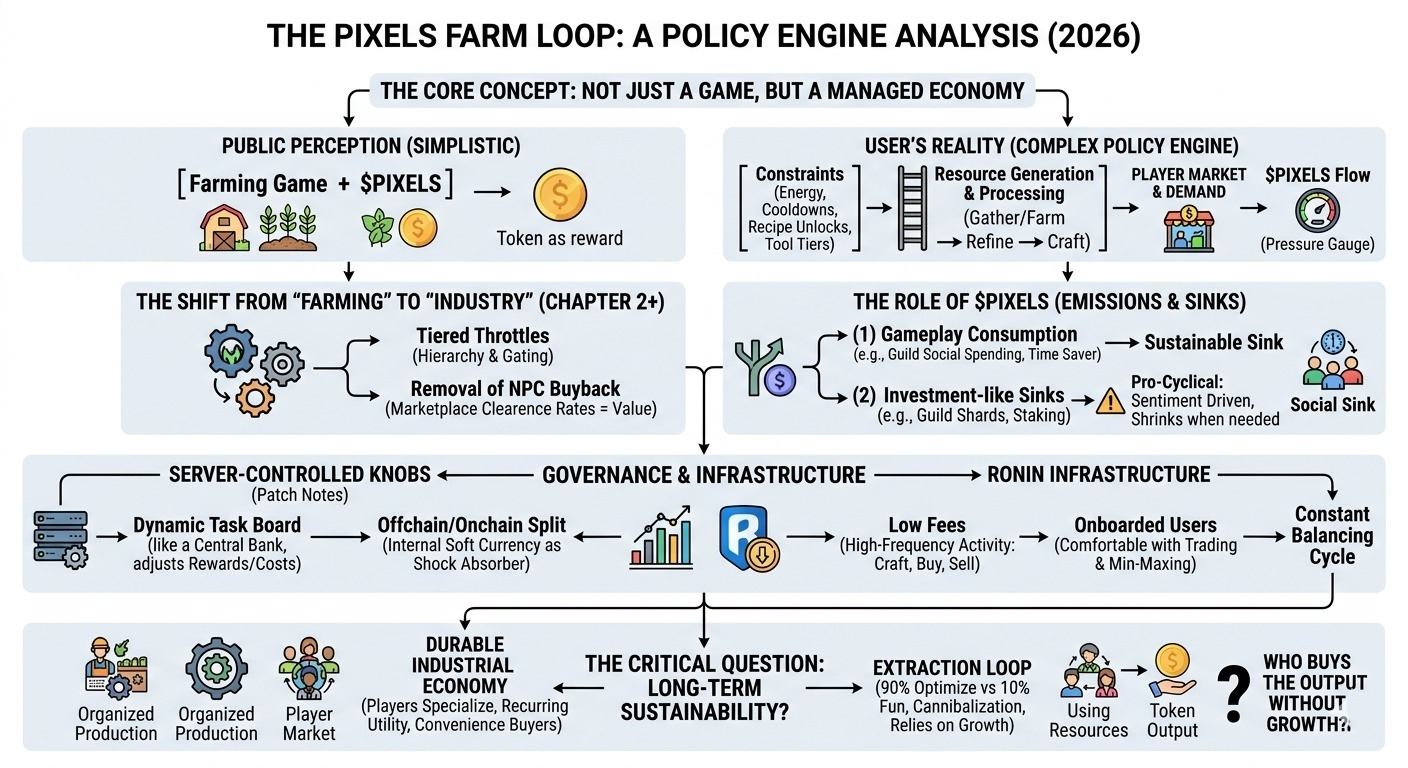
Most people still frame pixels as “farming game + $pixels,” like the token is just a reward layer you tack onto a cozy sim. but when i actually try to follow the system end to end, it feels more like: the game is a set of constraints that decide how quickly players can manufacture sellable stuff, and the token is the pressure gauge.
resource generation is the easiest place to see the shape. you’ve got the classic ladder: gather/farm → refine → craft → either consume for quests/progression or sell to other players. but it’s not just “produce as much as you want.” there are a lot of small throttles that act like supply controls: energy, cooldowns, recipe unlocks, tool tiers, maybe land/plot access depending on what you’re doing. an example i keep replaying: i harvest a crop, process it into an ingredient, craft a consumable, and list it because someone else needs it to complete a quest chain. that sounds like a normal player market, but the economics depend on how repeatable that demand is. if demand is mostly “this week’s quest wants x,” then players aren’t really responding to organic needs, they’re responding to a content schedule. which is fine, but it means the economy is more orchestrated than people admit.
then $pixels flow. honestly, this is where i stop trusting the “it’s just a game” narrative. emissions create activity and give players a clear scoreboard, but emissions also mean there’s always inflation pressure unless sinks are doing constant work. i’m trying to categorize sinks into two buckets: (1) sinks that are basically gameplay consumption (stuff you’d spend on even if you didn’t care about profit) and (2) sinks that are investment-like (spend now to earn more later). the second bucket worries me because it’s pro-cyclical. when players feel bullish, they reinvest and sinks look strong. when sentiment turns, they cut spending and the sink disappears right when you need it most.
and here’s the part i’m thinking about: in pixels, the “exit” is always visible. in a normal game, your currency is trapped, so spending is the default. here, $pixels is liquid-ish, so spending has to compete with holding or selling. that single fact makes sink design way harder than it looks on paper. a sink has to feel like a no-brainer from a fun perspective, not just from an optimization perspective.
the infrastructure layer (ronin) makes this whole design feasible. low fees mean the game can support a lot of small trades and market interactions without players feeling punished. that matters because pixels’ economy seems to rely on high-frequency behavior: selling crafted goods, buying inputs, moving assets, etc. also, ronin brings a userbase that’s already comfortable with wallets and asset trading, which helps liquidity and onboarding. but it also means the economy gets stress-tested by people who will absolutely min-max the loops. any mismatch between emissions, crafting costs, and market prices gets found quickly, and then you’re in the “tweak gates, tweak rewards” cycle.
i keep wondering about the offchain/onchain split too. gameplay state almost has to be offchain for responsiveness, while assets and the token settle onchain. that’s practical, but it means the real economic rules are server-controlled knobs: rates, drop tables, costs, eligibility. so sustainability isn’t just “tokenomics,” it’s governance-by-patch-notes. if the system needs constant intervention to stay coherent, that’s not automatically bad, but it does mean the economy is never really finished.
so, is the loop sustainable? i can see a world where players genuinely specialize, goods have recurring utility, and the market stays alive even when $pixels is boring. i can also see the less flattering world where players are mostly extracting emissions, and the item economy is an elaborate intermediate step to justify distribution. what depends on continuous user growth is liquidity and absorption: new players buy starter goods, keep low-tier markets moving, and make it easier for veterans to offload supply without nuking prices. if growth flattens, you find out if consumption is real or just event-driven.
watching:
- do sinks stay used when $pixels price/attention cools off, or do they shut off?
- marketplace clearance rates for everyday crafted items in non-event weeks
- how often emissions/gating get adjusted (balancing vs plugging leaks)
- retention after the “earning feels exciting” phase
i’m still not sure if pixels is building a durable economy or just running a very polished short-term loop. if the token goes flat and new users slow down, who’s actually buying the output?