
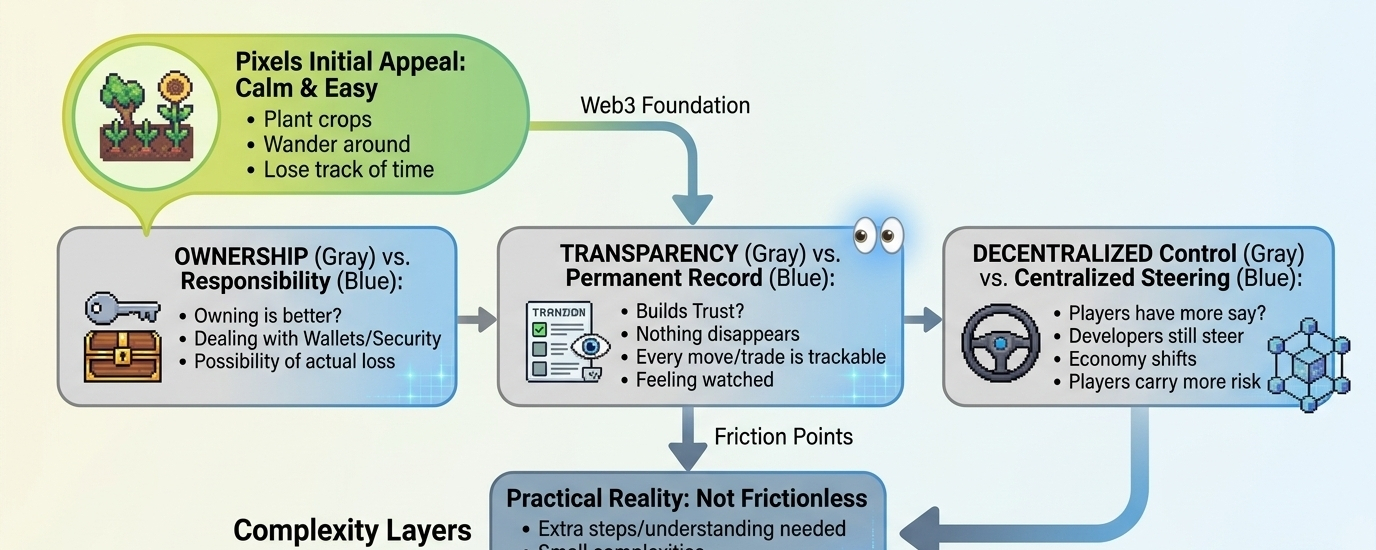

Pixels comes across like it wants to feel calm and easy plant some crops, wander around, maybe lose track of time a little. And then you remember it’s built on Web3, and the whole thing starts to feel a bit more layered than it first lets on.
There’s this idea sitting underneath it that owning things in a game is always better. And maybe it is, in some ways. But ownership here isn’t just a nice feeling it comes with responsibility. You’re dealing with wallets, security, the possibility of losing access to something that actually has value. That’s a different kind of pressure than most games ask for. It turns something light into something you have to think about, even if just a little.
Transparency is another one of those ideas that sounds good until you sit with it. Everything being open and trackable is supposed to build trust, but it also means nothing really disappears. Every trade, every move it’s all there. For some people, that’s reassuring. For others, it might feel a bit like you’re being quietly watched, even in a game that’s supposed to be relaxing.
Then there’s control, which is where things get a bit fuzzy. The whole decentralized angle suggests players have more say, or at least more balance in how things work. But realistically, the people building the game are still steering it. They decide what changes, how the economy shifts, what gets fixed and when. So you end up in this strange middle ground where players carry more of the risk, but not necessarily the same level of control.
Even on a practical level, it’s not frictionless. There are extra steps, extra things to understand, small bits of complexity that don’t exist in more traditional games. None of it is huge on its own, but together it adds a kind of weight. And for something that’s meant to feel casual, even a little weight can stand out.
What’s interesting is how it might change why people play. When there’s real value tied to what you do even in small ways it’s hard not to think differently. You might start optimizing without meaning to, or paying attention to things you’d normally ignore. The game doesn’t have to become stressful, but it might stop being completely carefree.
It’s not that Pixels is doing something wrong. It just feels like it’s trying to hold two moods at once something soft and something structured, something playful and something a bit more serious underneath. Maybe that balance works, maybe it doesn’t. It probably depends on how people actually experience it over time, not just how it’s designed to feel at the start.