i didn’t think staking on Pixels had anything to do with me at first… it always felt like a separate layer, something for people holding more pixels than actually playing. i was just inside the usual loops, Task Board, farm running, same pattern repeating, and staking sat somewhere else… passive, distant, not part of what i was doing moment to moment.
but that separation inside pixels doesn’t really hold once you sit with it longer than a few minutes, because the more i try to ignore it, the more it starts bleeding back into everything else. like where do rewards even come from… not in a vague way, but literally. they don’t just appear out of nowhere. something funds them, something routes that budget through validators, through RORS constraints, compressing it before it ever has a chance to become a Task on the board i see… and suddenly staking doesn’t look passive anymore.
it starts looking directional.
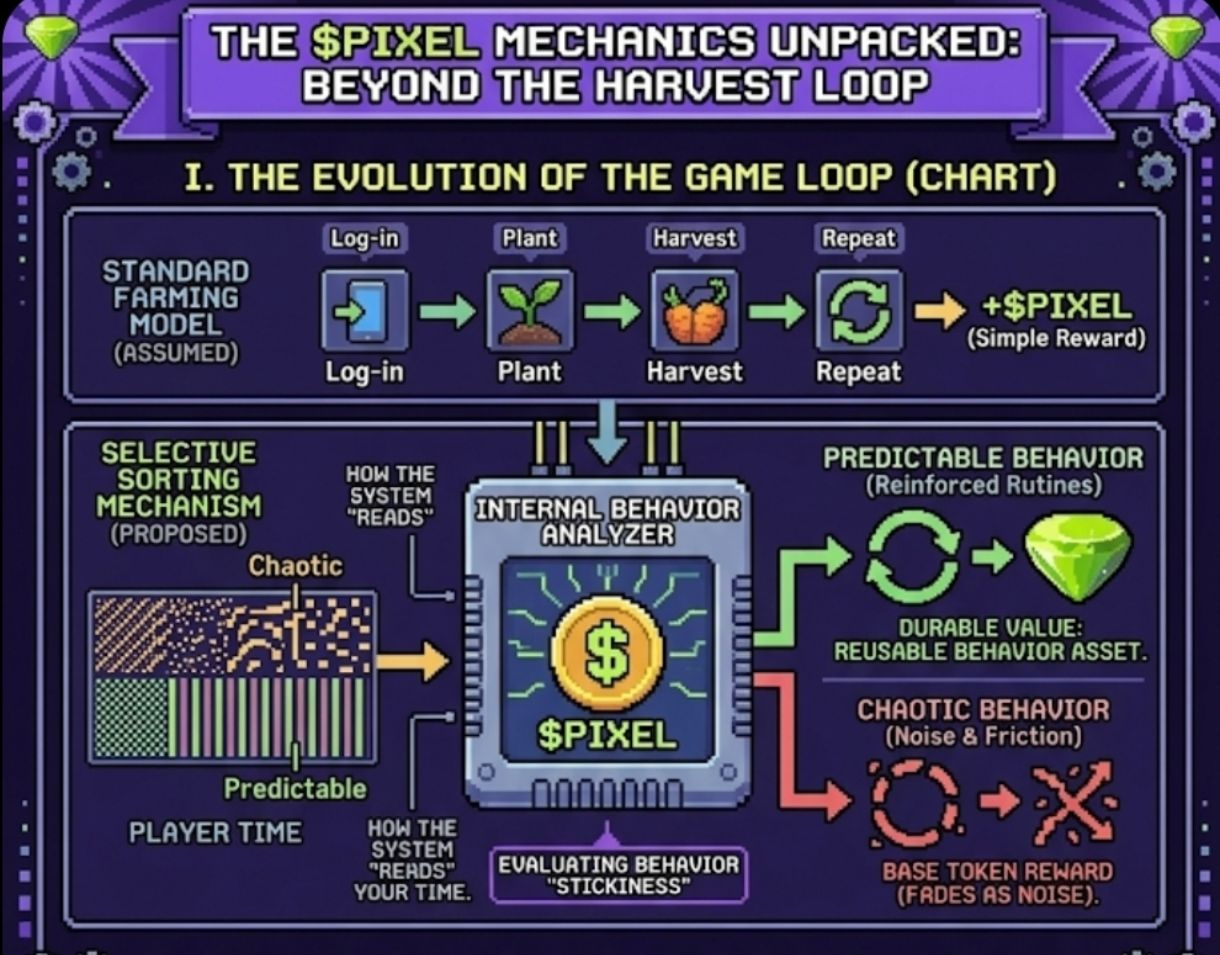
so when someone stakes pixels into a specific game… what actually happens there. is that just locking tokens, or is that pushing weight somewhere. because if that stake is tied to a validator, and that validator is where reward spend gets narrowed under RORS before anything is allowed to surface, then what i see on the Task Board isn’t neutral. it’s already reduced, already shaped… selection happening before gameplay even begins.
and i’m still here thinking i’m just playing a farm
“am i playing… or just downstream of something already filtered”
and then it shifts again, because it’s not just “someone else”… it’s players too. which makes it heavier in a way i didn’t expect, because now it’s not just a Pixels system deciding what survives. it’s a bunch of players pointing stake into validators, and those validators deciding what even qualifies to pass RORS, what becomes Tasks, what gets promoted into pixels pathways… and what never escapes Coins at all.
so what decides which game gets attention on Pixels… is it gameplay quality, or just where reward routing already allows value to pass. and how do you even separate those two here, when one feeds the other so cleanly. because if a game is receiving more routed reward budget that actually survives RORS, more Tasks that reach the board, more pixels conversion paths… of course it looks better. more activity, more players, more visible loops that actually resolve into something real.
and the ones that don’t get that flow don’t collapse loudly. they just don’t surface. fewer Tasks, thinner boards, less conversion out of Coins… like most of their activity never even made it past the first filter.
most of it doesn’t come back later either… it just never gets promoted at all.
that part doesn’t get explained.
but you can feel it.
because this isn’t just one game anymore. Pixels feels like the front layer, sure, the place where everything is visible and playable, but behind it there’s a Pixels system quietly deciding which games even get to stay alive long enough to matter. reward spend moves across validators, across games, across loops… most of which never even reach visibility because they don’t survive the constraints before the Task Board.
and in that context staking inside pixels stops looking like “earning yield” and starts feeling more like setting direction… where reward budget flows, what is allowed to surface under RORS limits, what gets reinforced because it can sustain itself without breaking the Pixels system.
and i keep coming back to that without meaning to.
because if that’s true, then i’m not just inside a game economy… i’m inside a filtered one. the rewards i see, the Tasks that feel alive, the ones that don’t… all of that is already shaped before it reaches me. most of what i do never even competes for Pixels… it just circulates in Coins, absorbed before it escalates.
so when something feels “good” to play… is that because it’s better, or because it’s receiving reward flow that actually survives RORS pressure
“fun might just be what the system can afford to surface”
and that sits differently, because now it’s not just about preference… it’s about allowance. what passes through RORS, what the Pixels system can afford to emit as pixels without breaking its own balance, what actually survives that pressure long enough to show up as a Task instead of disappearing into Coins loops.
and that loops back into behavior again, because players move toward what feels alive, staking moves toward what already survives those filters, and the whole thing tightens without needing to force anything.
so where does something new even break through… does it need to be better, or just receive enough routed reward budget that actually clears RORS early enough to even appear on the board consistently.
and if it’s the second one, then this isn’t really discovery.
it’s selection under constraint.
which means Pixels isn’t just solving the old play-to-earn problem by controlling exits or filtering rewards… it’s solving it earlier than that. at the point where reward spend is routed, where RORS decides what can even exist as a Task, where most gameplay never leaves Coins because it never qualifies to escalate.
so when i think about staking now, it doesn’t feel like a side feature anymore. it feels like the quiet center of everything… the part that decides which loops actually receive Pixels pathways, which games get consistent Task Board presence, which ones stay trapped in Coins circulation without ever becoming economically visible.
and i’m still here planting crops like that’s the main layer of pixels, but maybe it isn’t. maybe this whole thing isn’t about optimizing gameplay at all, maybe it’s about steering reward flow under constraint, and letting everything else behavior, players, attention, compress around whatever survives.
which makes the question shift again, but not in a clean way not what should i play next but something that sits a bit deeper.
who’s actually deciding what gets to become a Task on Pixels… and how much of what i’m doing never even gets that far.