

I’ll be honest… I didn’t plan on caring about another crypto game.
At some point, everything started blending together. New tokens every week, new “ecosystems,” new promises dressed up in slightly different language. AI gets thrown into the mix now, like seasoning on something that doesn’t really need it. Influencers are still yelling. Timelines are still full of conviction that somehow disappears the moment charts turn red. And the cycle just keeps looping like it always does.
You’d think after seeing enough of this, you’d stop paying attention entirely.
But here I am, looking at Pixels.
Not excited. Not dismissive either. Just… looking.
Because underneath all the noise, the idea it’s playing with isn’t fake. That’s the uncomfortable part. The problem of ownership in games has always been real. People sink hundreds, sometimes thousands of hours into these virtual worlds, building things, collecting things, grinding through repetitive loops — and none of it actually belongs to them. It’s all locked inside someone else’s servers. Always has been.
Crypto showed up and said, “what if it didn’t have to be like that?”
And yeah, in theory, that’s compelling. Still is.
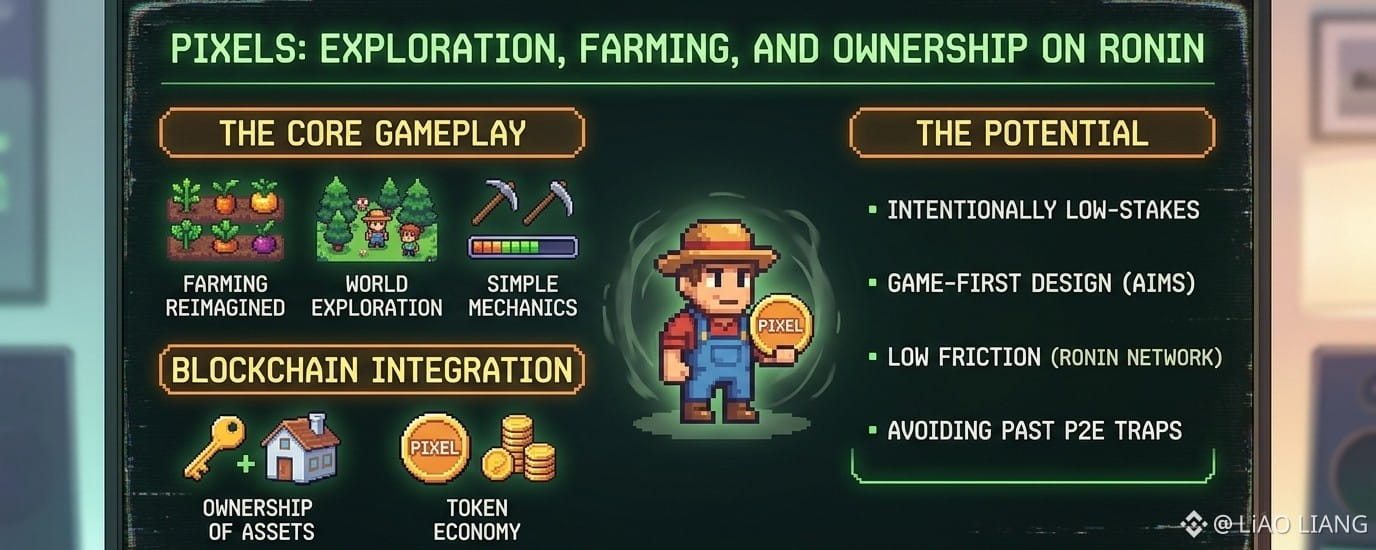
Pixels leans into that idea, but in a quieter way than most projects I’ve seen. It’s not trying to be some hyper-realistic metaverse or a AAA blockbuster. It’s farming, exploration, simple mechanics, pixel art. Almost intentionally low-stakes on the surface. And maybe that’s the point. Because if you’re being real about it, most people don’t want some complicated blockchain experience — they just want something that feels like a game.
That’s where Pixels actually has a shot.
But then again… we’ve said that before, haven’t we?
Every Web3 game claims it’s “game-first.” Every single one. And yet somehow the economy always ends up sitting in the driver’s seat. You start with fun, and then slowly, quietly, the incentives take over. Players optimize. Systems get gamed. The experience shifts from playing to calculating.
That’s the part that sticks in my head when I think about Pixels.
Because no matter how soft the visuals are, no matter how relaxed the gameplay loop feels, there’s still a token sitting underneath it all. PIXEL. And once a token exists, behavior changes. It always does.
People don’t just play anymore. They evaluate. They compare time spent versus value extracted. They ask whether it’s “worth it.”
And honestly… that’s where things tend to get messy.
To be fair, it looks like Pixels is at least aware of that trap. There are attempts to slow things down, to avoid the instant drain that killed earlier play-to-earn systems. Mechanics that try to keep value circulating instead of immediately leaking out. You can tell someone on the team has seen what happened in previous cycles and is trying to adjust.
But let’s be real for a second.
You can design all the clever systems you want — if people are there to earn, they will eventually try to leave with something.
That tension doesn’t go away just because you’ve smoothed the edges.
And maybe that’s the bigger question hanging over all of this. Not just Pixels, but the entire category. Can a game with real financial incentives ever feel like a normal game again? Or does the presence of money permanently change the experience?
I don’t think anyone has fully answered that yet.
What Pixels does have going for it, though, is something more subtle. It doesn’t feel like it’s trying too hard to impress. And weirdly, that matters. There’s no over-the-top narrative about changing the world. No grand philosophical mission. It’s just… a game, with some blockchain elements stitched in.
That alone makes it stand out more than it should.
And the infrastructure choice — Ronin — is one of those boring but important decisions that people overlook. It’s not flashy, but it works. Fast transactions, low friction, something that doesn’t immediately punish you for interacting with it. After dealing with clunky wallets and painful gas fees for years, you start to appreciate that kind of thing more than you’d expect.
Still, even with all that, I can’t shake the feeling that this space has a memory problem.
We forget too quickly.
We forget how fast things can fall apart once growth slows. We forget how fragile these in-game economies can be. We forget that “millions of users” doesn’t necessarily mean millions of people who actually care — sometimes it just means millions of people passing through.
And that’s the part that worries me with Pixels.
Not whether it works right now, but whether it holds up when the easy momentum fades.
Because that’s when the real test begins.
Are people still logging in because they enjoy it?
Or because they’re hoping it pays off?
Those two motivations can coexist for a while. But eventually, one of them wins.
I find myself going back and forth on it. Some days I think maybe this is closer to what Web3 gaming should look like — simpler, less aggressive, more focused on actual gameplay. Other days I think it’s just another version of the same experiment, slightly better designed, but still carrying the same underlying risks.
And honestly… both of those things can be true at the same time.
Maybe it works, maybe it doesn’t.
Maybe it finds a stable niche and quietly survives while everything louder burns out. Or maybe it follows the same path we’ve already seen, just stretched over a longer timeline.
I’m not rooting against it.
I’m just past the point of believing easily.
At this stage, curiosity is about as far as I’m willing to go.
