

When I first came across Pixels I’ll be
honest I didn’t think too much of it
At surface level, it looked like just another
GameFi project trying to follow
the usual formula.You know the type
simple gameplay loop, farm a bit earn some
tokens maybe flip them and move on
We’ve seen that model so many times that it’s
hard to get excited anymore
So yeah, my first impression of PIXEL
was pretty basic. Just another in
game token tied to a farming simulator
But the more time I spent actually exploring
Pixels the more that initial assumption started breaking
Because once you go a bit deeper
it doesn’t really behave like a typical game
anymore.
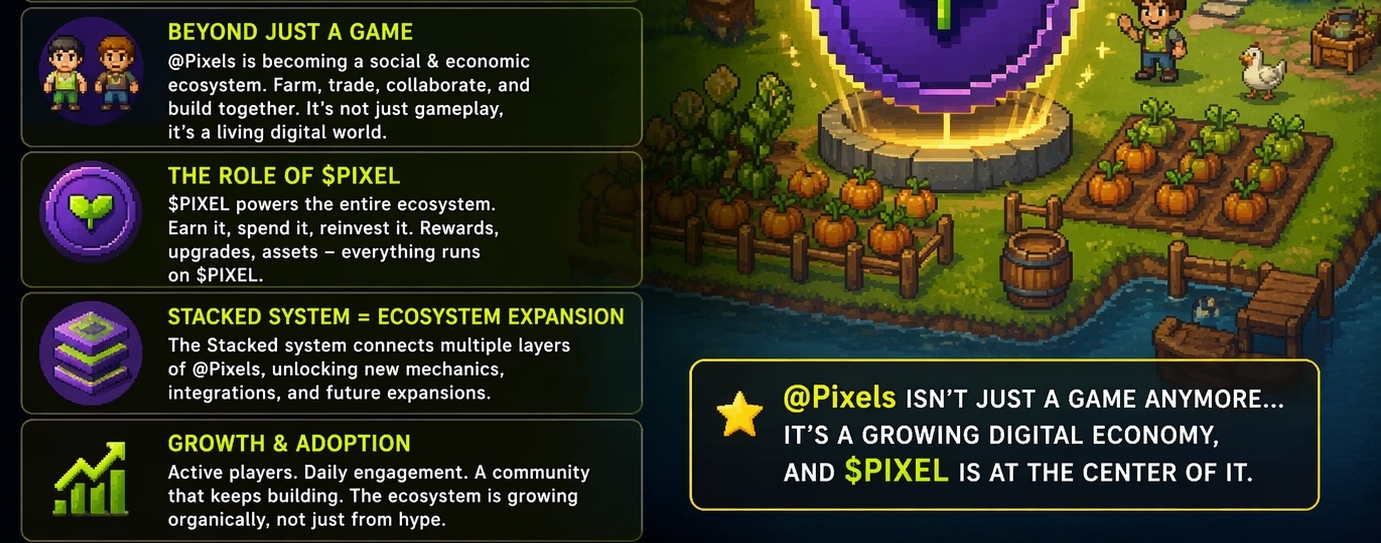
At its core, Pixels is still a farming game you grow crops, collect resources, manage your land. That part is simple and easy to
understand. But layered on top of that is
something more interesting: interaction, coordination
and small economic decisions that actually matter
You’re not just playing solo.
You’re part of a system.
Players trade, collaborate, compete for
efficiency, and optimize how they use
resources. That’s where it starts shifting from
“just gameplay” into something closer to a micro-economy.
And this is exactly where
PIXEL becomes important
At first, I thought PIXEL was just a reward mechanism play the game earn tokens
that’s it. But it’s actually sitting in the middle of multiple loops inside the ecosystem.
You earn pixel through activity
You spend it on upgrades, assets or
progression
You reinvest it back into your gameplay
And then the cycle continues.
That loop creates a kind of internal economy that doesn’t feel static. It’s dynamic, because player decisions affect how value flows inside the system.
It’s not just “earn and dump
There’s actual usage.
Another interesting layer here is what they call the Stacked system.
Now, from the outside. it might sound like just another backend feature. But if you simplify it, it’s more like an expansion layer for the ecosystem.
Instead of Pixels being locked into one fixed gameplay loop, the Stacked approach allows it to evolve. It connects different mechanics, potentially different experiences, and creates more ways for players to engage with the system.
So instead of one closed loop, you start getting multiple loops interacting with each other.
That’s a big difference.
Because most GameFi projects struggle with retention once the initial hype fades. But when you have expanding loops and deeper systems, you give players more reasons to stay.
And from what I’ve been seeing, player activity inside Pixels has been relatively consistent.
It’s not just a short-term spike
There’s actual engagement
happening People are spending time in the game, experimenting
optimizing, and participating in the economy That kind of behavior usually
signals something more sustainable than just hype driven traffic.
Now, I’m not saying this is perfect or that it’s guaranteed to succeed long term. That would be unrealistic.
But what stands out to me is the direction.
Pixels doesn’t feel like it’s trying to be just a “game with a token
It feels like it’s slowly building an ecosystem where the game is just one part of a larger structure.
And that’s an important distinction.
Because if PIXEL continues to stay integrated across these loops rewards, spending, progression, and expansion then its role becomes more than just a simple in-game currency.
It becomes a key piece of the system.
A lot of projects talk about utility but here you can actually see how the token is being used inside the environment. It’s not abstract. It’s tied directly to player behavior.
That’s usually a stronger foundation than pure speculation.
Also, the social layer shouldn’t be ignored.
Even though it’s subtle, the interaction between players adds another dimension. When people are not just playing, but also engaging with others, trading, and coordinating, it strengthens the overall ecosystem.
Games come and go.
Communities and economies tend to last longer.
And Pixels seems to be leaning more toward that second category.
From a trader’s perspective, this is
where things get interesting
Not in a “quick flip” kind of way, but in understanding how value might
build over time if the ecosystem keeps expanding.
Because if Pixels successfully grows its loops, increases participation, and keeps $PIXEL at the center of that activity, then you’re
not just looking at a game anymore.
You’re looking at a digital environment where value circulates continuously.
That’s a very different narrative compared to traditional GameFi
So yeah, my view has
definitely changed.
What started as just another farming game now looks more like an evolving system with economic
behavior, player.driven activity.and room to expand
Still early still developing but clearly moving in a direction that’s worth paying attention to
At the end of the day Pixels isn’t really acting like just a game anymore #pixel $PIXEL @Pixels
