
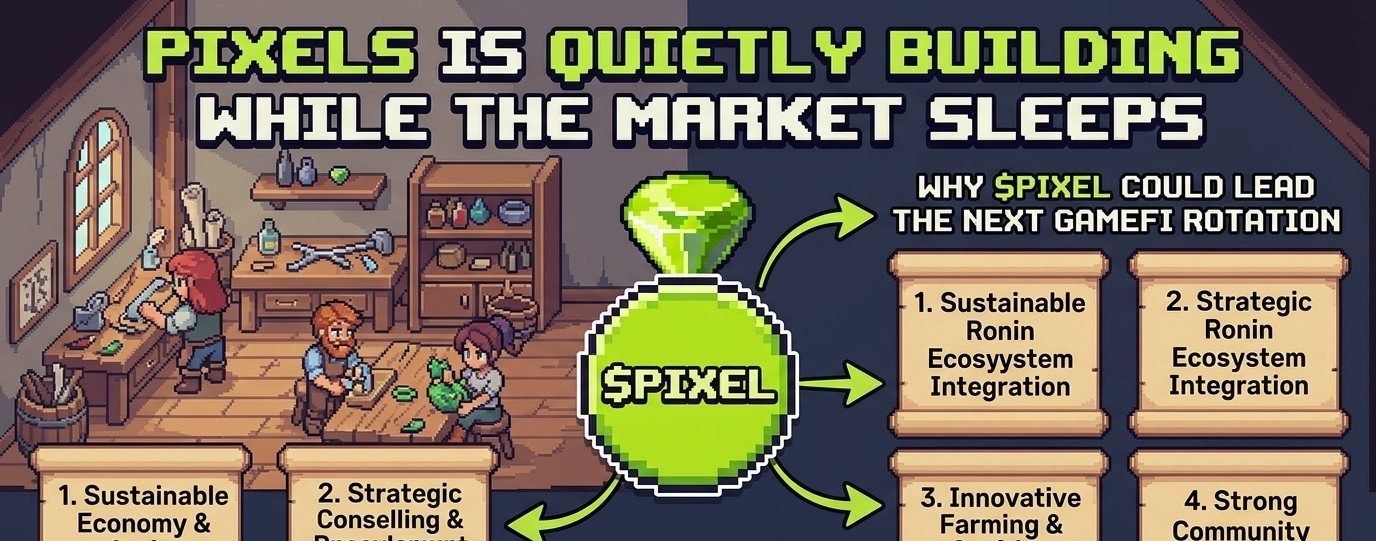
There’s something changing in the market right now, and if you look closely, it’s not about hype anymore. Liquidity hasn’t disappeared, it’s just become more selective. Money is no longer blindly flowing into every trending token. Instead, it’s slowly rotating into ecosystems that can actually hold attention and create ongoing activity. That shift is exactly where @Pixels starts to stand out in a meaningful way.
Most traders are still stuck chasing quick pumps, but the reality of the current market is different. Volatility comes in short bursts, and then everything cools off again. In this kind of environment, projects without depth struggle to maintain momentum. You’ll see the same pattern again and again: a spike, excitement, then silence. Pixels doesn’t fit neatly into that cycle, and that’s what makes it interesting.
The strength of $PIXEL isn’t just in price movement, it’s in how its ecosystem is structured. The stacked system behind Pixels keeps generating activity through gameplay, resource management, and player interaction. This isn’t just surface-level engagement. It’s a loop where users are constantly participating, which naturally feeds into the token economy. Even when the market slows down, that internal activity doesn’t completely stop.
That creates a different kind of behavior from a trading perspective. Instead of depending entirely on external hype, Pixels builds a base of demand from within. When market sentiment improves, assets like this tend to move faster because they already have attention and usage built in. It’s not starting from zero every time momentum returns.
Now if you compare this with a lot of competing GameFi projects, the difference becomes clearer. Many of them are still designed around reward-heavy systems that attract users quickly but fail to retain them. Once rewards drop or excitement fades, the ecosystem weakens. Pixels feels more balanced. The focus isn’t just on extracting value, it’s on keeping users engaged over time. That changes everything in terms of sustainability.
Right now, the broader market is going through a phase where smart money is quietly positioning rather than chasing. You can see accumulation patterns forming across projects that show real usage. Pixels fits into that category because it’s not relying on a single narrative. It has multiple layers working together, which gives it more stability compared to one-dimensional tokens.
Another thing worth paying attention to is how the ecosystem keeps evolving. The stacked structure means different elements are connected, so growth in one area can influence the entire system. That kind of design creates compounding effects over time. It may not always look explosive in the short term, but it builds pressure beneath the surface.
For traders, this opens up a different way to approach $PIXEL. It’s not just about catching a pump, it’s about understanding how the system behaves during both slow and active phases of the market. When you start looking at it this way, it becomes less about guessing and more about reading patterns.
Competition in GameFi is still intense, no doubt. New projects keep entering, and attention shifts quickly. But most of them are still chasing visibility rather than building something that lasts. Pixels is taking a quieter route, focusing on structure and consistency. That might not always grab immediate headlines, but it often leads to stronger positioning when the market turns.
As things stand, the market is preparing for its next bigger move, even if it doesn’t look obvious yet. When that shift comes, capital usually flows toward ecosystems that have already proven they can sustain activity. Pixels is gradually placing itself in that group.
So while others are watching charts for quick signals, there’s value in watching systems that are still working even when the noise fades. That’s where Pixels becomes more than just another token. It becomes something you can actually track, understand, and potentially position around as the next phase of the market unfolds.
