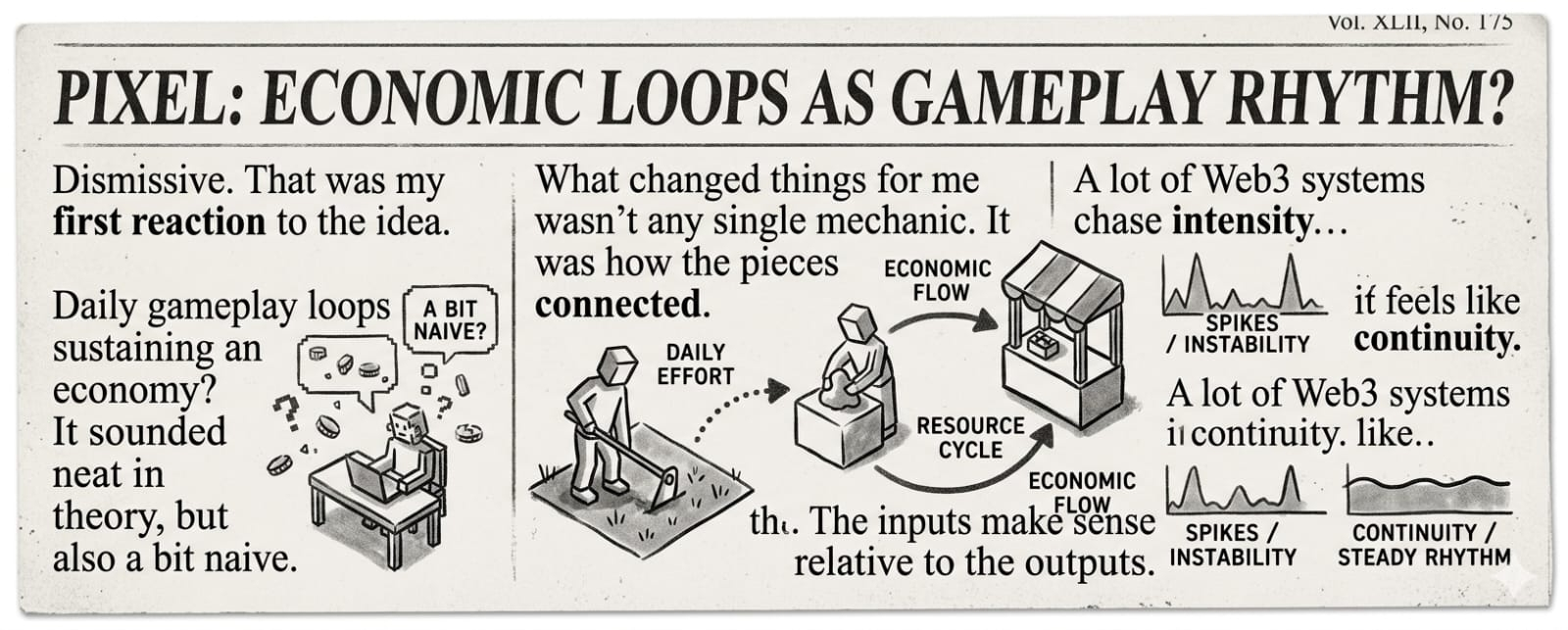
I’ll admit, my first reaction to the idea was pretty dismissive.Daily gameplay loops sustaining an economy? It sounded neat in theory, but also a bit naive. I’ve seen too many systems lean on repetition and call it “engagement,” only for it to slowly turn into grinding, and then eventually… nothing. People show up, do the same thing over and over, and at some point they stop asking why they’re doing it. Or worse, they start asking and don’t like the answer.
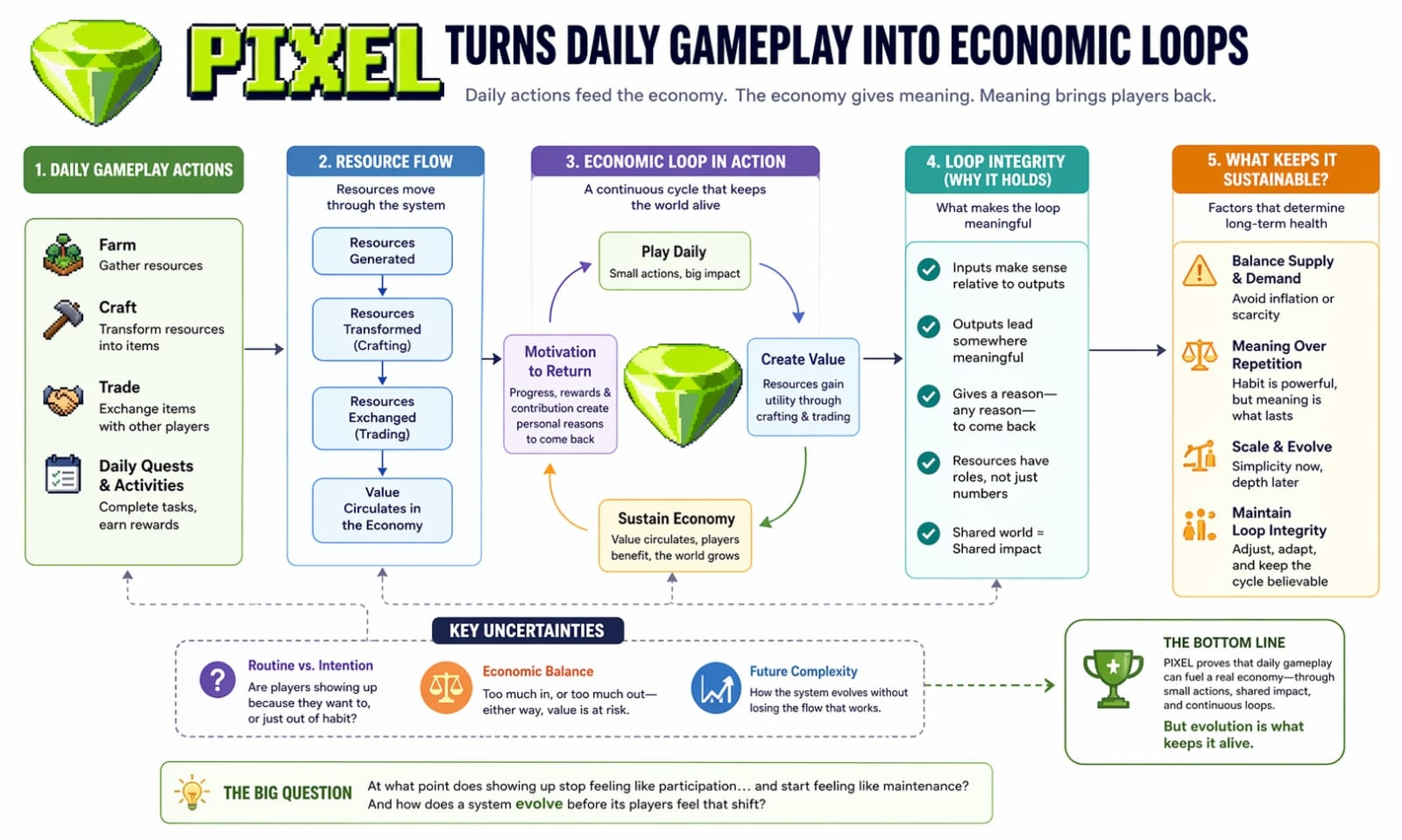
So when I looked at PIXEL, I kind of assumed it would follow that same path. Simple loops, daily actions, light structure it felt like something that would work for a while and then quietly lose its weight.But the more I paid attention, the harder it became to stick with that assumption.What changed things for me wasn’t any single mechanic. It was how the pieces connected. Logging in daily isn’t the interesting part on its own. Plenty of systems manage to get people to show up. What stood out here is that those small, almost forgettable actions actually feed into something larger. Farming gives you resources, crafting reshapes those resources, and trading pushes them back into circulation. None of it feels big in isolation, but together it forms this kind of quiet, ongoing cycle.And I think that’s where it starts to feel different.A lot of Web3 systems chase intensity. They build around spikes big rewards, rare items, sudden opportunities. It creates excitement, sure, but it’s also unstable. Once that peak moment passes, there’s often not much left holding things together. People come for the highs, and when those fade, so does everything else.Here, it feels like the opposite approach. Less about peaks, more about continuity. Nothing is trying too hard to be a “moment.” Instead, it’s just… always there, slowly moving.The way I’ve been thinking about it is through something I’d call “loop integrity.” Not just whether a loop exists, but whether it actually holds up when you look closer. Do the inputs make sense relative to the outputs? Do the outputs lead somewhere meaningful, or do they just sit there? And most importantly, do they give you a reason any reason to come back and do it again In PIXEL, at least right now, those loops feel intact. Resources aren’t just numbers going up for the sake of it. They have roles. They move through the system. And that movement gives even simple actions a bit of weight. You’re not just clicking through tasks you’re contributing, even if in a small way, to something that feels shared.But there’s another layer to this that I can’t ignore.Daily actions create rhythm. And rhythm, over time, turns into habit. You stop thinking about whether you should log in you just do. It becomes part of your day in the same way other small routines do. That’s powerful in a subtle way. It doesn’t rely on excitement or urgency. It just quietly embeds itself.Still, that’s also where things start to feel uncertain.Because habits can hold a system together… but they can also mask when something stops being meaningful. If people keep showing up out of routine rather than intention, is that still engagement? Or is it just inertia?Then there’s the economic side, which feels even more fragile. For these loops to matter, what comes out of them has to keep some kind of value. If resources pile up too quickly without enough ways to use or remove them, everything starts to feel diluted. On the flip side, if the system takes too much out through costs, sinks, or friction it can make the effort feel pointless.And that balance isn’t something you solve once and move on from. It shifts constantly, depending on player behavior, growth, and even sentiment. That’s the part that makes me hesitate. It’s not just about designing good loops it’s about maintaining them in a way that keeps them believable.I also keep coming back to the question of scale.What feels clean and accessible now might start to feel limited later. Players adapt. They get faster, more efficient, more aware of the system. And when that happens, simplicity can start to feel like a ceiling instead of a strength. But adding complexity isn’t a simple fix either it risks breaking the flow that made everything work in the first place.So I find myself somewhere in between.I can see what PIXEL is doing, and I can see why it works right now. Turning daily gameplay into something that feeds an economy even in a small, steady way isn’t trivial. It’s actually kind of rare to see it hold together this well.But I’m not fully convinced it’s enough on its own.Because eventually, repetition always raises the same question, whether we want to ask it or not: at what point does showing up stop feeling like participation… and start feeling like maintenance?And more importantly how does a system evolve before its players start to feel that shift