
I didn’t come into Pixels expecting much. At first glance, it feels simple — farming, crafting, walking around, repeating small tasks. Nothing about it immediately signals “this is where capital flows next.”
But the longer you stay, the more something subtle starts to stand out: nothing is pushing you to rush… yet you don’t feel like leaving either.
That’s where it gets interesting.
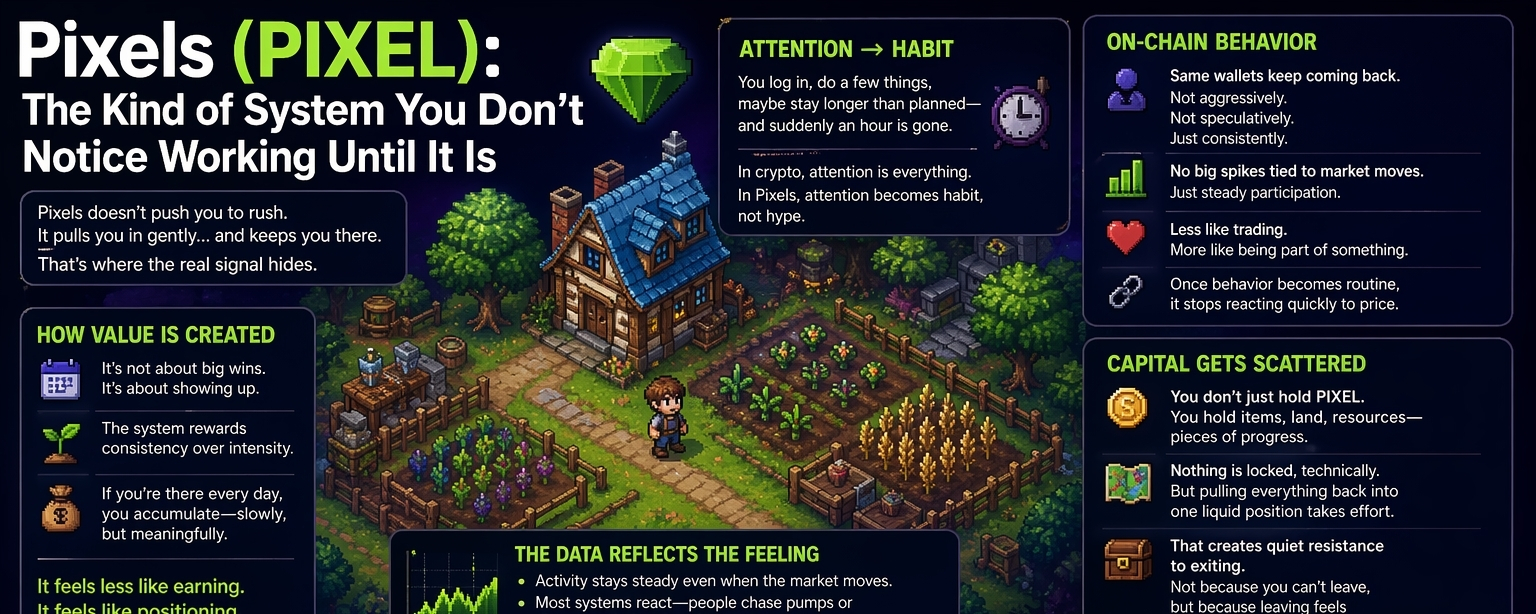
Most crypto systems are built on urgency. Buy before it pumps. Farm before emissions drop. Exit before everyone else does. Pixels doesn’t create that pressure. Instead, it stretches your time. You log in, do a few tasks, maybe stay a bit longer than planned — and suddenly an hour is gone, without thinking about price once.
That might sound small, but in crypto, attention is everything. And here, attention isn’t being converted into hype — it’s being converted into habit.
That habit shows up on-chain in a quiet way. The same wallets keep returning. Not aggressively, not speculatively — just consistently. You don’t see sharp spikes tied to market moves. You see steady participation.
It feels less like trading… and more like checking in on something you’re already part of.
And once behavior becomes routine, it stops reacting quickly to price.
What surprised me most is how value forms inside Pixels. It’s not driven by big wins. It comes from showing up. The system rewards consistency more than intensity. If you’re there every day, you accumulate — slowly, almost invisibly — until it becomes something meaningful.
It doesn’t feel like earning. It feels like positioning.
And because of that, people don’t treat their holdings like something to flip. Their “earnings” are tied to time already spent. Selling isn’t just financial — it feels like closing a loop.
That emotional friction isn’t visible in tokenomics, but it shows up clearly in behavior.
Then there’s how capital gets distributed.
You’re not just holding PIXEL. You’re holding items, land, resources — fragments of progress. None of it is locked, technically. But consolidating everything back into a liquid position takes effort.
That creates quiet resistance to exiting.
Not because you can’t leave — but because leaving feels inconvenient.
And when you look at the data, it reflects that. Activity remains steady even when the market moves. That’s rare. Most systems are reactive — people chase pumps and disappear during drawdowns.
Here, they just… continue.
But there’s a flip side.
This system works as long as participation feels worthwhile. The moment rewards start to feel slightly less efficient, behavior begins to shift. Not dramatically — but noticeably.
People stop wandering and start optimizing.
They log in with intention instead of curiosity.
They focus on extracting value instead of experiencing it.
That shift — even if subtle — changes everything.
You won’t see it immediately in price. You’ll feel it first in the “vibe” of the game. Less exploration, more efficiency. Less social behavior, more calculation.
That’s usually the early signal that an economy is tightening.
Right now, Pixels sits in a unique position. It’s not dominating attention — but it’s holding it. And in this market, holding attention is harder than attracting it.
Capital isn’t rushing in. But it’s not rushing out either.
It’s just… sitting there.
Spread across thousands of small, repeated actions.
That’s why PIXEL doesn’t behave like most tokens. It doesn’t spike the same way. It doesn’t collapse the same way either.
It moves slower — because the people inside it move slower.
And that might be its biggest strength, at least for now.
If you want to understand where it goes next, don’t just watch the chart. Watch the behavior.
Because the real signal won’t be price.
It’ll be the moment the habit breaks —
when showing up starts to feel like a task instead of something you just do.
That’s when everything else follows.