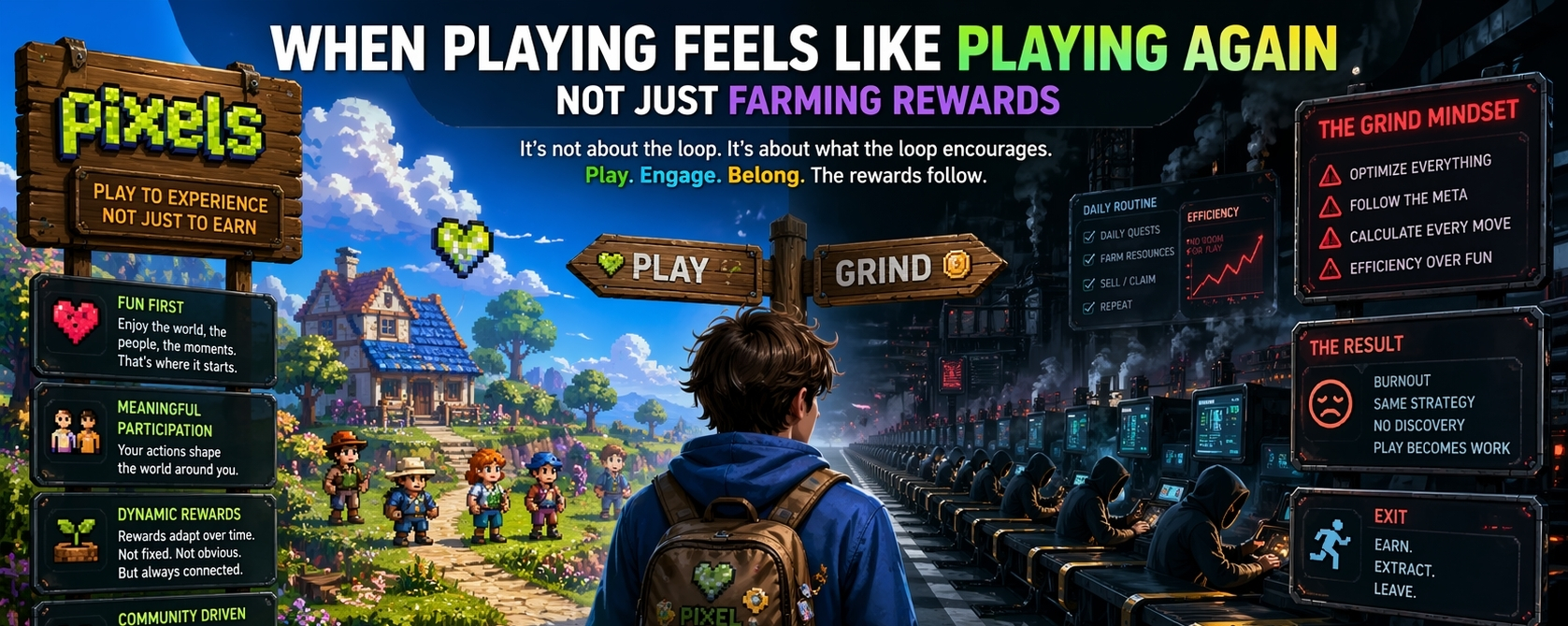
@Pixels Maybe it’s just me, but a lot of Web3 games don’t lose players—they lose the feeling of play. You log in expecting something simple, something enjoyable, and without realizing it, your mindset shifts. You stop thinking like a player and start thinking like a strategist. Time becomes input, rewards become output, and suddenly everything is about efficiency. No one tells you to do it this way—it just quietly takes over. And once that happens, the “game” part doesn’t disappear completely, but it fades enough that you notice something is missing.
I’ve experienced this more than once. At the start, everything feels exciting. The loop is clean and satisfying—you do something, you get something, and you repeat. It works because it’s easy to understand and rewarding enough to keep you going. But the longer you stay, the more predictable it becomes. Eventually, there’s a “best way” to play, and once that path is clear, most people follow it. That’s the moment things shift. You’re not exploring anymore, not experimenting—you’re just executing a solved strategy.
Going into Pixels, I expected that same pattern to repeat. Another farming loop, another token economy, another cycle of early hype followed by optimization. It felt familiar before it even began. But after spending some real time with it, I noticed something subtle. It didn’t push me to optimize right away. I didn’t feel that urgency to turn everything into numbers and calculations. And what stood out even more was the players themselves—they were still active, still engaged, but not drained or burnt out. That alone made me slow down and actually pay attention.
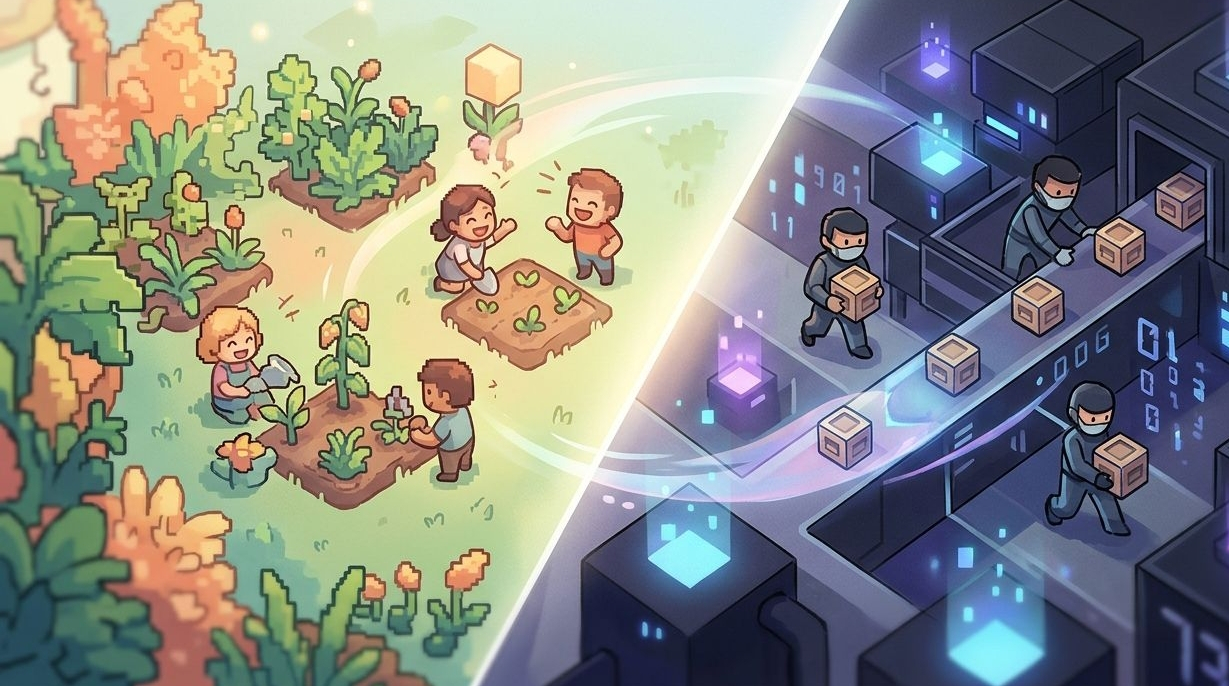
It made me realize that maybe the problem isn’t the loop itself—it’s what the loop encourages. When a system is built around maximizing output, players will naturally treat it like a machine. Efficiency becomes the goal, and enjoyment becomes optional. But when rewards aren’t completely obvious or fixed, something changes. You can’t just rely on repetition and optimization. You have to stay involved, pay attention, and actually engage with what’s happening.
That difference is small, but it matters. When everything is predictable, players eventually collapse into the same behavior. But when things are a little less transparent, people start approaching the game differently. There’s more variation, more curiosity, more room to just play instead of perform. It creates the feeling that the system is not just handing out rewards, but reacting—quietly shaping itself around how people participate.
Over time, that changes your focus. It’s no longer just about how much you can produce, but how you’re showing up. And that shift makes the experience feel lighter, less mechanical. Even when tokens are involved, they don’t feel like the only reason to be there. Their value seems connected to continued engagement rather than quick extraction, which creates a different kind of balance. But it’s also fragile. The moment value becomes too obvious or too high, the instinct to optimize will come back stronger than ever.
And to be honest, I’m not completely convinced yet. Every system that carries value eventually gets analyzed, broken down, and optimized. That’s just how people work. You can already feel that pressure slowly building in the background. It’s not a flaw—it’s just reality. The real question is whether a system can keep evolving fast enough to stay ahead of that behavior.
In a way, it reminds me of how platforms grow over time. At the beginning, everything feels natural and open. Then people start figuring things out, and behavior begins to shift. Eventually, it’s not the system that changes the most—it’s the way people interact with it. And once that happens, it’s incredibly difficult to go back.
What I find interesting here is how progression doesn’t feel forced or clearly defined. There’s no sharp line between where you start and where you end up, but over time you can see players naturally moving in different directions. It’s not something the system pushes—it just happens based on how people choose to engage. And that gives the whole experience a more organic feel.
At the end of the day, it’s not really about tokens or rewards. Those things matter, but they’re not the core. What actually matters is whether people keep coming back. Because if they don’t, nothing else holds value for long. And right now, the loop feels less like “earn and leave” and more like “play and return.” It’s slower, less aggressive—but maybe that’s exactly why it works.
It’s still early, and systems like this take time to show what they truly are. Maybe it will eventually fall into the same patterns as everything else, or maybe it will manage to hold that balance a little longer. For now, it just feels different enough to be worth watching closely.
“Fun first, rewards later” sounds simple.
But keeping it that way is where things get difficult.