
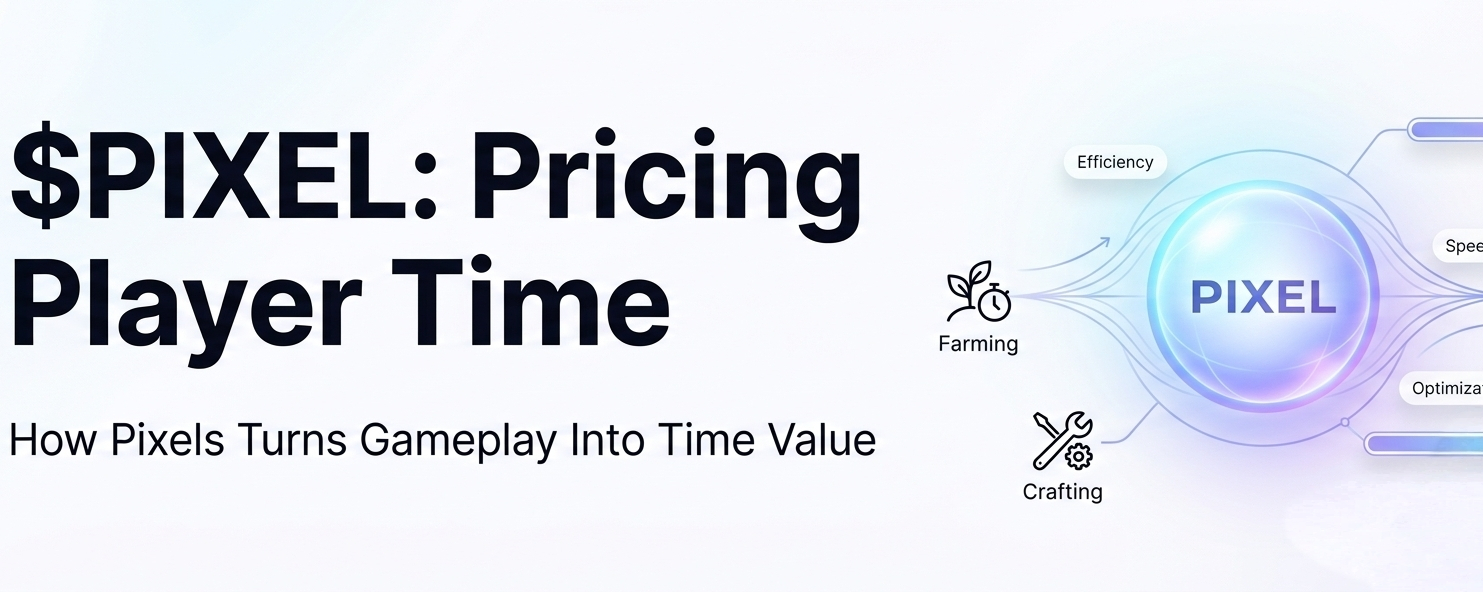
For years, time in games has felt light. You log in, complete a few tasks, maybe grind a bit, then log out. Progress happens, but it rarely feels like your time carries a clear, transferable value. Unlike work or infrastructure—where time is priced, optimized, and measured—games have traditionally treated time as something flexible, almost disposable.
That assumption starts to break down when you spend enough time inside Pixels.
At first, nothing feels different. The structure is familiar. You plant crops, wait for them to grow, harvest, repeat. It looks like a standard farming loop layered with progression systems. But as you continue playing, a subtle shift begins to emerge. Activities that should feel separate—farming, crafting, upgrading—start to feel comparable in a way that most games don’t usually allow.
This isn’t obvious at the beginning. There’s no message telling you that time is being measured differently. But over time, you begin to notice that every action carries a kind of implicit cost, not just in resources, but in time itself.
That’s where Pixels starts to diverge from typical game design.
Most games isolate their systems. Time spent farming has no direct relationship to time spent crafting or completing quests. Each loop exists in its own space, with its own reward logic. As a player, you move between them without needing to compare their efficiency in a meaningful way.
Pixels, however, seems to be building a structure where those boundaries blur.
Without explicitly stating it, the system begins to align different activities under a shared logic. Waiting becomes a factor everywhere. Progression is shaped by timing. Decisions start to revolve around whether something is worth doing now, later, or faster.
And in the middle of all this sits $PIXEL.
At first, it looks like a standard in-game token. Something you earn, spend, and accumulate. But as you interact more deeply with the system, it begins to feel less like a reward and more like a tool for adjusting time.
You start asking different questions. Not just “What should I do next?” but “Is this worth the time it takes?” or “Should I use Pixel to speed this up?” These decisions don’t stay confined to a single activity. They extend across the entire game.
Farming, crafting, upgrading—they all start to feel like variations of the same underlying calculation.
This changes how you experience the game.
Instead of choosing actions based purely on preference or curiosity, you begin to evaluate them based on efficiency. Which activity gives the best return for the time invested? Where is the least friction? What path moves you forward faster?
Without realizing it, you shift from playing to optimizing.
What makes this system particularly interesting is how subtle it is. There’s no aggressive push to spend. No obvious pressure. But small delays exist everywhere—waiting timers, minor progression gaps, slight inefficiencies that accumulate over time.
Individually, they don’t feel significant. Together, they create a constant background tension.
You always have two options: wait, or adjust.
And that adjustment is where $PIXEL becomes relevant.
In many ways, this resembles how modern digital infrastructure works. In cloud systems, you don’t pay for outcomes directly—you pay to reduce latency. Faster processing, quicker responses, improved efficiency. The value lies in saving time.
Pixels appears to apply a similar concept, but within a player-driven environment.
Instead of machines, it’s human behavior that gets shaped.
Two players might spend the same number of hours in the game, yet end up with completely different results. The difference isn’t just effort—it’s how their time was allocated, optimized, and, in some cases, accelerated through the use of $PIXEL.
This is where time stops being neutral.
It becomes structured.
And once a system reaches that point, new dynamics begin to emerge.
Players naturally gravitate toward efficiency. They search for the best returns, the fastest loops, the lowest friction paths. Over time, patterns form. Strategies converge. What initially feels like an open world starts to resemble a network of optimized routes.
This isn’t unique to Pixels. It happens in nearly every system where value can be measured and compared.
But here, the effect is tied directly to time.
That introduces a layer of fragility.
Because once players recognize that time is being shaped—intentionally or not—they begin to question the system itself. Are these delays natural? Are they part of the design to encourage engagement, or are they placed to influence behavior? Is speeding up a choice, or is it subtly encouraged?
These questions don’t immediately break the experience, but they change how it’s perceived.
Trust becomes part of the system.
Even if everything is technically balanced, perception matters. If players feel that their time is being manipulated rather than respected, the dynamic shifts.
Pixels seems to exist right on that edge.
On one hand, it creates a more unified and consistent economy. Time across different activities becomes comparable, which brings a level of structure that most games lack. On the other hand, that same structure introduces the risk of over-optimization and player skepticism.
Still, there’s something compelling about the direction.
If time can be made consistent within a single system, it opens the possibility of extending that logic beyond one game. It suggests a future where effort—not just assets—can carry meaning across different environments. Where the value of what you do isn’t locked into a single loop, but becomes part of a broader framework.
That idea is still early. It’s not fully realized, and it may evolve in unexpected ways.
But the foundation is there.
And it leads to a simple but important realization.
$PIXEL may not primarily be about earnings or rewards. Instead, it functions more like a layer that interprets and adjusts how your time operates within the system.
That’s a subtle shift, but a significant one.
Because once time becomes something you actively evaluate, manage, and price, the experience changes.
You’re no longer just playing.
You’re constantly making decisions about what your time is worth—and how you want to spend it.
