
I didn’t think much of it at first.
Pixels looked like a simple farming game with Web3 elements attached to it. Plant crops, gather resources, explore the world, build things, repeat. It had that familiar casual-game energy—easy to enter, easy to understand, easy to underestimate.
At a glance, it felt like something people would play for a few minutes, maybe longer if rewards were decent.
But the more I watched it, the more it felt like there was something deeper underneath the surface.
Something felt slightly off.
Not in a bad way. More in the sense that it seemed too effective at keeping people engaged for a game that appears so simple.
That usually means the visible product isn’t the whole product.
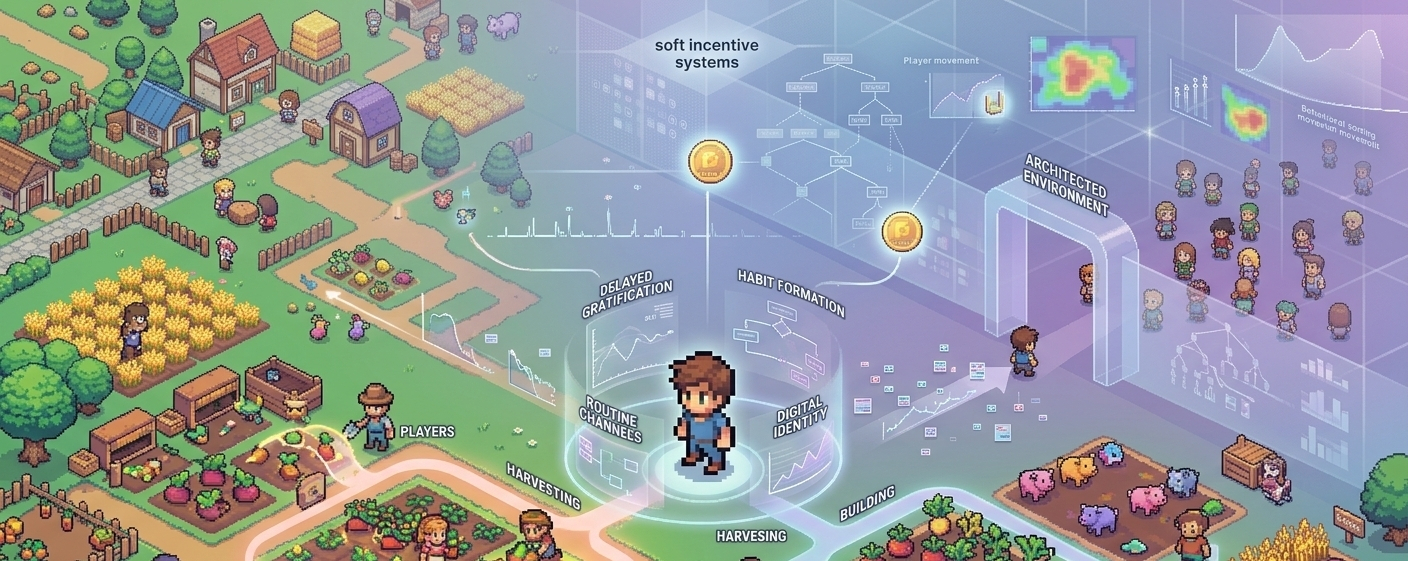
On paper, Pixels is about farming, exploration, and creation. But in practice, it may be doing something far more interesting: studying how people behave inside soft incentive systems.
That’s where it starts behaving differently.
Most people won’t notice this at first because the design feels friendly. Nothing feels aggressive. There are no loud demands. No obvious pressure.
You just log in and start doing small tasks.
Plant something. Harvest something. Move somewhere else. Craft something. Check back later.
But those loops matter.
Repetitive systems often reveal more about users than complicated ones do. They show who is patient, who gets bored quickly, who likes optimization, who values ownership, who returns daily, and who only shows up when rewards spike.
It doesn’t announce this. It just happens.
A lot of people think farming mechanics are there because they’re relaxing. And yes, that’s part of it.
But farming systems also create delayed gratification. You put something in now and receive something later. That small delay filters behavior. Some people enjoy it. Some people can’t tolerate it. Some people build routines around it.
Now multiply that across thousands of users.
What looks like gameplay can also become a sorting mechanism.
Exploration does something similar. It seems like movement through a map, but it also reveals curiosity. Some users follow efficient routes. Others wander. Some chase opportunity. Others chase novelty.
Creation goes even deeper.
When users build, customize, decorate, or shape spaces, they begin attaching identity to the platform. Once identity enters a system, retention changes completely.
People don’t just come back for rewards.
They come back for what now feels like theirs.
That’s the hidden power of games like this.
The real output may not be crops, items, or even token rewards.
The real output may be habit.
And habit is one of the most valuable things any platform can generate.
Once routines form, incentives no longer need to work as hard. Users start checking in naturally. They optimize on their own. They compare progress. They think long term. They care about updates because the system has already become part of their rhythm.
That shift is where many people misunderstand token ecosystems.
They focus only on price.
But price often sits downstream from behavior.
If a token exists inside a system that successfully creates recurring attention, identity, status, and daily participation, then its relevance comes from more than speculation. It comes from embedded behavior.
That doesn’t guarantee value.
But it changes the equation.
Because tokens tied to active human loops function differently than tokens tied only to narrative.
There’s also another layer most users feel but rarely explain clearly: transparency.
Many people can sense when a system is shaping their behavior, even if they can’t describe how. They feel subtle pressure to return. They feel fear of missing progress. They feel satisfaction from routine tasks that should feel boring on paper.
Why?
Because the system is not forcing them.
It is guiding them.
That distinction matters.
The strongest systems usually don’t control through force. They influence through environment. They make certain actions feel natural, efficient, rewarding, or socially visible.
And over time, users begin choosing the path the system quietly designed for them.
That’s not manipulation by default.
It’s architecture.
And good architecture is often invisible.
So when I look at Pixels now, I don’t just see a farming game on Ronin.
I see a platform experimenting with attention, consistency, ownership, and digital routine through a very soft interface.
The crops are visible.
The psychology is hidden.
Most people will only see the game.
Some will see the mechanics.
And a few will realize that the most powerful systems rarely look powerful at all.
They look simple, friendly, and harmless—right until they become part of your daily life.
