
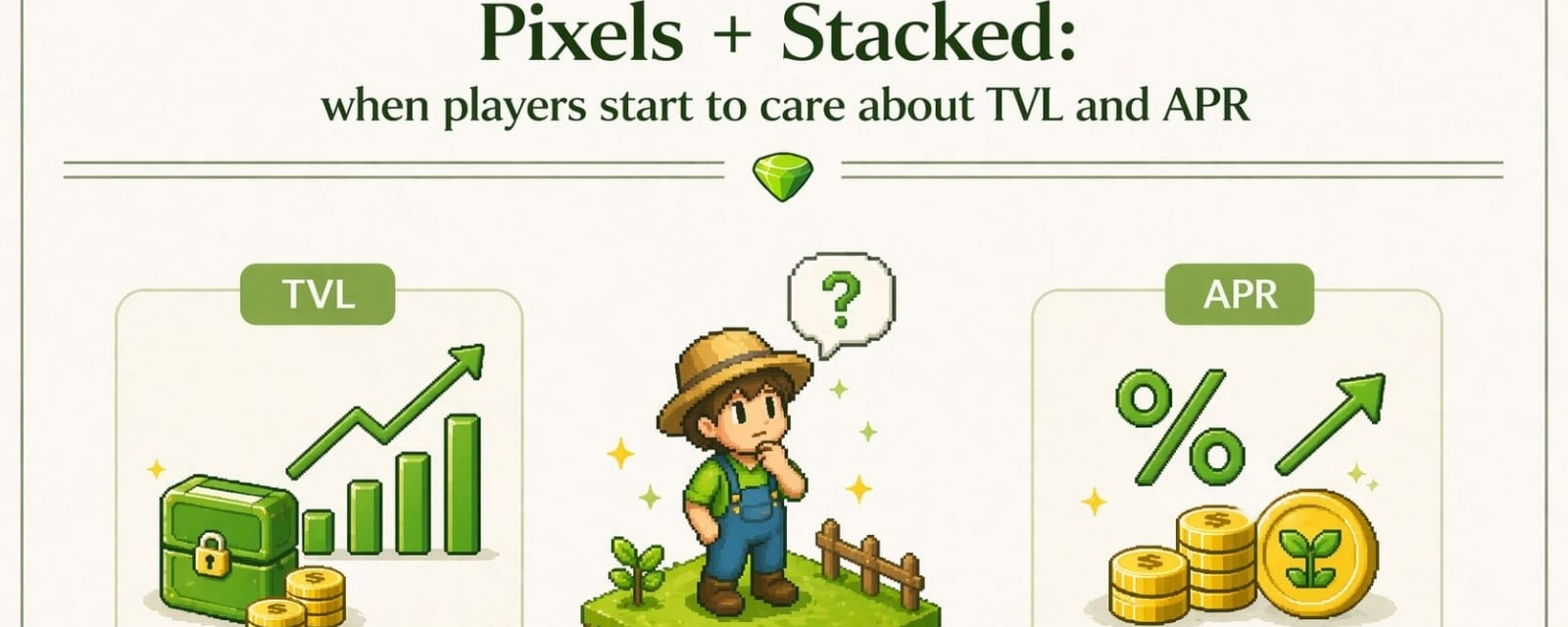
I've been Recently, while following discussions around Pixels and Stacked, I noticed something interestingIs TVL growie no longer only asking what activity gives the best rewards today.
Now the questions sound very different.
Is TVL growing or shrinking?
Is APR still strong enough to stay?
Where is liquidity moving inside the ecosystem?
To me, that shift says a lot.
When a community starts paying attention to TVL and APR, the project has entered a new stage. It is no longer just a game with a reward loop that keeps people engaged. It starts becoming an economy where players are also acting like capital allocators.
In the early phase of most Web3 games, people focus on gameplay efficiency. Which quests pay more? Which resources are easier to farm? Which loop gives the fastest return? That is normal player behavior.
But once TVL and APR become daily conversation topics, the mindset changes.
People stop thinking only like players and begin thinking like participants in an ecosystem with real capital flow.
This is where Stacked creates the biggest difference.
Without it, Pixels could still be a strong game with a loyal community and good rewards. But TVL and APR would not become metrics players seriously track.
Stacked adds another layer.
Value is no longer only created through gameplay. It is also retained, redistributed, and measured like an internal financial system.
TVL becomes more than a DeFi number outsiders watch. It becomes a way for players themselves to judge whether the ecosystem is getting stronger or weaker.
APR changes too.
Before, rewards were simple: do X and earn Y.
Now players ask deeper questions: Is this return sustainable?
Does it make sense to keep assets here longer?
Is this yield coming from real efficiency or just temporary incentives?
That is a major transition.
The question shifts from “what can I farm today?” to “is it still rational for my capital to stay here?”
That distinction matters.
It means users are starting to see Pixels not just as a place to spend time for rewards, but as a system where time, assets, and cash flow are connected.
When communities begin discussing TVL and APR regularly, participation becomes more mature.
Higher TVL signals stronger value retention.
APR changes show whether staying in the system is becoming more or less attractive.
Even without using heavy financial language, players are learning to read ecosystem health through metrics that were once mostly DeFi-focused.
That maturity is powerful, but it is also risky.
The good side is that users think longer-term. They stop chasing only short-term rewards and start paying attention to structure and sustainability.
That is exactly what Pixels needs, because no ecosystem survives forever on temporary farmers.
It needs people who stay long enough to understand that value is not in one quick reward cycle, but in how incentives and capital continue circulating.
The risk is when the community focuses only on TVL and APR and forgets the game itself.
If that happens, Pixels starts looking less like a game and more like a financial wrapper without real utility.
That is the trap.
The best version of Pixels + Stacked is when both layers exist together.
Gameplay remains the entry point. People come for the fun, the habit, and the community.
Then over time, they begin paying attention to the deeper layer: how value moves, how capital is retained, and whether the system is truly healthy.
That balance is what makes the model interesting.
It also changes player behavior.
Someone focused only on short-term rewards optimizes daily.
Someone watching TVL and APR starts thinking about duration, positioning, and capital efficiency.
They ask where to hold assets, how long to stay, and whether the yield is healthy or artificially inflated.
That is when the ecosystem starts moving beyond simple play-to-earn.
Not because it becomes pure DeFi, but because users begin making decisions with capital allocation logic, not just gameplay logic.
This also creates a real test for Pixels.
Once players care about TVL and APR, the system has to prove itself.
Gameplay being fun is no longer enough. Rewards being attractive is no longer enough.
APR must be sustainable.
TVL must reflect trust, not temporary inflows.
Retention must be real, not manufactured.
At that stage, the ecosystem has to operate with more maturity.
If I had to summarize it simply:
The biggest shift in Pixels + Stacked is that players stop asking what they can earn from the game and start asking how capital inside the system is creating value.
That is the clearest sign of a project moving beyond simple play-to-earn.
When TVL and APR become everyday community language, Pixels is no longer just being played.
It is being evaluated like an economy.