
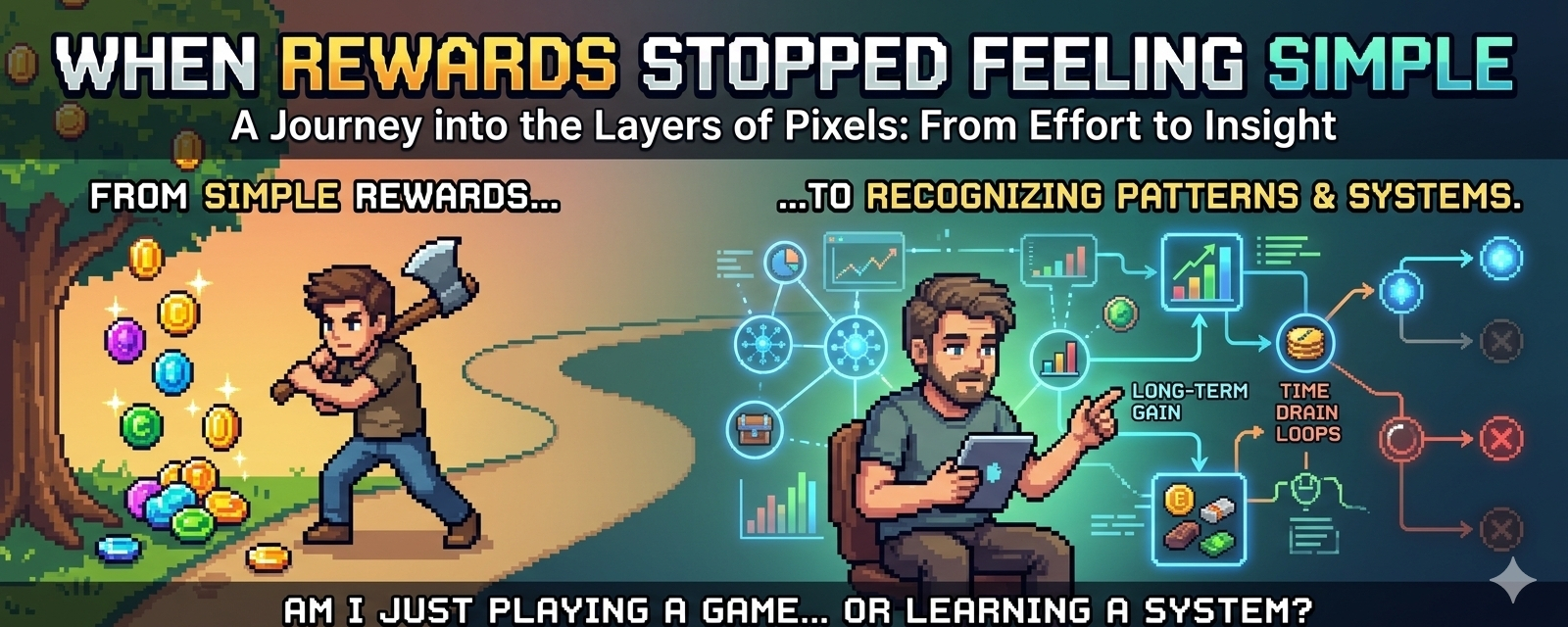
@Pixels At the beginning, the reward system in Pixels felt almost effortless to understand. You put in time, you completed tasks, and you got rewarded. It followed that familiar rhythm most games rely on, where effort naturally turns into progress. There was something satisfying about how direct it felt. Nothing seemed hidden, nothing felt complicated. You just played, collected, and moved forward. For a while, I didn’t question any of it because it worked exactly the way I expected it to. But over time, that clarity started to fade in a subtle way. It wasn’t that the system changed suddenly, it was more like my experience inside it started revealing layers I hadn’t noticed before.
The first thing that caught my attention was a strange imbalance. There were moments when I put in more effort, spent more time, and somehow ended up with outcomes that didn’t feel as meaningful as they should have. Then there were other times when I did less, chose differently, and somehow felt like I gained more in the long run. That disconnect didn’t make sense at first. It created this quiet confusion, like something beneath the surface wasn’t aligning with what I was seeing. So instead of just playing on autopilot, I started paying closer attention to what was actually happening.
What slowly became clear is that the system doesn’t really reward actions the way it first appears to. It feels like it’s rewarding patterns of behavior. And that shift changes everything. Early on, it’s easy to chase whatever looks valuable in the moment because visible rewards feel like the right direction. But as you go deeper, that mindset starts to break down. Not every reward carries the same weight, even if it looks like it does. Some choices lead you into loops that drain your time without giving much back, while others, even if they seem small, quietly build momentum over time. The difference isn’t obvious unless you step back and start looking at how everything connects.
That’s where the perspective changes. Instead of asking “what do I get right now,” the question becomes “what does this lead to next?” And once that question enters your thinking, the game starts to feel completely different. You stop reacting and start evaluating. You begin to notice that certain rewards are not really endpoints, they’re entry points into another set of decisions. Some of them open up better opportunities later, while others lock you into cycles that look productive but don’t actually move you forward in a meaningful way.
Watching more experienced players makes this even more noticeable. They don’t seem rushed or overly reactive. They’re selective. They skip things that look rewarding on the surface because they understand the hidden cost behind them. They’re not just playing for what they get now, they’re positioning themselves for what comes after. Meanwhile, newer players are still engaging with the system at face value, taking everything as it appears. It’s almost like two completely different versions of the same game are being played at the same time, depending on how you choose to see it.
What makes it even more interesting is that the game doesn’t clearly explain any of this. There’s no direct guide telling you which behaviors are optimal or which paths are more efficient. Instead, it lets you experience the outcomes yourself. You learn by noticing patterns, by making mistakes, and by slowly adjusting your decisions. It’s a quiet kind of learning, one that doesn’t feel obvious at first but becomes more real the longer you stay with it.
At some point, this shift also becomes a little uncomfortable. The simplicity that made the game enjoyable at the start starts to disappear. You’re no longer just collecting rewards, you’re thinking about them. You’re questioning them. Every choice carries a bit more weight because you’re aware of what it might lead to. It becomes less about playing in the moment and more about understanding the system you’re inside.
And that’s where it starts to feel oddly familiar, almost like something beyond a game. The way rewards change meaning depending on how you use them, the way small decisions build into larger outcomes, it mirrors real-life thinking more than expected. It’s similar to how money works differently once you stop looking at it as just income and start thinking about how it flows, how it grows, and what it turns into over time. The value isn’t just in receiving it, it’s in how it moves forward.
So now the question feels a bit deeper than it did at the start. If rewards aren’t meant to be taken at face value, but instead are shaping how you think, how you choose, and how you adapt over time, then the experience becomes something more than just completing tasks. It turns into a system where your mindset matters as much as your actions. And that leaves me wondering, in a quiet way, whether I’m just playing a game… or learning how to move inside a system that rewards certain ways of thinking more than others.
