
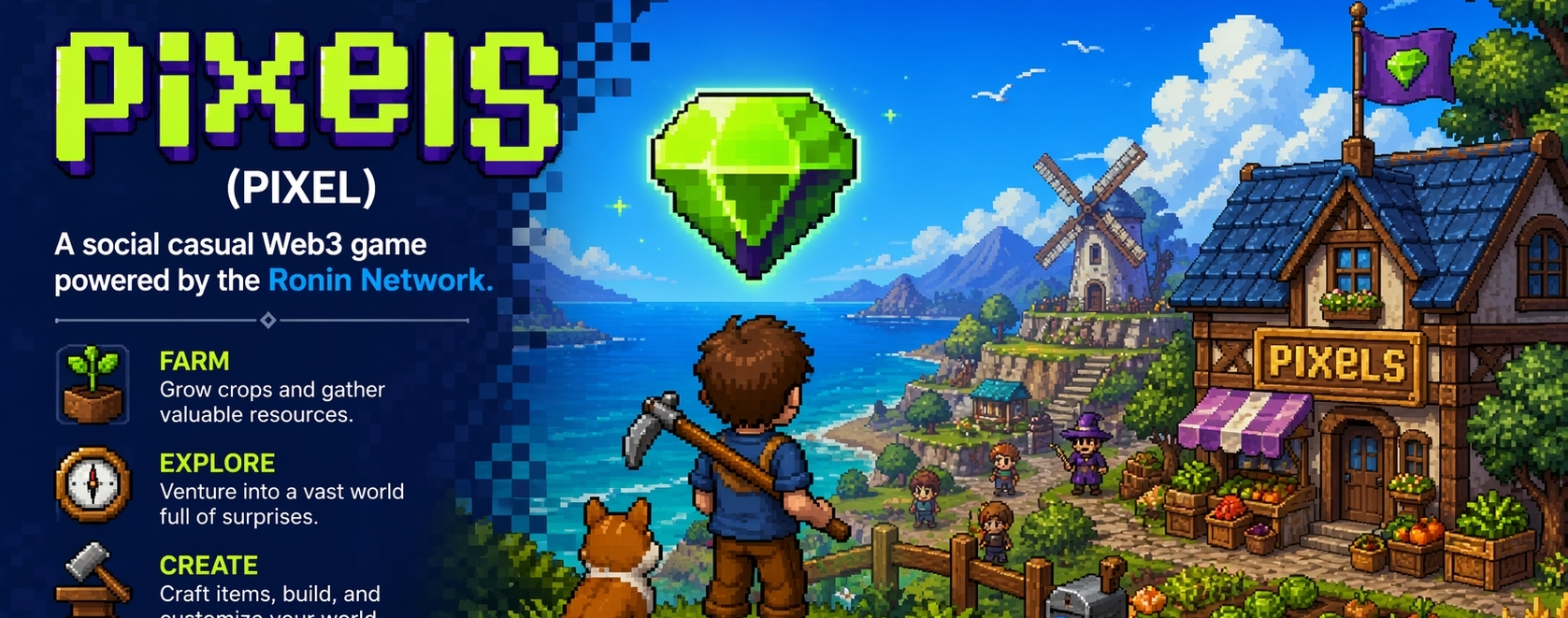
Pixels (PIXEL) is part of a new generation of blockchain-based games that are trying to move beyond speculation and into something more grounded, playable, and sustainable. When I first came across the project, I noticed that it didn’t position itself as a complex financial system or a purely competitive environment. Instead, it presented something much simpler on the surface: a farming and exploration game. But as I started thinking more deeply about it, it became clear that the simplicity is intentional, and the structure underneath is carefully designed to support long-term engagement rather than short-term attention.
At its core, Pixels is a social, open-world farming experience built on blockchain infrastructure. Players grow crops, gather resources, explore land, and interact with others in a shared environment. This idea may sound familiar because it draws from traditional casual games, but the difference lies in ownership and persistence. I’m seeing a shift where games are no longer closed systems controlled entirely by developers. In Pixels, players can hold assets, contribute to a living world, and participate in an economy that continues to evolve alongside them.
The decision to build on the Ronin Network reflects a practical understanding of what blockchain games actually need to succeed. They’re clearly trying to reduce friction. If it becomes difficult for users to interact with the system, especially in a casual environment, adoption slows down quickly. A farming game depends on smooth, frequent interactions, and any delay or high cost can disrupt that rhythm. From what I observed, the infrastructure choice is less about technical prestige and more about usability, scalability, and maintaining a consistent player experience.
Gameplay remains the foundation of everything in Pixels. I noticed that the project does not rely on overly complex systems to attract attention. Instead, it builds around familiar loops such as planting, harvesting, crafting, and exploring. This approach may seem basic, but it serves a deeper purpose. Simple systems are easier to understand, more inclusive, and more sustainable over time. We’re seeing that many blockchain games struggle because they prioritize financial mechanics over actual playability, while Pixels appears to move in the opposite direction.
The world itself is persistent, which changes how players relate to it. Over time, land ownership, customization, and interaction begin to form a sense of place rather than just a temporary session. I started thinking about how this affects behavior. When players feel that their actions contribute to something ongoing, they tend to engage differently. They return not only for rewards, but also for continuity and connection.
The PIXEL token exists as part of this system, but it does not dominate it. It supports gameplay activities such as crafting, progression, and participation in various mechanics. What stands out is that the token is embedded into the game rather than sitting outside it. They are trying to align economic activity with actual player behavior, which is not easy to achieve. If the balance shifts too far toward financial incentives, the experience can lose its identity as a game. This remains one of the most important challenges for Pixels moving forward.
Several design choices reveal a careful and deliberate direction. The focus on farming is not random. Farming mechanics are repetitive in a way that encourages routine engagement, making them well suited for a persistent world. The social layer adds another dimension, allowing players to collaborate, interact, and share experiences. This suggests that the project is not only building mechanics, but also trying to create a space where people can spend time together in a relaxed way.
Accessibility is another important element. The visual design is simple and clear, which lowers the barrier for new users. This is not a limitation, but a conscious decision. High-end visuals are not required for long-term engagement, especially in social environments. What matters more is clarity, responsiveness, and ease of use. We’re seeing that games with simpler designs often sustain larger and more diverse communities.
When evaluating progress, it becomes clear that short-term metrics do not tell the full story. Growth in user numbers is important, but retention and engagement matter more. I wondered whether players are forming habits within the game. Sustainable projects are usually those that become part of a user’s routine rather than a temporary trend. Pixels seems to be designed with this idea in mind, focusing on repeatable actions and social interaction.
At the same time, there are real risks that cannot be ignored. Maintaining a balance between gameplay and economic incentives will require constant adjustment. If rewards become the primary motivation, the system may attract participants who are not interested in the game itself. This can lead to instability. There is also the challenge of managing the in-game economy. Resource generation must be balanced carefully to avoid inflation and loss of value for player efforts.
User retention remains another critical factor. Casual games often experience strong initial growth but struggle to keep users engaged over long periods. Pixels will need to continue evolving without becoming overly complex. This balance between simplicity and depth is difficult, but essential. In addition, the broader regulatory environment surrounding blockchain-based systems continues to develop, which introduces uncertainty that the project must navigate over time.
Looking ahead, it becomes clear that Pixels is building gradually rather than trying to achieve everything at once. The direction suggests a long-term vision of a digital world where players can create, trade, and interact in meaningful ways. This includes deeper customization, expanded systems, and a more stable economy. I’m noticing that this approach aligns with a broader movement toward digital ownership and community-driven environments.
If it becomes too complex, the experience could lose its accessibility. If it remains too simple, it may struggle to retain long-term engagement. The success of Pixels will depend on how well it manages this balance while continuing to refine its systems based on real user behavior.
In the end, Pixels represents a thoughtful attempt to integrate blockchain technology into a familiar and approachable gaming format. It does not rely on exaggerated claims or rapid expansion. Instead, it focuses on building a system that players can understand, use, and return to over time. We’re seeing a project that is still evolving, still adjusting, and still learning, which is a necessary part of developing any persistent world.
It leaves the impression of something steady rather than rushed. A space where players can gradually build, interact, and participate without pressure. Whether it fully achieves its long-term vision will depend on consistent execution and careful decision-making, but the foundation suggests a direction that is measured, grounded, and worth following with patience