
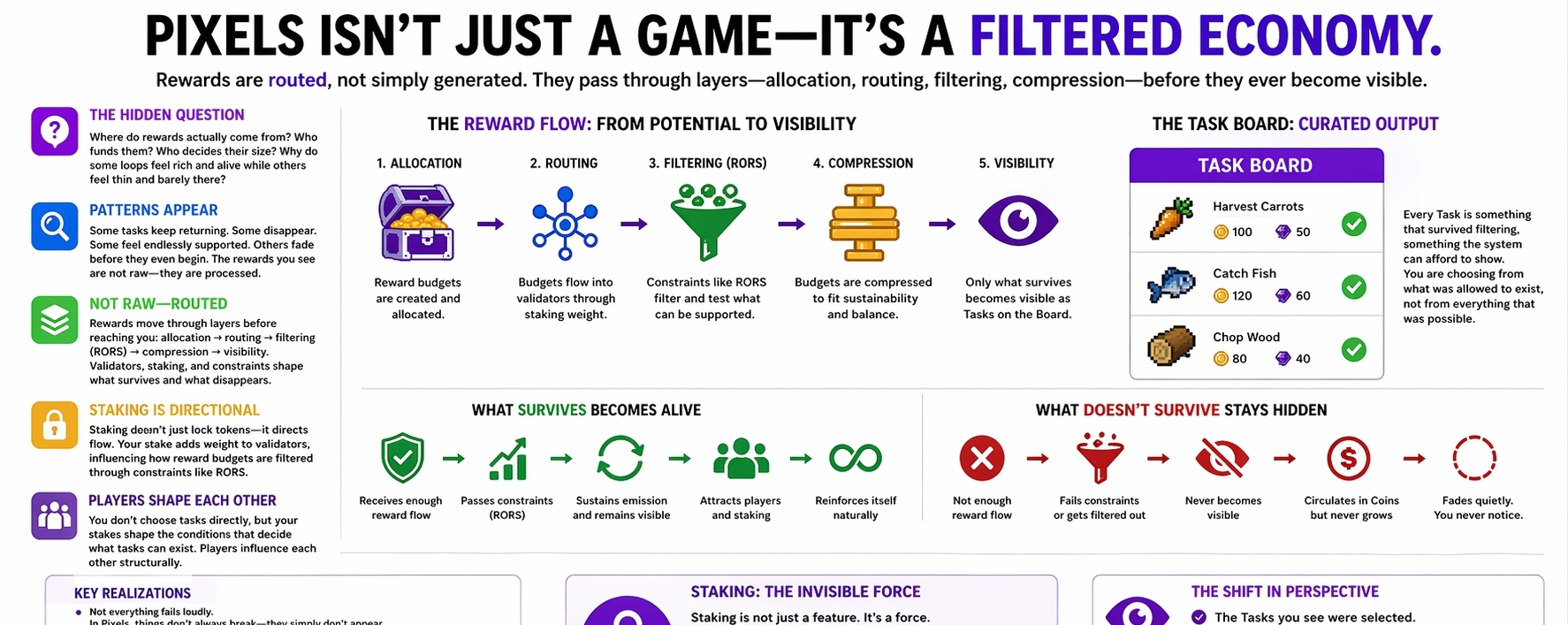
At first, staking in Pixels didn’t feel like it belonged to me at all. It felt like a separate room in the same house—connected, but never necessary. I stayed in the visible layer: planting crops, running loops, refreshing the Task Board, watching numbers rise in a rhythm that felt complete. It was simple. Or at least, it looked simple. Because the longer you stay inside that loop, the more it begins to feel like you’re only seeing the surface of something deeper. A quiet question starts forming beneath everything you do: where do the rewards actually come from? Not the surface explanation, not “complete tasks, earn tokens,” but the real source. Who funds them? Who decides their size? Why do some loops feel rich and alive while others feel thin and barely there? At first, you ignore it. The system works, so you keep playing. But the more you think about it, the more you notice patterns. Some tasks keep returning. Some disappear. Some feel endlessly supported. Others feel like they’re fading before they even begin. And slowly, it becomes clear: the rewards you see are not raw—they are processed. They’ve already passed through something before reaching you. Pixels may look like a farming game on the surface, but underneath, it’s a system where rewards are routed, not simply generated. They move through layers—allocation, routing, filtering, compression—before they ever become visible. Validators, staking, and constraints like RORS sit at the center of this process, shaping what survives and what disappears. By the time a Task reaches your board, it has already been reduced from a larger pool of possibilities. It has already survived pressure. And that realization changes how staking feels. What once looked passive now looks powerful. Because staking doesn’t just lock tokens—it directs flow. When players stake, they push weight into the system. That weight flows into validators, and validators influence how reward budgets are filtered through constraints like RORS. This means staking is not neutral. It’s directional. It’s influence applied before gameplay even begins. So the Task Board isn’t a neutral list—it’s curated output. Every Task is something that survived filtering, something the system can afford to show. And that means gameplay itself is shaped before you ever interact with it. You’re not just choosing what to do—you’re choosing from what was allowed to exist. And that leads to a deeper realization: not everything fails loudly. In Pixels, things don’t always break—they simply don’t appear. If a loop doesn’t receive enough reward flow, or if that flow doesn’t survive constraints, it never becomes visible in a meaningful way. It doesn’t get enough Tasks, doesn’t attract players, doesn’t grow. It fades quietly. Most of its activity stays trapped in lower layers, circulating in Coins without ever becoming something bigger. And you never notice it, because you can’t see what never reaches you. This creates an illusion. When something feels fun, it seems like it’s just better. But that’s not always true. Sometimes it’s simply surviving. A loop feels alive because it receives enough reward flow to remain visible. It clears constraints, sustains emission, and continues to exist. That survival creates activity, and that activity attracts players. Players move toward what feels alive, staking follows what looks successful, and the system reinforces itself without needing to force anything. It becomes a cycle—quiet, natural, but deeply structured. And what makes it even more interesting is that players are part of this structure. Through staking, they influence where rewards go. They don’t directly choose Tasks, but they shape the conditions that decide what Tasks can exist. In that way, players are shaping each other’s experience. Not directly, but structurally. And that changes how success works. In a normal game, something succeeds by being better. Here, it also needs to survive early. If it doesn’t receive enough routed reward flow, if it doesn’t pass through RORS strongly enough, it may never reach visibility. Not because it’s bad, but because it never had the chance. So discovery becomes something else. It becomes selection under constraint. A system where what you see is not everything that exists, but everything that survived. Which means Pixels isn’t just a game—it’s a filtered economy. Every Task, every reward, every loop is the result of layers of selection designed to maintain balance. Most gameplay never reaches that level. It remains below, circulating quietly without ever becoming visible. And this brings everything back to staking. It’s not just a feature. It’s a force. A mechanism that influences where reward flows, what survives, what becomes visible, and what disappears. It shapes the structure beneath the surface while remaining almost invisible to the player. And once you see it that way, the entire experience shifts. You return to your farm, to your crops, to your Tasks—but now you understand something deeper. The Tasks you see were selected. The rewards you earn were filtered. The loops you enjoy survived pressure. And most importantly, there is far more happening than what you can see. So the question changes. Not what should I play next—but who, or what, is deciding what gets to exist in the first place? And how much of what you’re doing never even had the chance to appear?
