
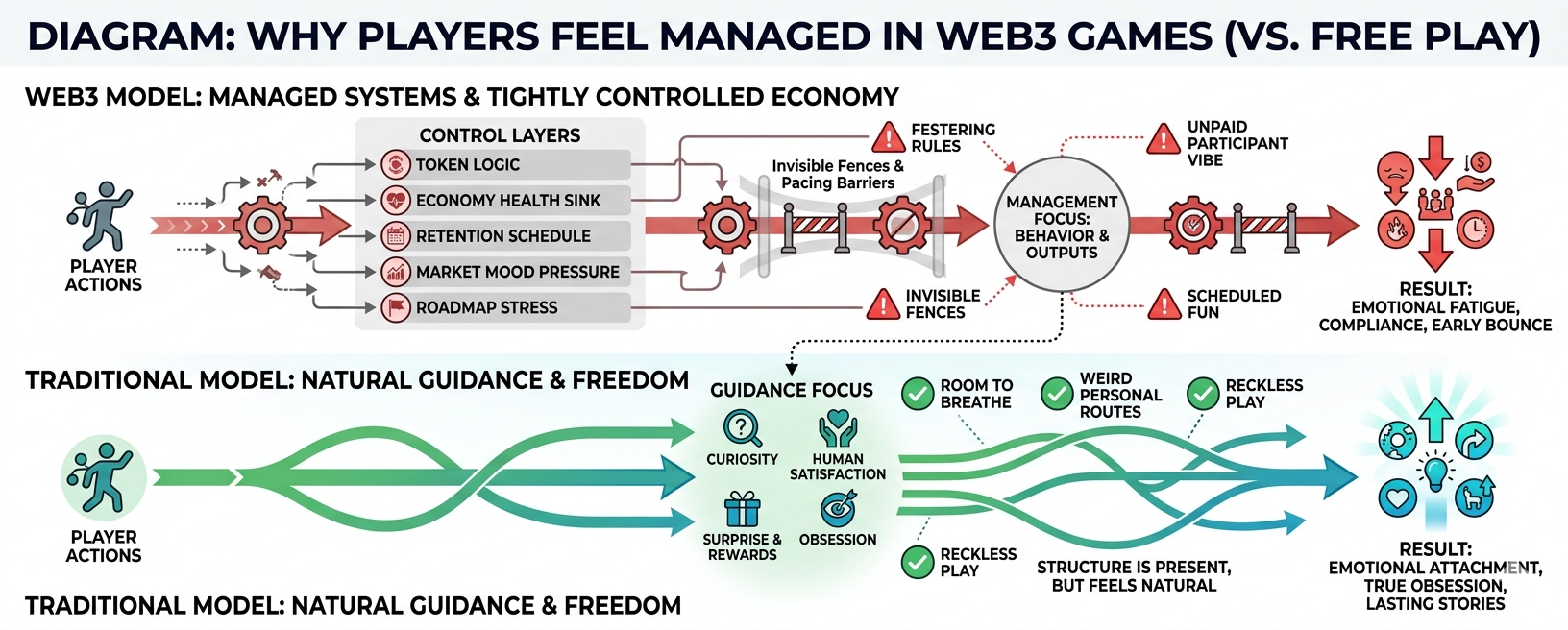
You can feel it almost right away in a lot of Web3 games. Not always in the first minute. Sometimes it takes an hour, sometimes a few days, but eventually the feeling shows up. The game stops feeling like a world and starts feeling like a system that is quietly trying to manage your behavior. Push you here. Slow you down there. Nudge you toward this reward. Stretch your time around that event. Keep you active. Keep you visible. Keep you circulating inside the machine.
That feeling kills a lot of games before the teams even realize it is happening.
Because players do not just react to mechanics. They react to intention. They can tell when a game wants them to have fun and when a game wants them to behave. That difference matters. A lot. One feels inviting. The other feels controlling, even when the controls are dressed up in bright colors, daily bonuses, community events, and all the usual language about engagement.
And Web3 games are especially bad at hiding this.
Part of that is because they carry too many layers at once. There is the game itself, then the economy, then the community pressure, then the token logic, then the roadmap pressure, then the retention structure, then the market mood floating over all of it like bad weather. So even when the game is trying to be playful, there is often this second voice in the background saying no, do it this way, at this time, for this reason, before this window closes. It starts to feel less like play and more like compliance.
That is where the mood goes wrong.
A normal game can guide you too, obviously. Every game nudges players. That is basic design. But the best games make that guidance feel natural. You move because you are curious. You repeat something because it feels good. You chase progress because it wakes something up in your brain that feels satisfying in a simple human way. The structure is there, sure, but it does not feel like it is constantly watching you and adjusting your habits for business reasons.
Web3 games often do feel like that. Watched. Tuned. Managed.
And the reason is not hard to figure out. Too many of them are built with economy health sitting near the center of every major decision. Not game health. Economy health. Those are not the same thing. A healthy game creates freedom, obsession, surprise, and routines people actually enjoy. A healthy Web3 economy often wants pacing, sinks, scarcity, controlled outputs, careful incentives, and all kinds of invisible fences that keep the numbers from going off the rails. The problem is those fences do not stay invisible forever. Players run into them. Then they start seeing the shape of the cage.
Once that happens, the magic gets thinner.
You log in and the game no longer feels open in the emotional sense, even if it is still technically full of options. Every action starts looking connected to some larger balancing act. That quest is there to move behavior. That cooldown is there to control flow. That event is there to spike activity. That reward is there to smooth sentiment. That feature is there to create a sink. The player may not know all the design language, but they know the feeling. They know when the game is less interested in delighting them than regulating them.
And honestly, that is one of the least discussed reasons people bounce off these projects.
It is not always that the game is ugly or boring or broken. Sometimes it is just spiritually exhausting. There is a stiffness to it. A feeling that the player is always inside somebody else’s optimization model. You are allowed to play, sure, but only in ways that support the larger machine. That is why so many Web3 worlds feel tense even when they are supposed to be casual. Too much of the design is trying to solve downstream economic problems before it has earned upstream emotional trust.
The sad part is that the teams probably think they are being smart.
And maybe they are, in a narrow way. Maybe the sinks do need to exist. Maybe the loops do need to be controlled. Maybe the incentives really would break if players were given too much freedom. But if that is true, then it says something ugly about the model. It says the system is fragile enough that genuine play has to be carefully managed before it causes damage. That is not a great sign. A strong game should be able to survive people being weird inside it. Wandering. Hoarding. Wasting time. Chasing dumb goals. Playing inefficiently. That mess is part of what makes a world feel alive.
Web3 games keep sanding that mess down because the economy cannot always handle it.
So players end up in these worlds that are technically active but emotionally narrow. Lots to do. Very little looseness. Lots of systems. Not much room to breathe. And breathing matters more than these projects seem to understand. A player needs space to develop weird personal attachment. Personal routes. Personal habits. Personal nonsense. The moment every valuable path becomes too clearly managed, the world loses that wild little spark that makes people feel like they are inside something instead of on rails.
That is also why so much of the fun in these games can feel strangely official. Pre-approved fun. Scheduled fun. Incentivized fun. Community fun with branded hashtags and reward layers attached to it. Even the social side starts feeling supervised. Like the game is not just providing a place for people to gather, but actively designing what kind of gathering counts as useful. That is a bad vibe. A really bad one. Players can tolerate a lot, but they hate feeling like unpaid participants in somebody else’s live operations dashboard.
And no, this is not every Web3 game all the time. But it is common enough that you start noticing the pattern. The stronger the economic pressure, the more the player experience starts getting shaped around maintenance instead of freedom. The game becomes something like a polite manager. Not openly cruel. Not even obviously manipulative at first. Just always there, quietly trying to keep you aligned.
That is not why people fall in love with games.
People fall in love with games when they feel a little reckless inside them. A little lost in them. When they can follow curiosity longer than they meant to. When they can ignore the efficient path because the world makes room for detours. When the game lets them feel stupid, playful, obsessive, wasteful, specific. That is the good stuff. The human stuff. The stuff that creates stories instead of just behavior.
Web3 gaming still has not fully made peace with that kind of player freedom. It says it wants empowered players, but a lot of the time it only wants empowered players inside a tightly managed economy. That is not the same thing. That is conditional freedom. Structured rebellion. A sandbox with accounting rules taped to the walls.
And that is why so many of these games feel off even when the art is good, the chain is fast, the community is loud, and the roadmap is full. Players can feel when a game is trying to make room for their imagination, and they can feel when it is trying to manage their output. One creates attachment. The other creates fatigue.
Web3 games keep talking about ownership like it is the big breakthrough. Maybe. But ownership means a lot less if the world itself still feels like somebody else is standing over your shoulder, directing traffic.
