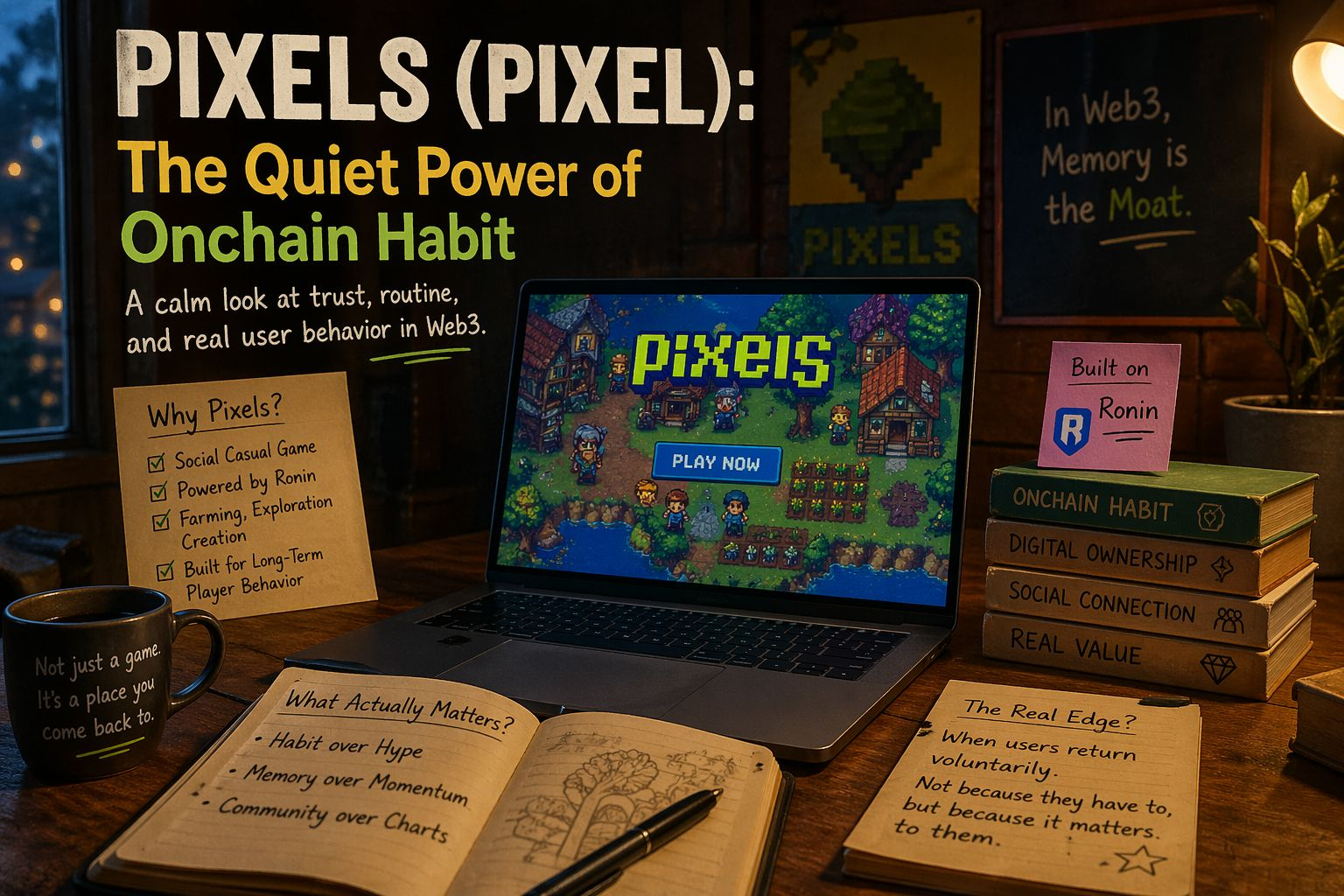
I’ve noticed something strange lately. In crypto, people say they care about utility, but most of the time they only react to movement. They notice volatility fast, but they rarely stop to ask what actually keeps users coming back.
There is a gap there that the market usually ignores. Attention is easy to measure for a few days. Habit is much harder to see, and maybe more important. The projects that survive are often the ones that quietly become part of someone’s routine.
That is partly why I keep looking at Pixels (PIXEL). Not because it feels loud, and not because the chart is supposed to tell the whole story. Mostly because it sits in a corner of the market where behavior matters more than headlines.
Pixels is a social casual Web3 game on Ronin, built around farming, exploration, and creation. On the surface, that sounds simple. But simple loops are sometimes where the strongest user behavior starts to form.
What I find interesting is not the usual gaming pitch. It is the way ownership, routine, and social presence seem to meet in one place. Crypto has tried this before, of course, and a lot of those attempts felt forced or overly financialized.
That is probably why I’m careful here. I’m not saying every game with a token deserves serious attention. Most do not. But I have learned that when users return for reasons beyond pure speculation, it usually tells you something worth watching.
Maybe the quieter point is this: Pixels may matter because it builds memory. Not in the technical sense only, but in the human sense. People remember where they spent time, where they built something small, and where other people noticed they existed.
That matters more than many investors admit. Trust in crypto is often discussed like it can be engineered overnight, but trust usually grows through repeated interaction. A system starts to feel real when users return to it without needing a fresh promise every week.
Ronin also matters here. Networks develop their own culture, and some environments are naturally better at supporting gaming behavior than others. A game does not exist in isolation, especially in Web3.
I’m still unsure about some of it, to be honest. Maybe I’m overthinking this. Maybe the market will keep treating projects like this as temporary distractions, even when the underlying user behavior is more durable than people expect.
I’m not fully convinced the market knows how to price habit-based ecosystems yet. It understands excitement. It understands scarcity. But it still struggles with products that grow quietly through repetition instead of spectacle.
That may be the hidden angle with Pixels. It is not just about gameplay or token exposure. It is about whether a project can become a place people return to often enough that it starts to mean something.
And in this market, meaning is still rare. A lot of things get traded. Very few get remembered. Sometimes the more important question is not what people are buying today, but what they will still care about when the noise fades.