
The Farm Where Not Everyone Gets Paid
There’s a kind of marketplace you only notice once you’ve spent enough time inside it. Everyone is working—some planting, some trading, some building—but somehow, not everyone is earning. The effort is real, the time is real, yet the rewards feel uneven. And the strange part is: the system isn’t broken. It’s working exactly as designed.
That’s the closest real-world analogy to what Pixels actually is.
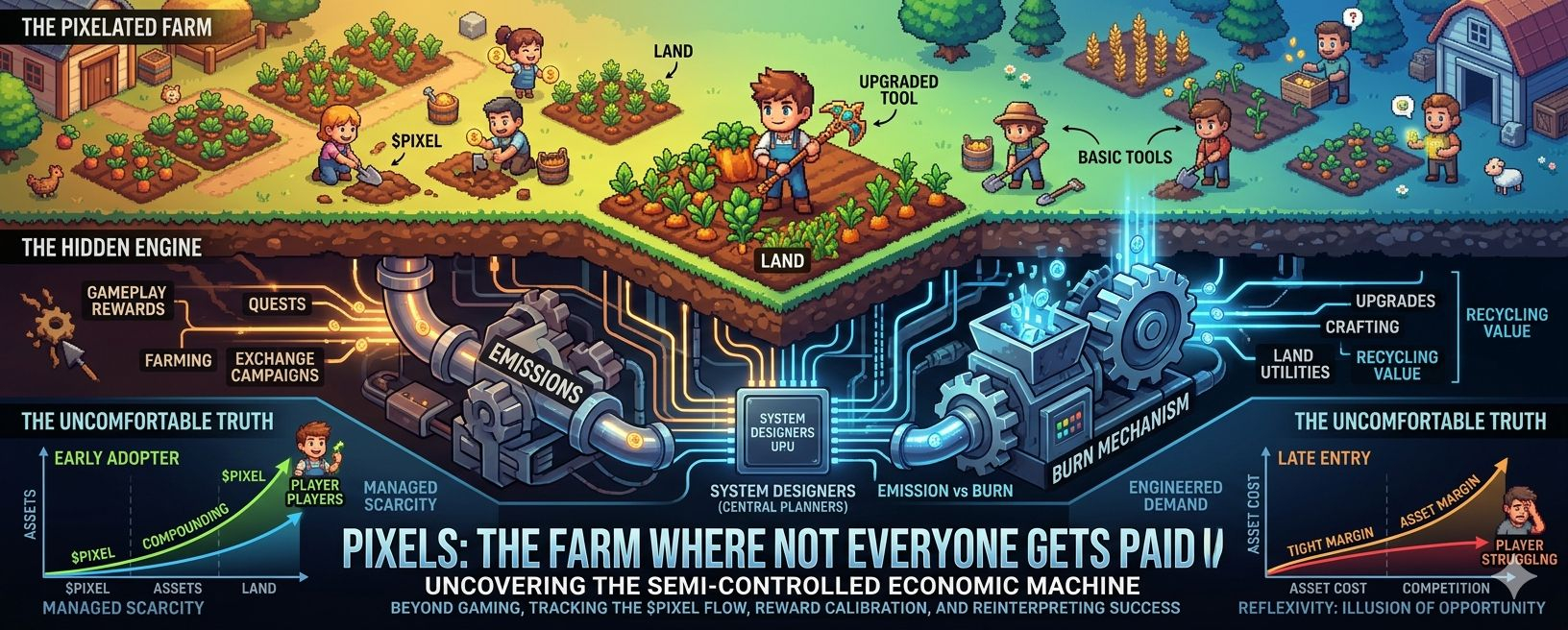
At the surface, Pixels looks like a calm, pixelated farming game. But underneath, it behaves less like a game and more like a semi-controlled economic machine—where players supply labor, the token (PIXEL) acts as both incentive and currency, and the developers quietly function as central planners.
A Game That Behaves Like an Economy
In Pixels, every action—farming, crafting, exploring—is a form of labor. Players invest time, attention, and strategy. In return, they receive rewards denominated in PIXEL or assets tied to it.
But here’s the shift most players miss:
This isn’t a free market.
It’s a managed economy where:
Emissions are controlled
Rewards are calibrated
Scarcity is engineered
Players don’t just “earn.” They operate within parameters defined by the system’s designers. The game doesn’t react to players—it shapes their behavior.
Tokenomics: The Flow of Money Inside the Machine
To understand Pixels, you have to track the flow of PIXEL.
Emission (Supply Creation)
New $PIXEL enters the system primarily through:
Gameplay rewards (quests, farming output, tasks)
Incentive programs (campaigns, especially exchange-driven like Binance-style onboarding waves)
Seasonal reward adjustments
This is essentially player payroll. The system pays users to participate.
Burn Mechanisms (Supply Removal)
PIXEL leaves circulation through:
Upgrades (tools, buildings, efficiency boosts)
Crafting and progression systems
Land-related utilities and enhancements
These are sinks, designed to recycle value back into the system.
Net Dynamics (Inflation vs Deflation)
Here’s where it gets interesting:
If emissions > burns → inflation pressure → token weakens
If burns > emissions → deflation pressure → token strengthens
Pixels constantly tries to balance this, but during growth phases (like campaigns), emissions often spike faster than burns.
Which means:
Early growth is usually inflationary, even if it feels profitable.
Demand: Real or Designed?
Demand for PIXEL doesn’t come from outside necessity—it’s internally manufactured.
Players need PIXEL for:
Progression (upgrades unlock efficiency)
Competitive positioning (faster farming, better output)
Land utility (ownership amplifies earning potential)
Social status (visible progression loops)
But this demand is not entirely organic.
It’s game-induced demand—carefully engineered to:
Keep players reinvesting earnings
Prevent excessive token extraction
Create friction between earning and withdrawing
In simple terms:
The system creates problems, then sells you the solution in PIXEL.
The Rules You See… and the Ones You Don’t
Every system has visible rules—and invisible ones.
What Pixels Rewards:
Consistent activity
Early adoption
Asset ownership (especially land)
System understanding
What It Quietly Ignores:
Late entry without capital
Passive players
Extract-only behavior
The Hidden Reality:
Early players compound faster because they acquire assets when they’re cheap
Landowners earn from other players’ activity (a subtle rent system)
Efficiency scales non-linearly—meaning small advantages turn into large gaps over time
Late players aren’t just behind—they’re structurally disadvantaged.
They’re entering a system where:
Assets are already distributed
Margins are tighter
Competition is higher
From a Trader’s Lens
Forget the farming aesthetics. Look at the signals.
Bullish Indicators:
Rising DAU (Daily Active Users) with stable retention
Increasing burn rate relative to emissions
Expansion of sinks (new mechanics that require $PIXEL)
External onboarding waves (exchange campaigns, partnerships)
Bearish Signals:
Player growth without retention
High emissions during hype phases
Declining in-game activity despite stable token price
Asset concentration (wealth clustering among few players)
Key Metrics to Watch:
DAU vs token price divergence
Burn-to-mint ratio
Average player earnings over time
Retention curves after campaign spikes
Because ultimately, price follows behavior—not hype.
The Cycle That Repeats
Pixels doesn’t move randomly. It follows a recognizable loop:
Hype → Extraction → Stabilization → Decline (or Reset)
Hype: New players flood in, attracted by earnings
Extraction: Early players and smart users take profit
Stabilization: System adjusts rewards, slows emissions
Decline/Reset: Player interest drops, new features or campaigns restart the cycle
Each cycle redistributes value—from late entrants to early, from uninformed to informed.
Reflexivity: The Illusion That Feeds Itself
There’s a feedback loop at play:
Rising price → attracts more players
More players → increases demand → supports price
Higher price → increases perceived earnings
Perceived earnings → drives more participation
But this works both ways.
When growth slows:
Demand weakens
Price drops
Players lose incentive
Activity declines
This is reflexivity—the system feeding on its own perception.
The Uncomfortable Truth
Pixels is not unfair.
It’s precisely structured.
The system:
Rewards early positioning
Encourages reinvestment over withdrawal
Uses tokenomics to control behavior
Maintains the illusion of open opportunity
But underneath it all:
Not everyone is meant to win at the same time.
Some players are there to earn.
Others are there to sustain the system.
Conclusion
Pixels isn’t just a game you play—it’s an economy you enter, where the rules are fixed, the incentives are engineered, and the outcome depends less on effort… and more on where you stand when you arrive.
